
STONIER-NEWMAN – Thanks to TRU for careful look at Williams Lake campus

(Image: Mel Rothenburger.)
HAPPY CANADA DAY… and thank you to TRU’s board of governors, directors and administrators!
Celebrating Canada Day and being Canadian for me is enhanced by your decision to evaluate before deciding what to do with Thompson River University’s Williams Lake campus. Its massive financial losses do make that decision-making difficult and, in my opinion, generating up-to-date data is critical.
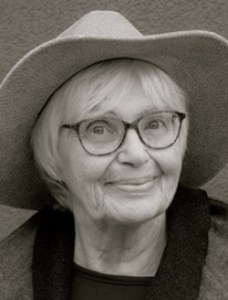
Lynne Stonier-Newman.
Like most of the Cariboo Country’s residents and supporters probably are, I’m relieved.
When TRU has completed its extensive evaluation within the Cariboo regions and its internal analysis of that campus’ advance educational courses’ successes and failures, the data will enable astute decisions. Certainly those evaluations’ findings will be deeply shaded by the extraordinary factors of covid and the Cariboo regions’ post-pine beetle wildfires’ devastation.
Yet around those issues, the findings will reveal how to shape the future advanced eduction needed by the Cariboo regions’ future students.
Before continuing, two factors: first, being a Cariboo kid shapes my perspectves. Born in Quesnel, I spent my formative teenage years in 100 Mile House, riding horses, working in my folks’ hardware store and not completing my Dept. of BC Education’s Grade nine correspondence courses mail-in lessons; had to repeat Grade nine when it became available the next year in the 100 Mile House school.
Yet in retrospect, I learned so much that year. Around family needs when I became a part-time junior clerk in our very busy hardware and building supplies store, I learned to listen and fill customer needs. Perhaps that helped educate me as much as all the benefits and skills I’ve gained in my diverse and invaluable formal education since?
Especially as I was also allowed to ride with a friend in the vast pasture lands with range cattle and in forests with bears and a few cougars. That helped me develop responsibility and savvy.
Factor two is since Cariboo College a.k.a. Thompson Rivers University began offering courses in 1970, I’ve benefitted as a student and a community user. The education I received as an evening student kick-started my writing career. How satisfying it was to get a babysitter for my sons and attend classes, first in the old Indian Residential School, next in a portable surrounded by piles of gravel while Cariboo College was built and then we moved into the fresh paint-smelling rooms of what is now Old Main.
As I became a regular night-time student along with being an employee and mothering, I was grateful for how much Cariboo College had added to my options. And have encouraged many to become part-time students, if he or she can’t manage full-time.
I’m also aware of what the Williams Lake Campus has added to the whole Cariboo Country – and, hopefully, will continue to add more opportunities for those students. I’m thankful for the TRU’s governors, directors and administrators’ recent decision to do extensive research before deciding what’s next for their Williams Lake Campus.
As a given fact is for Canadians to flourish, we need to become increasingly educated. And providing that innovative education is a hard task. Figuring out how best to provide relevant advanced education is a massive challenge, especially as public education dollars lessen, necessitating even more creative management.
But what matters for the Cariboo, North Thompson, Nicola-Thompson and Shuswap students is analyzing what is needed and providing it locally. Perhaps most critical is what courses will be offered in future years?
When I read the recent news release from TRU’s top management team that deep evaluations will be undertaken, I cheered. Relieved that the board and management will learn more about the residents’ needs as well as about the history of the TRU’s Williams Lake Campus’s successes and failures before making any decisions.
What excellent common sense. Because when and why the B.C. Ministry of Education decided to fund and establish Cariboo College decades ago is still what is required throughout the Cariboo – and in all TRU’s geographic regions. Finding out what needs to be added and/or changed will fine-tune the complex management decisions required.
Especially in 2026 and around the decisions made by our federal government that the vast revenues generated by international students for educational institutions were missteps and were changed. Why was in part because findings revealed that as more courses were filled with international students, the focus on local students’ needs became diffused – or not met as were no longer the institutions’ main priority.
Now, it is TRU’s as the managers are going to create current data by evaluating the Cariboo residents’ complex and diverse needs. The projected data generated will reveal what has generated viable enrolment successes and what hasn’t at the TRU Williams Lake campus. As well, how and why were the courses that had very low enrolments offered?
And, most important, what’s needed next? That will provide meaningful facts enabling relevant future course offerings and astute decision-making.
As a retired social marketing consultant, I’ve questions about how the planned evaluating will be undertaken. Will there be local interviews of a significant sampling of Cariboo residents? In my opinion, to create accurate data, it’s mandatory to actually interview local people rather than expect digital surveying to supply factual information. And the interviewers hired need to talk the Cariboo lingo and be adept at reading the diverse body language used there.<
As well, within the many long-established First Nation communities, many residents want advanced education to meet their needs within their geographic regions. Similarly, the long-established families’ students and those who are recent arrivals to Cariboo Country intend to keep living, working and raising families there and need relevant advanced education within their home regions where their families, outdoor activities and horses are easily accessible.
So … if TRU evaluates effectively, the results can be effective for planning. And they won’t be as shaded as some of AI’s answers are. Although I’m awed by some of AI’s offerings and use it regularly as a historian, I project we’ll be in the StarTrek era before AI or any similar tools will be able to herd cattle or kill a calf-eating bear or operate a bulldozer and nudge an overflowing creek into its newly-dug temporary channel.
I hope the internal TRU investigations will require specific questions and answers about the courses offered at the Williams Lake campus. What worked, what didn’t and why not? What courses attracted large enrolment because they fitted the needs of the Cariboo communities and the rural students? And how and where were the decisions made about what courses to offer?
Thanks again to TRU’s board of governors, directors and administrators for committing to undertake those evaluations before making the necessary decisions about the Williams Lake Campus. And if after the results are in, selling to or partnering with other educational institutions needs to happen to continue providing advanced and relevant education for the Cariboo’s students, I appreciate the decisions have been made with due diligence.
Isn’t that one of our strengths as Canadians? We expect to analyze before reacting, whether balancing complex financial findings – or dynamiting stumps out of a field with unknown underground waters.
To celebrate our Canada, I want to share a quote from John Ralston Saul’s illuminating book “A FAIR COUNTRY: Telling Truths About Canada.”
We are a people of aboriginal inspiration organized around a concept of Peace, Fairness and Good Government. That is what lies at the heart of our story; at the heart of Canadian mythology, whether Francophone or Anglophone. If we embrace a language that expresses that story, we will feel a great release. We will discover a remarkable power to act and to do so in such a way that we will feel we are true to ourselves.
Let’s each of us take time to say on July 1 … “yeah, even around what seems to be warts to me, I’m glad to be a Canadian … ”
Lynne Stonier-Newman is a resident of Kamloops. She’s a retired social marketing and communication consultant, and a B.C. historian and author.


Technology is now so advanced that remote learning is easy, possible, available, accessible, affordable.
LikeLike
When my wife and I heard on the news that the Williams Lake campus of TRU was going to close, we were both saddened. Our first thoughts were what will the graduating high school students do now, when they won’t have a local institution of higher learning in (or near) their community? We didn’t even think about the opportunities for older students who want to further their education without having to move to a larger institution and pay not only the fees for courses, but also the costs of living in another community while likely maintaining their residence at home.
I have lived in Kamloops since 1963, and I can tell you that when I went to the lower mainland after high school to attend BCIT, it didn’t work out well for me. Being away from home for the first time, having to become responsible for making it work, try to keep my grades up, and trying to understand what was being taught, was too much for my immature person.
After working at a few other places, and then getting hired at the pulp mill, I worked there for about 5 years where I learned something about life and responsibility. So about 7 or 8 years after high school graduation, I returned to higher education, taking university transfer courses at Cariboo College, with its lower student to teacher ratio, instructors who generally seemed interested in helping me to grow, and me finding out that I could do this thing and be successful. Being in my city with my supports, helped me to become successful in the next stage of my development.
I’m sure that if Cariboo College hadn’t been in Kamloops, I wouldn’t have had the opportunities to “grow up” as I became responsible for my family and myself, and managed to attend full-time at this institution, with lots of support from my spouse. This is my story on my road to success. That is what we felt when we heard of the closure of the TRU campus in Williams Lake. This is what we were so concerned about for those young people who want to continue their education in that area of the province, but have to leave the security of the support systems they have there, and hopefully can manage the huge changes between school as a learning young student, and the “freedom” as they move on to higher education.
We hope that the TRU evaluation will show that these types of higher education are needed, and that the provincial road-blocks will be removed to foreign students will be removed so that this institution can continue to have enough funds to provide for their local region students.
LikeLiked by 1 person