
JOHNSON – With Trump as our neighbour, we need new friends
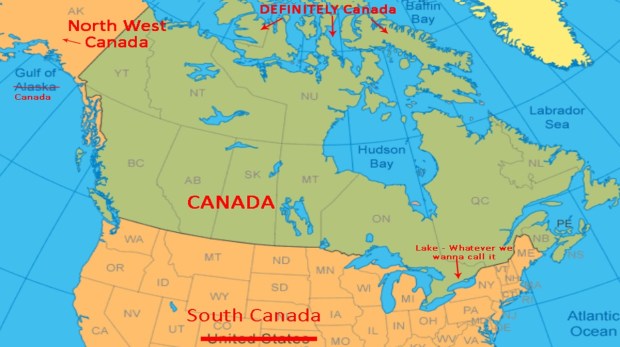
SOME THOUGHTS about the recent trade negotiation failure between the United States and Canada.
Now, it’s the Trump administration, so by the time this is published or you read it, its possible negotiations may be back on already. But I’m thinking this time … maybe not. On the outside it looks like Carney is in the driver’s seat at the moment as HE cancelled the talks.
 The economic effect of the facts, figures, dates, numbers of tariffs and reciprocal tariffs are easily found elsewhere. What I want to talk about today is some of the geopolitical implications of not just what happened, but how it happened and the predatory way the Trump administration has led the United States to behave in these negotiations with Canada.
Then the short-term feeling we all have around it and possibly the long-term legacy.
Historically, America has enormously benefited all around the world in reputation, directly from its relationship with Canada. The U.S.-Canada relationship is a textbook example of America’s benignity and good intentions. If you’re a country anywhere in the world wondering whether to partner with the United States you would look at the U.S.-Canada relationship and say, “Hey, there’s a country only one-tenth the economic or power size of the United States, and they are being treated reasonably, maybe we will be too.”
Let’s face it, Canada is a country that could be highly vulnerable to abject American pressure.
And yet, historically, America has consistently treated Canada as an equal, as a partner, and as a friend. And that model relationship is a proof of the good intentions of America to anybody looking in from the outside.
And so there you are on the other side of the world thinking, you’re asking yourself, can we trust the Americans? Then you’ll look at the Canadians next door, and see that Canada seems to trust the Americans, and have benefited from that trust, been treated with equality.
For as long as the relationship worked, America stood proud in the eyes of the world and benefitted from the perspective other countries had, as they view U.S.-Canadian relations in trade as well as other less visible or tangible ways.
To put it bluntly, America realized long ago that good, friendly relations with Canada is one of the best ways to sell itself to the world, and by handling Canada properly and professionally, they benefit by this sales job when they deal with other countries around the world.
It’s just good business to attract new business … by doing good business with those you already do business with. Wow … that was out loud … sorry.
To be clear, the American-Canadian relationship isn’t the only box to check before doing business with America, and many other countries came to talks with America with capabilities and advantages all their own … but it didn’t hurt.
Fast forward to today. Under the Trump imperial vision of America, the landscape is very different. At home, Trump’s vision of how America should arrange its economy borrows a lot from China.
As much as Trump rails against China, it seems he wants America to be more like China.
His government is taking ownership stakes in major corporations.
Favors are dispensed according to cronyism and patronage.
He attempts to intervene in the courts on behalf of his own interests, in ways that are very familiar to those who follow the precedents and processes of the Chinese Communist Party.
Internationally, his foreign policy looks not like the historic America as we knew it, i.e. the world leader of a coalition of democratic states, bound by agreements and treaties negotiated in good faith … but more like Russia, a country that has given up on the rest of the world in order to be a bully and hegemon at home.
Clearly, Trump would prefer Canada to be a 51st state but that didn’t go over well, so maybe he has pivoted.
Maybe what Trump wants from these trade negotiations, is not actually any kind of trade deal amongst equals, or even a reasonable deal between a larger and smaller power.
He wants to turn Canada into a kind of American Belarus.
A satellite state, nominally independent, but in fact governed from a capital like Ottawa that is directed by the larger southern imperial zone where power becomes economics not by trade and mutual benefit, but by subjugation by domination, exploitation and predation.
Imagine you’re a country on the other side of the world, a country without a long friendly history with the United States; let’s say you’re an Indonesia, a Malaysia, or a Philippines … if you’re a Vietnam, and you look at what Trump is doing to Canada, you begin to think, “What will they do to me?”
These countries, and many, many more around the planet will begin to say, “We don’t share a language with the Americans, we were not their allies in two world wars, we don’t have 150 years of cultural bonding behind us and share a 8,891 km direct physical border including Alaska … so if they will do this to their nearest neighbor and closest partner, what will they do to us?”
It sends a message to the whole planet that America is reinventing itself not as the leader of a league of democracies, but as an imperial power, like Russia, like China. Places where power corrupts at home, dominate abroad, and maybe somebody ‘you have to deal with’ because they’re so big and rich and powerful, but not someone you want to be a partner with.
Certainly not someone you can trust.
But these countries are farther away from American shores. They have options. Maybe they should keep as equal a distance between us and America as America keeps between the it and Russia. They aren’t bound by the problem of an 8,891 km border … so they don’t HAVE TO negotiate with America … maybe there’s other options that are easier, and safer.
Trump is proving to us again and again that America is no different and no better than these other imperial powers like Russia and China. He has literally said in interviews, even when he was running for president for his first term, “Do you think we’re any different from anybody else?” He really doesn’t see America as different from Russia and China.
Previous administrations very much saw themselves as different to these powers.
And today, he leads America to behave in ways that are no different from them.
We already know that he is envious of Putin and Xi, who enjoy the despotic rule that he wants, a thing he doesn’t hide. They can do anything they want any time it crosses their mind, and human rights and democratic norms are not a part of their process. They are not bound by a Congress or a Senate or the free press or international diplomatic norms. He clearly likes to shimmy up to them and imagine he has the same power.
One of the things that Canadians have kept alive through all these dark months is a confidence that the American really is different from these non-democratic behemoths of corruption and demagoguery.
And looking at the American-Canadian relationship of the past, that was true.
At present, this all appears now to be a dead end, a space in which we are misperceiving as a potential way forward. It isn’t. That is a misdirection. What we are all trying to keep alive here is a faith that there is a better America down there, and we hold onto the hope that maybe some day it will rediscover itself.
Maybe that’s a belief in a faith that we can hold on to, through these very dark chapters.
The best we can hope is that Carney finds a way to stall trade talks until at least November, and also hope that American voters have had enough and make trump a lame duck by taking the House and Senate away from him, then tying him up with a few more legal woes.
Luckily, if nothing happens, the existing deal will just keep rolling over, until … again … until we have another president to deal with. Then we will reassess from the top again.
Even if the future beyond Trump is a return to roses and free trade and friendship, we can’t rest on that as we navigate the now. Carney is on the right track … the U..S under Trump can not be trusted in any way, and at this stage we don’t know about after Trump, or if America will ever be fully trustworthy again,
So, we need to find friends elsewhere. We are no one’s Belarus.
David Johnson is a Kamloops resident, community volunteer and self described maven of all things Canadian.


Leave a comment