
CHARBONNEAU – B.C. telescope finds hydrogen from eight billion years ago
(Image: Lenzatic, Pixabay.com)
A RADIO TELESCOPE nestled in the hills above Penticton has found out what the distribution of hydrogen in the universe looked like eight billion years ago.
 The discovery is significant because it will help measure the strength of dark energy at the time.. Dark energy’s dark secret is unknown. What is it that causes the universe to explode? Not just explode as a bomb would but accelerate as it goes. Because of dark energy, the universe is flying apart faster and faster.
How do you find eight-billion-years-old hydrogen? It’s not easy.
The radio telescope, called CHIME, was built in 2017. It found all kinds of other things before it found the hydrogen signal. It routinely detected other radio sources such as pulsars (rapidly spinning stellar corpses) and fast radio bursts (brief but intense blasts of radio energy).
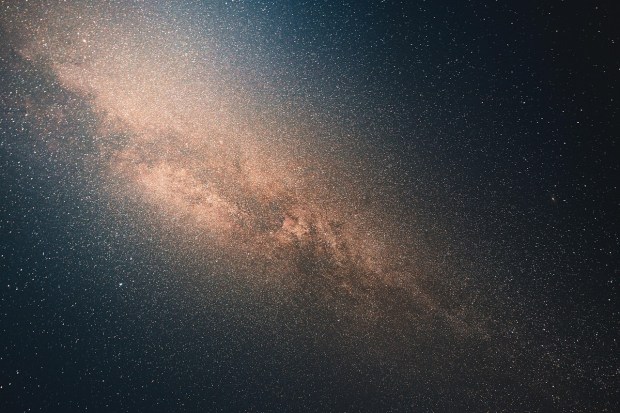
But the signals from ancient hydrogen remained elusive. That’s because our Milky Way is very noisy. The noise is 10,000 times stronger than the faint hydrogen signal in the background.
I last reported on the observatory in February. This was before the ancient hydrogen discovery. The observatory’s discovery of fast radio bursts had made the news.
At the time, I spoke to Dr. Michael Rupen at the radio observatory. Dr. Rupen told me that they were installing new dish antennas to better detect fast radio bursts.
He told me how hard it was to find delicate radio signals, not only because of the noise from our galaxy but from the growing use of electronic devices in the Okanagan. Even a jet flying over the site would reflect noise from the valley.
The configuration of the original CHIME telescope was not dishes but a series of four enormous trough-shaped antennas, each measuring 100 metres.
Nine years after its work began, the project has realized this goal.
“This is the measurement CHIME was designed to do,” said Prof. Mark Halpern from the University of British Columbia.
I’ve been keenly interested in how ancient hydrogen can be detected ever since I wrote about it in 2014, before CHIME was even built.
Hydrogen is the simplest of elements, consisting of a proton nucleus and an orbiting electron. The spin of the electron can be in the same direction as the proton or the opposite.
The energy level of hydrogen is slightly greater when the spins are the same. That’s the key to detection.
When hydrogen cools, the electron flips its spin to the opposite. The loss of energy is released as a signal of a specific frequency.
Think of the lost energy as being like a campfire that releases heat as it burns.
But unlike a campfire that releases energy at various frequencies, the energy release of hydrogen is very specific -1,420 megahertz, corresponding to a wavelength of 21 centimetres.
The expansion of the universe due to dark energy distorts this signal.
Because the universe is rapidly expanding, the wave is stretched out resulting in something called redshift.
By the time the hydrogen signal gets here from eight billion years ago, it’s now 31 centimetres in length. That’s the signal that CHIME found.
The radio telescopes near Penticton, both the original CHIME troughs and dish configurations, will continue to inform and surprise us.
David Charbonneau is a retired TRU electronics instructor who hosts a blog at http://closetproductions.ca/EyeView/eyeviewcover.htm


Leave a Reply