
JOHNSON – What to expect from B.C.’s new government, and it’s not all good
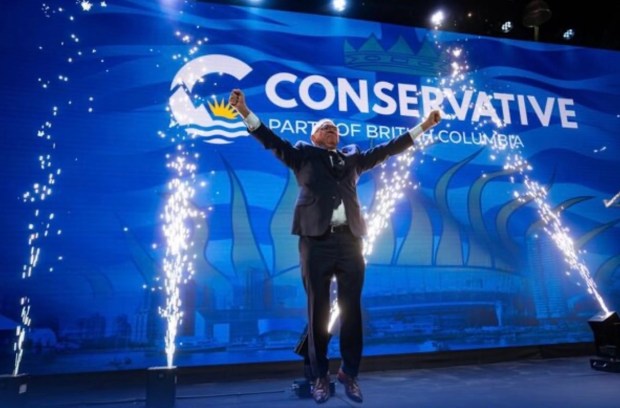
Premier-elect Lorne Doerkson in victory. (Image: BC Conservatives)
OK … SO I AM gonna go out on a limb, and blindly forecast the next four years or less, after we voted in a Conservative majority.
 To be clear, there is no way we can predict every decision and every angle of repercussion of Conservative moves on Day 2, but we can wonder … and dream up scenarios. This is an opinion column; it’s what we do here.
As a bit of a history lesson, they enter as government for the first time since their last majority government in the 1928 provincial election, under Simon Fraser Tolmie.
I’d say “remember that?” but ya, if you do … you’re dead.
But that wasn’t the last time they were in power. They last held a share of power during WW2, a war and post-war coalition government with the BC Liberal Party, from 1941 to 1952. It was a world war time common act around the world in democracies, as a way to ‘let’s just get through this together’ approach, which has been looked back on as generally a good idea.
Even if you do remember this power sharing government, you’re as old as salt as the expression goes.
Not since then has a formal Conservative party held any power in B.C.
Following the 1952 election, the newly formed Social Credit Party broke away and seized power. The Conservative Party frequently struggled to run full slates of candidates but always ran in every British Columbia general election since 1952.
From 1956 to 1969 they held zero seats, failing to elect a single MLA across five consecutive general elections. From 1972–2020 the party saw occasional spikes in popularity, before sinking back to the margins. A seat here, a couple seats there. Since 1983, across 11 consecutive general elections spanning nearly 40 years, the party failed to win a single seat.
Then in 2024, party fortunes underwent a dramatic turnaround, shifting from a fringe party to a major political force in less than two years: 44 seats (43.28 per cent of the popular vote) under John Rustad, wiping out the BC United party (formerly Liberal) and forming the Official Opposition.
Some say the result was the simple social popularity of ‘Conservatism,’ and how it is statistically up in so many parts of the world that is the cause, when others say that all that’s really happening is tiredness and apathy towards the NDP and nine years of their rule.
Remember, Canadians have a long history of changing governments every 10 years or so, regardless of governments performance. Add to that the David Eby boneheaded idea of calling a snap election, when no one needed one … and people were suddenly driven to see who else could give it a shot.
The reality is we hired a leader we know nothing about, who managed to hold his own in one single televised debate, and many of us voted for the Conservative candidate without even knowing anything about them platform-wise at all.
Remember, this was the party that attracted the likes of Dallas Brodie, Tara Armstrong, Joachim Agou, Mike Hicks, Heather Maahs, Jordan Zheng McIntosh, Rachael Weber, Damon Scrase, Stephen Malthouse, Jan Webb and a few others who were tossed out of caucus or dropped as candidates due to fringe ideologies.
Now we have dropped into the Ledge a whole new raft of inexperienced first timers. It looks like 20-25 Conservatives elected have not held office before. We know little about these newbs, and it would be fair to be concerned about any hidden personal agendas.
Now, obviously, past fails and successes do not foretell future governmental function, but in this case ‘we don’t actually know’ regarding what they will or won’t do is a rampant voter view this time … far more so than previous provincial governments going back a long way.
This party … with this leader, heading into this snap election, happened so quickly that we don’t really know the platforms they hold in most portfolios our provincial government is responsible for … period.
The fact that a costed economic platform was not released before the debate at all, and when it was, it concerned those who tried to understand it, as it clearly did not pay for itself.
But we voted them in anyway, because we were PO’d at Eby for driving us to the polls at all, when he still had two years to go. But he did, so we did as well. All Lorne Doerkson had to do was shut up, and he would win …. and he did.
THIS … is democracy, good or bad. At least we don’t have an incumbent refusing to accept the results and flinging out conspiracy claims of fixed elections, as apparently that can happen.
So, back to the headline here … a forecast.
We can expect a few newcomers to eventually show their true colours and be tossed out. One interesting difference is, at this level of significant majority, Doerkson could literally lose about 17 of his MLA’s to NDP or independent status before it becomes a power balance issue.
We can likely expect some large corporation tax cuts, we can expect nearly double the ICBC rates, and cuts to a long list of social funding — daycares, medical, seniors care, various hiring freezes, etc. .. again … a long list we just don’t know about.
What we do know is they plan to raise the provincial basic personal income tax exemption from $13,216 to $32,000, costing over $2 billion per year. Add to that the seven per cent Provincial Sales Tax that will be completely removed from Canadian beer, wine, and spirits, as well as on specific business machinery, industrial equipment, and software … and we have a cost plan just for these two of $4.3 billion a year from provincial revenues if secondary economic growth targets are not met. And that’s the unknown key here.
This is all costed on an unknown economic growth target that relies heavily on aggressive economic expansion, the Conservatives projecting that GDP growth will reach 2.5% in 2027, 2.8% in 2028, and a bizarrely exaggerated 3.2% by 2029.
I’ll just put this here:
Independent economists like Dr. Tsur Somerville / Dr. Thomas Davidoff (UBC Sauder School of Business), Dr. Ross Hickey (University of British Columbia Okanagan), Mike Moffatt (economist and senior director, Smart Prosperity Institute), have all flagged these targets as highly optimistic.
These individual assessments are further compounded by the reality that these growth targets drastically outpace the independent projections issued by the Bank of Canada (which projected national growth at 1.8%), the Royal Bank of Canada (forecasting B..C growth at 1.5%), as well as baseline outlooks from Deloitte and the OECD.
In other words, this Conservative government will in no way earn the revenue it needs to pay for the platform it released and is planning on. Expect in Year 2 or 3, serious cuts to services, or a massive increase in the deficit and debt, should they not back down from this ledge of economic ridiculousness.
The more interesting story is about how the voting base in B.C., in their desire to punish David Eby, dropped into power a completely untested and inexperienced premier and party, on an election-vote-gain platform and budget that won’t be paid for.
It will be fun over the next four years to ask people, when they are complaining about provincial cuts, whether they voted for it … as chances are … they did.
David Johnson is a Kamloops resident, community volunteer and self-described maven of all things Canadian.


Leave a Reply