
GUEST COLUMN – British Columbia’s caribou and the economics of extinction
(Image: Pixabay.com)
What a TRU student’s research reveals about old-growth forests, ecological tipping points, and the future of British Columbia’s caribou
By PETER TSIGARIS
Thompson Rivers University
BRITISH COLUMBIA’ss caribou are disappearing, and they may be warning us about something much larger than the fate of a single species. A recent paper by former Thompson Rivers University economics student Trang Minh Phan, published in Future Earth: A Student Journal on Sustainability and Environment, examines the relationship between old-growth forest conservation and caribou recovery in British Columbia.

Dr. Peter Tsigaris.
The findings are important. Without stronger habitat protection, some caribou herds may face local extinction within decades. One herd in particular illustrates a modern ecological tragedy of the commons. The Itcha-Ilgachuz herd in the Cariboo region once numbered close to 3,000 animals in the early 2000s. By 2019, that population had collapsed to approximately 185 caribou.
In one simulated scenario, strong protection of old-growth forests, allows the Itcha-Ilgachuz herd to recover above conservation targets within a decade. In another scenario involving limited regulation, recovery remains slow and uncertain. Under continued unrestricted logging, the herd eventually collapses toward extinction by 2035.
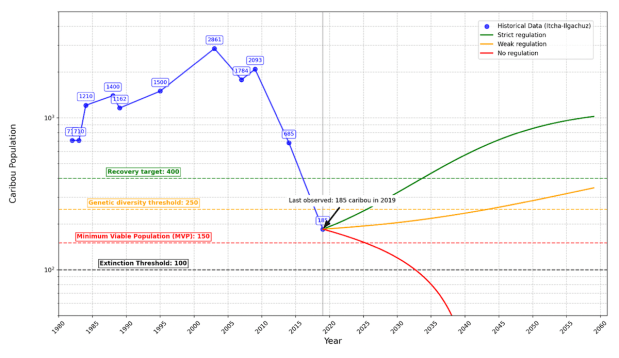
Figure 1: Historical decline and projected futures of the Itcha-Ilgachuz caribou herd under strong regulation (green line), weak regulation (orange line), and no regulation scenarios (red line). Source: Phan, T. M. (2025).
The causes of the decline are complex, but the message is increasingly clear: old-growth forests are not simply collections of aging trees but ecological infrastructure. Caribou depend heavily on old-growth forests for survival. Mature forests provide lichen, one of their primary winter food sources. Dense forest cover helps protect them from predators. Logging fragments those habitats, creates roads and open corridors, and increases predator access.
Over the years, governments have attempted various recovery strategies, including wolf reduction programs and maternal penning. Recent evidence provides a cautious note of optimism. A 2024 provincial report found that calves accounted for 24.2 per cent of the Itcha-Ilgachuz herd in 2023, the highest proportion recorded since the 1980s.
While intensive wolf reduction efforts appear to have improved short-term prospects, the herd remains far below its historical population levels, and its long-term recovery will likely depend on habitat conservation in addition to predator management.
Drawing on Taylor and Weder’s economics of extinction framework, the research shows how continued habitat degradation gradually reduces the carrying capacity of caribou populations. At first, declines may appear manageable. But once critical thresholds are crossed, recovery becomes extremely difficult or impossible.
Climate change, wildfires, pine beetle infestations, drought, biodiversity loss, and declining wildlife populations all point toward ecosystems reaching a tipping point. The loss of caribou may be one of the clearest indicators that northern forest systems are approaching ecological limits.
The paper also points toward a more hopeful path forward, one increasingly shaped by Indigenous-led conservation initiatives. One example highlighted in the research is the expansion of Twin Sisters (Klinse-Za) Provincial Park through collaboration between Indigenous communities and governments. The park expanded dramatically in recent years to protect critical habitat for species such as caribou, grizzly bears, and bull trout.
Importantly, conservation has benefits, but it also comes with costs. Communities affected by reduced logging activity require economic alternatives, investment, and long-term planning. The paper discusses financial support programs, Indigenous stewardship initiatives, habitat restoration, forestry road deactivation, and expanded second-growth forestry as possible components of a more sustainable transition.
For years, environmental debates have often been framed as a simple conflict between jobs and conservation. Yet the growing evidence suggests the relationship is far more interconnected. Healthy ecosystems provide long-term economic value through biodiversity, tourism, water protection, climate regulation, wildfire mitigation, and cultural significance. As Trang Minh Phan writes in the paper, “Preserving old-growth forests not only supports caribou survival but also enhances British Columbia’s ecosystem services and long-term ecological resilience.”
The lesson from this research is not that development must stop altogether. Rather, it is that ecological limits are real, and once crossed, they may not easily be reversed. Equally encouraging is that these insights emerged from undergraduate research, highlighting the important role that student scholarship can play in addressing complex environmental and policy challenges facing British Columbia today and in the future.
Reference
Phan, T. M. (2025). How Old-Growth Forest Conservation Policies Support Caribou Recovery in British Columbia. Future Earth: A Student Journal on Sustainability and Environment, 1(1). https://doi.org/10.29173/bcelnfe710


I read Mr. Phan’s paper.
Its here for people, as its hard to find the link:
https://publishing.bceln.ca/index.php/future-earth/article/view/710/612
Very well researched and written. Fact based, and does not seem guided or ‘bent’ by any personal ideologies in its summation and conclusion … an issue I have taken up with Mr. Tsigaris with previous student papers.
A worthy read, with a very reasonable conclusion.
That said, ‘others’ on the forestry employment side of the coin, may see this as a ‘do the science and twist it to suit an environmental political statement’ … because thats what … to be fair, both sides do: ignore the reality that what he is saying here which is that forestry and caribou preservation can co-exist, and jump on the jobs, or trees … bandwagon.
Not Mr. Phans fault, thats just the BC environmental vs economic/jobs media communication norm, since I was a kid and Greenpeace was saving whales, and I was getting arrested at Clayoquot.
The shame is that when we need everyone to read the nuance of this report, its the soundbite and headline which most people in general and political leaders (looking for votes from those same people), will see.
Thankfully the academic world has this in the vault, and we can just hope it one day is given the breath it deserves.
Cynical … but also realism.
LikeLike