
ROTHENBURGER – Milobar’s indigenous family ties should be a non-issue
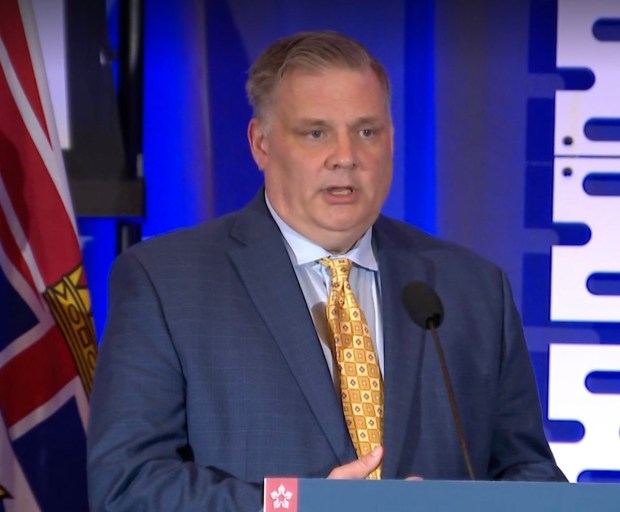
Leadership hopeful Peter Milobar, MLA for Kamloops Centre, during debate. (Image: Screen grab)
IS PETER MILOBAR in a conflict of interest because of his family’s indigenous connections? Do those relationships make him ineligible to become leader of the BC Conservatives and possibly the province’s next premier?
 Kerry-Lynne Findlay, one of his opponents in the party’s leadership race, raised the issue during a candidates’ TV debate. “On a conflict of interest issue,” Findlay said, “the property rights issue is overlying all of this, and Mr. Milobar, I do not see how on the major issue of our time you will be able to get around the conflict of interest rules.”
“Just say it,” retorted Milobar. “My wife is indigenous so you think I’m in conflict of interest? I’ve never heard of anything so ridiculous in my life.”
But Findlay came back, “She also works for the Kamloops Indian Band.”
Milobar: “The last shift I think she had was about nine months ago and worked one day as the part-time, on-call receptionist where she answers the phone and apparently this is a big gotcha moment.”
As the contentious exchange continued, he insisted, “I’ve been voting against lots of indigenous issues.”
It has resulted in the biggest controversy yet in the leadership campaign. Findlay’s comments have been variously labeled as “morally indefensible” (the words of Conservative MP Frank Caputo), “abhorrent” and “racist.” On the other hand, social media has lit up with comments siding with Findlay.
So let’s unpack some of this. It’s true Lianne Milobar has indigenous heritage (and, course, so do their children). And, their son-in-law is a TteS member. Although Peter Milobar says Lianne hasn’t worked for the Band in nine months, she’s currently listed as “Reception and Office Assistant” for the Shuswap Nation Tribal Council. (She is, if I may say so, a wonderful person.)
And while he says he’s voted against “lots of indigenous issues,” he’s also spoken vigorously against what he considers “denialism” and hasn’t been reluctant to proudly spotlight his family as indigenous.
All of which should draw a yawn and a “so what?” when it comes to assessing his qualifications to become leader.
Like the other leadership candidates, he promises to get rid of DRIPA if he becomes premier. DRIPA, of course, is the Declaration on the Rights of Indigenous Peoples Act, passed in B.C. in 2019 as an attempt to align provincial laws with UNDRIP, the United Nations Declaration on the Rights of Indigenous Peoples.
Milobar, as a BC Liberal, voted in favour of adopting DRIPA, which has since become anathema in the context of property rights issues that have arisen recently. He leaves no doubt, though, about his determination to get rid of it.
“I will repeal DRIPA on Day One and always protect your private property rights,” he declared back in March.
But that’s at the centre of the accusations. How, his critics demand, can he be trusted to ditch DRIPA given those indigenous family relationships?
It’s a patently ridiculous argument. If anything, he probably has a greater understanding of indigenous issues than most but to assume he’ll automatically support anything that appears favourable to indigenous causes is undeserving of even talking about.
If Milobar should be criticized about anything on that front, it’s his lack of a strong position on the Cowichan situation and on the lawsuit in which the Skeetchestn and Tk’emlups bands are claiming title over a vast swath of land including the entirety of Kamloops, Sun Peaks and the region surrounding them. It’s been going on since 2015 and is still in the courts.
Those two situations are specific examples at the heart of concerns about private property rights in this province. They deserve more attention from the man who would be premier.
It’s also strange that Milobar has attacked the one opponent who defended him against Findlay’s assertions. Black called Milobar “an honourable man,” for which he received the thanks of a Milobar video accusing him of trying to make “political hay” and to “score political points” by siding with him over Findlay.
To be clear, Findlay’s claim that Milobar is in a potential conflict of interest doesn’t make her a racist. She said nothing derogatory about indigenous people — including Milobar’s family members — based on their ethnicity. Her point was about Milobar’s suitability for the role of leader and premier. Her suggestion was that he may be seen to be biased when it comes to decisions involving indigenous issues.
But if that were the case, then no indigenous person, or anyone with indigenous relatives, would be eligible to serve as an MLA, and that’s as dumb as it would be to disqualify any non-indigenous legislative member from debating or voting on non-indigenous matters.
At the end of the day, it will be party members who decide who their leader will be, not the non-voting public. Findlay’s groundless allegation of conflict shouldn’t be a factor in their decision.
Mel Rothenburger is a former regular contributor to CFJC-TV and CBC radio, publishes the ArmchairMayor.ca opinion website, writes for the Kamloops Chronicle and is a recipient of the Jack Webster Foundation Lifetime Achievement Award, and was a Webster Foundation Commentator of the Year finalist. He has served as mayor of Kamloops, school board chair and TNRD director, and is a retired daily newspaper editor. He can be reached at mrothenburger@armchairmayor.ca.

 ArmchairMayor.ca
If Milobar’s Indigenous identity make him potentially biased on Indigenous issues, then so would any non-indigenous person be potentially biased because all Indigenous issues have a bearing on non-indigenous person. No one is in a disinterested position.
Manitoba has an Indigenous premier who is modeling strong leadership skills.
LikeLiked by 1 person
The problem here is that the infighting between conservatives hasn’t stopped and will potentially benefit the dreadful NDP. That would be unprecedentedly truly awful!
LikeLike
What makes the dreadful NDP a worse alternative to the dreadful Conservative Party of BC? We’re not Alberta, we’re a centralist province with centralist ppl and a centralist ideology being forced to choose from 2 extreme parties. Whichever party can tack back to the centre will get my vote.
LikeLike