
FORSETH – Forestry must not be ‘key’ industry in B.C., at least not to NDP
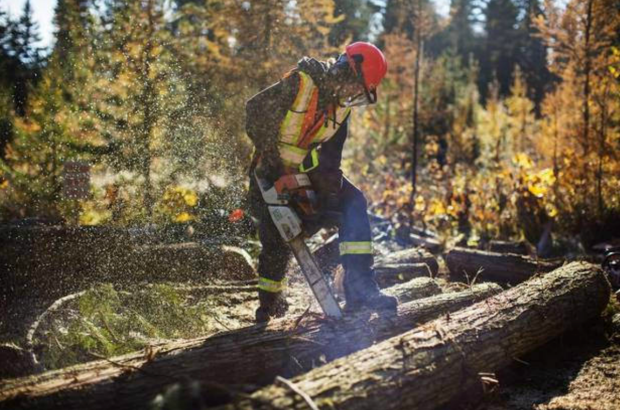
(Image: Govt of B.C.)
Direct forestry job losses have resulted in a hit to the economy of 4.164 billion dollars
BC Government News, Thursday May 14: “Province to showcase key BC industry sectors during FIFA World Cup 2026” (my added emphasis)
OVER A DOZEN YEARSO ago, while my brother and I were on a road trip with our motorcycles, we stopped at the BC Legislature. I was impressed by the architecture, and the many murals that adorned the building, especially the four which are on the ceiling of the dome.
If you research them, you’ll find they were painted nearly a century ago (1935) by George Southwell. Each depicts one of the province’s then key industries; agriculture, fishing, mining, and forestry.
But back to that government media release I mentioned a moment ago. Included in the text of the release was this statement:
Through BC Business House, the Province is working with industry leaders to host sector showcases that will highlight key industries, including tourism, energy, life sciences, mining, technology, agriculture and food (let’s say that includes fishing), and trade and logistics infrastructure.
Anyone notice what I did? For me, it jumped out immediately.
Where is Forestry?
It should not be a surprise to anyone that forestry is missing from that list. Over the past decade the provincial government of Premier David Eby, and in particular Forestry Minister Ravi Parmar, have overseen a devastating collapse of the industry.
In just the past four years alone, an estimated 15,000 men and women have seen their jobs disappear as nearly two dozen mills closed.
Over 300 communities that rely on forestry and logging have seen their tax base drastically reduced – and many residents and families, in these mostly rural communities, have had to move elsewhere to try and find work.
At an average $100,000 per year (including benefits) those 15,000 job losses have resulted in a direct hit to the economy of $1.5 billion dollars.
I understand that each of those forestry jobs support another three to five individuals who work in jobs directly dependent on forestry, as well as secondary jobs such as grocery workers, restaurant servers, retail workers, etc.
Using the low side of three, we can say that has resulted in an additional 45,000 jobs vanishing from BC’s economy. Little wonder then that Stats-Can reports 40,200 jobs lost in the first four months of 2026.
Overall, British Columbia has seen 60,000 direct and indirect jobs, relating to forestry, vanish … with a hit to the BC economy amounting to a staggering $4.164* BILLION dollars!
Given all that, is it any wonder that Eby’s NDP government no longer considers forestry to be a key industry in our province?
For all intents and purposes, at least for this government, it appears that forestry is indeed a sunset industry. Back in 1935, whoever would have thought that would be its future?
Alan Forseth is a Kamloops resident. For 50+ years he has been active, in a number of capacities, in local, provincial and federal politics, including running as a candidate for the BC Reform Party in the 1996 provincial election, and as a four-time provincial campaign manager.
*The initial $1.5 billion from direct forest job losses as well as $2.664 billion from indirect job losses from an average BC median wage of $59, 200 – includes tips)

 ArmchairMayor.ca
In 2003, one of the units that I was teaching at TRU was forestry. What has happened in the past 20 years that Forseth blames on the NDP? Do the Math, Mr. Forsth.
Gordon Campbell introduced a policy of deregulation, which resulted in significant consolidation and closures of mills since the early 2000s due to factors like beetle infestation, reduced old-growth timber availability, U.S. softwood lumber disputes, raw log exports, market shifts, company investments elsewhere (e.g., U.S. South), and policy changes. Over 70–80+ sawmills closed province-wide since 2000/early 2000s (Liberal period).
My UBC professor, Dr. Pierce, findings 50% of BC mills were technologically outdated. Mega mills were built in the USA southern states that get raw logs from BC
BC Liberal era (roughly 2001–2017) today’s Conservatives reports cite over 80 mills shut down and 30,000 forestry jobs lost during this period, with major impacts from mountain pine beetle and policy shifts (e.g., increased log exports). Sawmill employment dropped sharply (e.g., from 43k to 27k in one cited period).
NDP era (2017–present): Continued pressures with dozens more closures/curtailments. Examples include 9 major sawmills in 18 months, 10 coastal mills since 2018 (5,800 jobs), 21 permanent/indefinite closures since 2023, and high-profile cases like Crofton pulp mill, 100 Mile House, etc., 15,000 forest sector jobs lost since 2022.
LikeLike
Mr. Forseth:
Your opinion reads more like propaganda.
You fall short of providing an analysis that examines the industry’s challenges and how both NDP and conservative governments such as BC Liberals Social Credit have responded.
I prefer reporter Ben Parfitt’s more objective analysis using 20 years of data and interviews with experts at the following link:
https://thetyee.ca/Analysis/2024/10/17/Both-Parties-Wrong-BC-Forestry-Crisis/
LikeLike
Imagine that, according to the Tyee article Canfor operations in Europe is profitable but not in BC/Canada…that does not make any sense. Typically Europeans would definitely have more “red tape” than Canada at every level but also our land mass is so much greater. Maybe the Tyee is not writing about it properly?
LikeLike
Perhaps you missed the point. Mr. Forseth blames the NDP and does not acknowledge any responsibility for the issues stems also from the policies of the “free enterprise” parties. Mr. Parfitt uses 20 years of data to assert the problem isn’t red tape; it’s a lack of access to trees for all the reasons cited in the article and that both political sides have failed in their responses. Maybe fill in the blanks and provide an alternate analysis?
LikeLike