
TOXIC DRUG POISONING – A decade of deaths and drivers in Kamloops

By JAYSE HEER-MATONOVICH and PETER TISGARIS
Thompson Rivers University
THE TOXIC DRUG poisoning crisis has had a profound impact on British Columbia communities, including Kamloops. It is “fueled by an unregulated drug supply contaminated with fentanyl and other toxic substances, compounded by stigma, criminalization, and inadequate access to harm reduction services,” according to the Canadian Public Health Association.
Despite public health efforts to control the situation, overdose events and deaths have remained high, but there are some signs of reversal of the trend in the last two years. Key contributors include fentanyl contamination, compounded by poverty, homelessness and unaffordable housing, unemployment, chronic stress, mental health challenges, limited access to treatment, slow policy responses, insufficient coordination across levels of government, and the impacts of the COVID-19 pandemic, as noted by the Canadian Public Health Association and Health Canada.
At the macro level, deaths (D) from toxic drug poisoning can be understood as the product of three key components: the population at risk (P), the probability of overdose within that population (I), and the probability of death given an overdose (E).
A recent study published by Heer-Matonovich in Future Earth: A Student Journal on Sustainability and Environment develops and applies a DPIE framework to examine how these three factors contribute to rising mortality across British Columbia, including in Kamloops.
In Kamloops, over the full period from 2016 to 2025, there were 9,543 overdose cases and 615 deaths. Paramedic overdose responses increased from 565 in 2016 to 1,471 in 2023, nearly tripling over seven years, according to BC Emergency Health Services.
However, overdose cases started falling in 2024 to 1,226 and again in 2025 to 1,086, showing signs of improvement in the incidence rate. Deaths from overdose in Kamloops followed a similar trajectory, rising from 44 unregulated drug deaths in 2016 to a peak of 91 deaths in 2024, according to the BC Coroners Service.
In 2025, however, deaths dropped sharply to 54, the lowest level since before the COVID-19 pandemic. Furthermore, recent local reporting suggests that this improvement may be continuing into 2026, with only three toxic drug deaths recorded in Kamloops through the first two months of the year, while deaths remain highly concentrated in private residences.
Figure 1 illustrates the annual pattern in overdose cases and deaths in Kamloops over the last decade. The figure shows clearly that both measures rose substantially with COVID-19 in 2020 before improving in the most recent years.
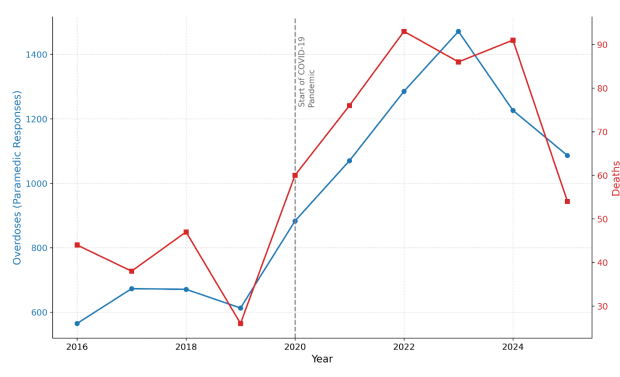
Figure 1: Overdose cases and Deaths in Kamloops (2016 – 2025)
To better understand what changed after the onset of COVID-19, it is useful to distinguish among three broad drivers of toxic drug deaths: the size of the population at risk, the likelihood of overdose within that population, and the likelihood that an overdose becomes fatal.
In Kamloops, the post-COVID rise in deaths appears to have been driven mainly by a higher incidence of overdose rather than by demographic change. The population at risk changed only modestly, but overdose events increased substantially after 2020.
The good news is that the most recent three-year period offers some optimism. From 2023 to 2025, deaths declined by 15.5 percent annually, incidence fell by 10.4 percent annually, and the fatality rate declined by 5.4 percent annually.
This improvement may reflect the cumulative effects of expanded public investment in treatment, recovery, harm reduction, education and other opioid-response measures in British Columbia and Canada, according to the Ministry of Mental Health and Addictions and Health Canada.
It may also have been reinforced, particularly in 2025, by intensified federal action on fentanyl trafficking, including the creation of Canada’s new Fentanyl Czar position and additional border-security investments, according to Health Canada, the Prime Minister of Canada, and Public Safety Canada.
Recent national reporting reinforces this interpretation by suggesting that the decline in opioid-related deaths may reflect several forces, including reduction in the drug supply, expanded access to naloxone, and, more troublingly, a declining population at risk, as reported by CBC News.
While the first two explanations point to improvements in prevention and response, the third may reflect the cumulative loss of life over previous years. This distinction is important: a reduction in deaths does not necessarily mean that the underlying drivers of the crisis have been fully addressed but may instead partly reflect a shrinking high-risk population.
The decline in overdose cases and deaths over the last few years offers cautious hope, but it is too early to conclude that the crisis is over.
Sources include BC Emergency Health Services, the BC Coroners Service, Health Canada, CBC News, CFJC Today, the Canadian Public Health Association, and Heer-Matonovich, J. (2026). The Toxic Drug Poisoning Crisis through the DPIE Framework in British Columbia. Future Earth: A Student Journal on Sustainability and Environment, 1(2). https://doi.org/10.29173/bcelnfe713


Leave a Reply