
Moncton killings of RCMP officers bring back memories of Peterson Creek tragedy
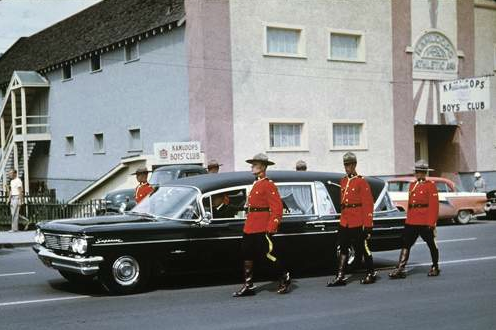
Funeral procession for RCMP officers slain at Peterson Creek.
NEWS/ POLICE — Police arrested suspect Justin Bourque, 24, early today in connection with the killing of three RCMP officers and wounding of two others in Moncton, N.B.
A manhunt began after a man opened fire Wednesday night.
Kamloops RCMP Supt. Brad Mueller offered “deepest sympathies” Thursday to the families of the slain officers, saying that while police understand the risks of the job, “you can never really prepare for the loss of a colleague.”
Kamloops experienced its own such loss 52 years ago. Two years ago this month, Kamloops residents gathered for a 50th anniversary memorial service in honour of slain RCMP officers Joseph Keck, Donald Weisgerber and Gordon Pedersen.
Until the ambush of four Mounties in Mayerthorpe, Alta. in March 2005, the deaths of the three Kamloops Mounties at Peterson Creek in June, 1962 were the single largest loss of RCMP officers ever experienced in one day.
On the occasion of the anniversary, Kamloops Daily News reporters Michele Young and Catherine Litt wrote a two-part series on the tragedy that shook Kamloops in 1962. Here are some excerpts from that excellent series:
• • •
The early morning of June 18, 1962, was shaping up to be a busy one at the Kamloops RCMP detachment.
It was the Monday after a boisterous Indian Days weekend and 64 post-party revellers were waking up in the city’s jail cells to pounding headaches, bruised knuckles and black eyes — the full effects of their weekend of excess dawning on them and on the small detachment of police officers who faced processing the arrestees through the court system that morning.
It was going to be a busy day, and it had only just begun.
Const. Joseph Keck and Const. Gordon Pedersen were among the officers who reported for duty at 8 a.m. Keck was 25, two years older than Pedersen, but already a dad with a second child on the way.
Pedersen had only been married a month. He would die that morning without knowing that his 21-year-old wife was carrying their child.
As the dayshift officers began their routines, Const. Donald Weisgerber stopped by the detachment to do some work before going to play golf. It was his day off and he was eager to try the new clubs his wife, Joan, had given him for his 23rd birthday a week before.
Neither Weisgerber nor his two colleagues on duty had any idea of the trouble brewing just a few blocks away, where the first act of a tragedy was about to begin.
• • •
George Booth was in good spirits that morning, according to a neighbour who gave the 31-year-old man a ride into town from the hamlet of Knutsford, where Booth lived with his dad, John Wilkes Booth, in a two-room shack.
But he was a man with a troubled past and, by all accounts, a tangled mind. Back in 1957, his family committed him to Essondale psychiatric institution in Coquitlam for four months because he kept asking if someone was poisoning his coffee. In those days, the law required police to escort a patient to the facility.
John Booth had let his son believe it was the RCMP’s decision to commit him. It was a lie, of course, but it provided the flame for George’s long-simmering resentment toward police.
On the morning of June 18, Booth tucked his .303-calibre British rifle into his father’s buckskin sheath, along with several rounds of ammunition and headed to Kamloops.
• • •
Just before 9 a.m., game wardens George Ferguson and Frank Richter spotted Booth and his rifle at the footbridge near the Glenfair seniors’ residences, a housing complex between the government buildings and the downtown entrance to Peterson Creek.
Ferguson believed Booth was nervous and upset and could see the man swinging and pointing the rifle. As Ferguson approached, Booth shoved the muzzle of his .303 against Ferguson’s stomach. “Get the hell out of here or I’ll kill you,” said Booth.
The two game wardens went to the nearby provincial highways building and Ferguson called police, saying he’d been threatened and believed Booth was dangerous.
It was shortly after 9 a.m. when Const. Joseph Keck took the call and told everyone in the detachment there was a man with a rifle at the provincial welfare office who needed to be checked.
He, Pedersen and Weisgerber were at the scene in minutes.
Witnesses report the officers tried to approach Booth, but he kept walking away and didn’t respond to their words.
They made their way among the buildings until they were on a dirt road toward Peterson Creek. Booth pulled the rifle from its scabbard and made threatening gestures as the officers tried to move around him.
Their movements only agitated Booth. When he saw Pedersen crouching on the side of a dry creek bed, he fired his rifle, shooting the young officer in the back.
Keck returned fire on Booth with his snub-nosed .38 revolver as Weisgerber — unarmed and in his off-duty clothes — moved behind a gravel hopper.
Pedersen, injured but still alive in the creek bed, raised his revolver and shot at Booth, hitting the gunman on his right side.
Keck made a run toward the bridge but was no match for Booth’s marksmanship. Keck was shot dead.
Booth then walked to the bridge deck and shot Pedersen again, this time fatally.
Weisgerber tried to run, but was shot twice.
• • •
By noon, the G.I.S. team of (Cpl. Jack) White, (Cpl. Ab) Willms and (Const. Norm) Belanger were walking in a spread triangle through the bush and nearing the area where they suspected Booth was hiding.
Belanger reached a crest, levelled his revolver and began backing away.
Booth suddenly stood up and began shooting at them.
They had found their man. Now they just needed to take him in.
From the eastern flank, McDonald heard the exchange of gunfire between White and Booth.
“It was just like a bloody war broke out.”
The two marksmen were in a duel to death, with White crouched behind a rock and Booth taking cover behind the crested hillside.
White, three decades later, wrote about the shooting in an RCMP periodical.
This time as I looked, he had rolled onto his left side to reload and exposed the back of his head past the safety of the tree. I shot and he appeared to dive over backward to my right and out of sight.
I couldn’t believe I could possibly have missed him and we couldn’t afford to lose track of him.
I motioned Belanger to guard the right and to Willms to guard the left while I gingerly stood to advance. I could then see him lying prone some 10 feet from where he had been. The impact of the shot had actually lifted him over backward.
Our trading of six shots had caused a flurry of activity far below us and soon the helicopter swept by. We waved it in and then learned that three of our members had been slain.
Three hours after Booth’s deadly rampage began, he was dead. White’s shot had stopped him cold.
• • •
The days that followed were shrouded in grief and shock for the slain officers’ families, Booth’s family and, indeed, many of Kamloops’ 10,000 residents.
A public funeral was held at Memorial Arena on Friday, June 22. People lined the streets as the bodies of three officers lay in state.
After the service, a 127-car funeral procession drove up Sixth Avenue to Columbia Street and toward Hillside Cemetery, where Keck and Weisgerber were buried.
Pedersen’s hearse headed toward Vernon, where a service was held in the church he’d been married in just weeks before.
The full version of the Kamloops Daily News story is on the paper’s website. An official RCMP recounting of the Peterson Creek shootings can be read here.


I remember it well I was 6 years old from the porch of my aunt & uncles home I could see the helicopter and before even hear the gunfire.
LikeLike
The Moncton tragedy brought the Kamloops tragedy back to me as if it were yesterday.
LikeLike