
RECONCILIATION – Genocide declaration fails Indigenous children
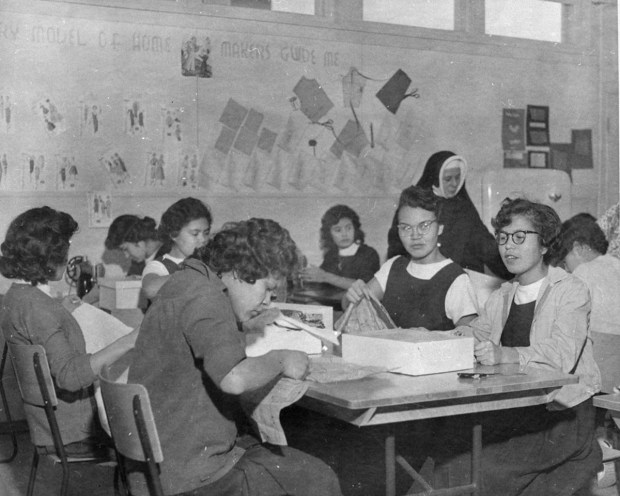
Sewing class at Kamloops residential school, late 1950s. (Image: Govt of Canada)
FIVE YEARS after the Kamloops announcement, the evidence has still not caught up to Parliament’s genocide declaration.
Marco Navarro-Genie.
On October 27, 2022, the House of Commons gave unanimous consent to a motion by opposition MP Leah Gazan of Winnipeg Centre, declaring that Canada’s Indian Residential School system constituted genocide under the United Nations Convention. No formal recorded vote took place. Parliament committed the country to that designation without a division of the House.
The motion arrived 14 months later. On May 27, 2021, Chief Rosanne Casimir of the Tk’emlups te Secwepemc announced that ground-penetrating radar had detected the remains of 215 children at the former Kamloops Indian Residential School. Former prime minister Justin Trudeau ordered flags to be flown at half-mast. Churches burned.
Not one body has been found. Not at Kamloops. Not anywhere.
The scan described soil anomalies, not confirmed human remains. Archival records showed that septic field tiles installed in Kamloops in 1924 produced GPR readings indistinguishable from those of graves. Of roughly 20 similar announcements by 2023, excavations yielded no residential-school-related burials.
Some will say that further investigation may yet confirm what Chief Casimir announced. Perhaps. The resolution passed on no evidence and unrealized expectations.
In a free society, accusations of genocide require evidence, at least proportionate to the gravity of the charge. Parliament chose to dispense with that requirement. It declared Canada guilty of one of humanity’s greatest crimes while the claims remained unverified. That is not due diligence. It is political theatre masquerading as moral certainty.
Canadians were never obliged to prove that genocide did not occur. The burden rested, and still rests, on those making the allegation. Yet Parliament reversed that principle, endorsing the conclusion before the evidence.
Parliament paid a price for that failure. The number of Canadians expressing confidence in the federal government fell below 50 per cent in 2023 and has not recovered. Credibility, once spent on an unverified premise, does not return easily.
Canada has been here before. In August 1914, Parliament passed the War Measures Act hastily, enabling the internment of more than 8,500 persons in the First World War and around 22,000 Japanese Canadians in the Second. The Mulroney government repealed the Act in 1988 and issued a formal apology. Urgency and unanimity are not substitutes for sound judgment.
The internment parallel is instructive given what followed. Two years after the genocide motion passed, Ms. Gazan introduced Bill C-413, punishable by up to two years’ imprisonment for denying or downplaying the residential school system; prorogation killed it but Gazan re-tabled it in 2025. First declare a genocide on unverified evidence, then criminalize asking whether the evidence warranted it. That is the logic that produced internment camps.
The Truth and Reconciliation Commission concluded in 2015 that the system amounted to cultural genocide: a coercive assimilation policy. It did not find physical extermination. Calling the schools cultural genocide is an arguable historical verdict. Calling them genocide, unmodified, tells Indigenous children that their country tried to murder their ancestors wholesale. Those are not the same claim.
Reconciliation built on a false foundation will not hold. A Parliament willing to trade its judgment for moral approval will not recover the trust it forfeits in the transaction.
Any sitting MP can introduce a motion to rescind or amend Ms. Gazan’s resolution. The evidentiary foundation on which it rested has not been confirmed, and the historical record does not support the unqualified genocide designation. The Government of Canada ran an assimilationist program, not a mass murder campaign. Parliament should be capable of saying both things at once.
Indigenous children deserve the truth. All of it. Parliament, which failed them once with a rush to judgment, can begin to make that right. It would go a long way toward restoring what has been squandered.
Dr. Marco Navarro-Génie is the Vice-President of Research and Policy at the Frontier Centre for Public Policy. An expert on radical revolutionary movements and political identity, he is a recipient of the King Charles III Coronation Medal for exemplary public service. He is the author of three books, including the 2023 release Canada’s COVID: The Story of a Pandemic Moral Panic, co-authored with Barry Cooper.


https://thetyee.ca/News/2026/05/08/Who-Behind-Residential-School-Denialism/
Dr. Navarro-Genie is referenced in this article in the Tyee, “Who is Behind Residential School Denialism” as one of the contributors behind the propaganda campaign of denialism.
LikeLike
The article you quote is, itself, anything but unbiased. It is an opinion piece written with the objective of discrediting those the writer labels as “denialists.” So, essentially, this is a battle of opposing opinions. But in this debate it’s important to distinguish between skepticism surrounding the ‘215’ and the abuses committed within residential schools. The ‘215’ debate is very specific to the question of whether or not the “anomalies” turn out to be human remains.
LikeLike
Mel Rothenburger,
I am glad that you recognize when opinion pieces are biased which is exactly what the article by Dr Navarro-Genie is that you have chosen to share on your platform.
Here is another article about how the media upholds racist beliefs about Indigenous people in Canada.
https://thetyee.ca/Analysis/2021/06/21/Story-By-Story-Canada-News-Media-Built-Indigenous-Oppression/
LikeLike
If you wish to keep quoting Tyee articles on the subject, perhaps you should read as an alternative some of journalist/ author Terry Glavin’s recent work, which tells quite a different story of the media’s role. And you might want to give a thorough read to the Final Report of the Native Indian Residential School Task Force carried out by the RCMP over an eight year period and belatedly released in 2023. The purpose of it was to “to investigate every allegation of physical and sexual abuse that occurred at each of the 15 residential schools that operated within the province of British Columbia.”
LikeLike
I used to subscribe to the Tyee. Just like the CBC they are a totally unbalanced bunch. Unlike the CBC I have the option and stopped giving them money.
LikeLike
First of all, even the Pope said It was a genocide
Under Article II of the Convention, genocide is defined as any of the following acts committed with the intent to destroy—in whole or in part—a national, ethnical, racial, or religious group:
Killing members of the group.
Causing serious bodily or mental harm to members of the group.
Deliberately inflicting conditions of life calculated to bring about the group’s physical destruction.
Imposing measures intended to prevent births within the group.
Forcibly transferring children of the group to another group.
Given that Canada sterilized Indigenous women against their will and foricblly transferred children to another group via schools and sixties scoop, how does the author and Mel square that circle? Perhaps they think Canada was acting in the best interest of the mother when they destroyed her internal organs and or took her child away.
Duncan Campbell Scott called it the Indian Question needing to be solved. “Kill the Indian, save the man.” They said that about Jews too and Hitler had his final solution. Funny now, how right wingers defend Israel’s right to exist and Jews to return to a land “God” promised them 5,000 years ago, but will deny Indigenous People the right to the land they clearly owned too hundred years ago in BC. Funny how we’re told to “never forget,” while politicians stand solemnly shoulder to shoulder with Jewish leaders but tell Indians to get over it.
Funny how white Canadians say we cannot forget our history and tout the achievements of historical figures and regale in their preferred version of history, but the second that history includes inconveniences like the fact what became BC failed to live up to the obligations of the Royal Proclamation of 1763 and sign treaties, it’s again, “get over it.”
If only the racist forefathers of BC had any sense, Indigenous people in BC would be receiving the $5 treaty payment annually and BC would have been ceded.
I think the read-between-the-lines of this article reflects that a lot of whites think Indigenous People have a victim complex. I’ve always viewed it as a resilience whites will never understand because nobody tried to do it to them. Maybe the Doukhobors, but the definition of white has changed a lot since the early days of Canada.
Regarding churches being burned, I recall churches on reserves burning to the ground. These churches were built by the communities and no funding came from the dioceses. When it happened, I was reminded of the film Forrest Gump where Jenny returned to the home where she was abused and three rocks at it. Eventually Forrest tore the house down. Anyways, all buildings matter right?
LikeLike
It is silly to make assumptions that the author is “white” or canadian. Also, the Argentinian pope had opinions of his own. None are bound, not even Roman Catholic Argentinians, by his opinions, let alone the erroneous ones.
LikeLike
What a narrow respone.
I didn’t assume anything about you Dr Marco, you;re just parroting white Canadians which I’ve read is what immigrants do when they want to fit in with the right class.
Is an American Pope different than a Polish Pope or an Argentinian Pope? Frances was Italian, which made him European. Funny because Italians were also NOT white when Canada was in the midst of it’s work against Indigenous people. Do you think he felt bad because his country of birth worked to extirpate Argentinian Indigneous people?
How many Indigenous women need be sterilized to qualify as genocide in your mind? How many children need be taken from their families? Forcing an ideology and way of life on people sounds like communism no?
LikeLike
Native questions notwithstanding I seriously dislike anonymous comments. Whoever you are stand tall on your opinions!
LikeLike
You’ll notice, my username is in blue. Click it.
LikeLike