
GUEST COLUMN – Regional divides in politics are not necessarily a bad thing
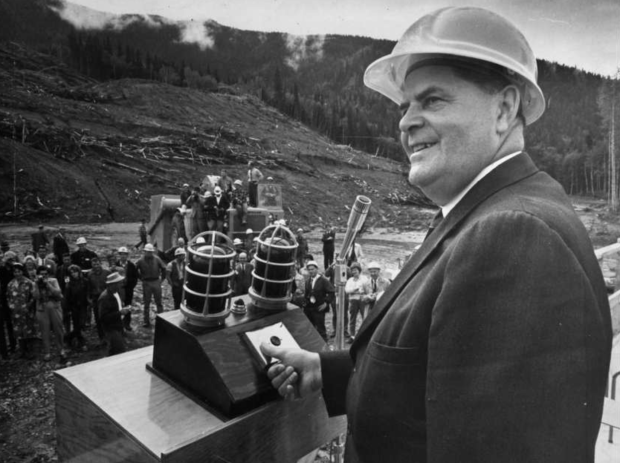
W.A.C. Bennett built economic and political success by focusing on infrastructure. (Image: BC Museum and Archives)
By NICHOLAS HAMSON
Guest Columnist
FOR YEARS, politics in British Columbia followed a fairly familiar pattern.
You had the BC Liberals, later rebranded as BC United, the BC New Democratic Party, and the BC Green Party. Those were the major political forces that shaped conversations and elections across the province for decades.
Nicholas Hamson.
But over the past few years, something has clearly shifted.
British Columbia’s political landscape is changing rapidly, and for the first time in a long time, it feels like the province is standing at a crossroads.
The rise of the Conservative Party of British Columbia has changed the conversation entirely. Whether people support the party or not, there is no denying that it has tapped into frustration that many British Columbians have been feeling on issues like affordability, housing, public safety, and trust in government.
At the same time, the governing NDP continues to hold strong support, particularly in urban areas and regions where population density is highest.
That is one of the realities of governing British Columbia.
The province is incredibly diverse, not just culturally, but politically and economically as well. The priorities of someone living in downtown Vancouver are naturally going to be different from someone living in the Interior, Northern B.C., or smaller communities like Kamloops.
In Kamloops, conversations often revolve around affordability, resource industries, healthcare access, infrastructure, and community safety. In other parts of the province, the focus may be transit, density, climate policy, or urban growth.
Neither perspective is necessarily wrong. They are simply shaped by different realities. And that is where governing British Columbia becomes complicated.
Historically, some premiers managed to bridge those regional divides more effectively than others. Former premier W.A.C. Bennett is often remembered for building support across multiple regions of the province by focusing heavily on infrastructure, economic development, and large-scale provincial projects. Whether people agreed with every decision or not, there was a sense that the province was being approached as a whole.
Today, politics feels more fragmented.
Federal politics have also played a role in shaping provincial conversations. Political trends in Ottawa and even the United States increasingly influence how people view issues here at home.
Social media has amplified that even further, creating a political environment that moves faster and feels more polarized than it once did. That influence can now be seen across the spectrum of political parties in British Columbia.
Smaller parties, including newer movements such as OneBC, are attempting to carve out their own space by appealing to voters who feel disconnected from the traditional political structure. Meanwhile, the Greens continue to approach issues from a different perspective entirely, particularly around environmental policy and sustainability.
One thing I do find encouraging, regardless of party, is seeing younger voices becoming more involved in politics. That matters.
Politics cannot be shaped by the same generation forever. New perspectives are important because every generation experiences the province differently and faces different challenges. At the same time, experience still matters too.
That balance between experience and change is part of what makes this moment in British Columbia politics so interesting.
Right now, it feels like the province is trying to decide what direction it wants to move in next. There are debates happening around affordability, healthcare, housing, energy, economic development, and the relationship between urban and rural British Columbia. And unlike in previous years, the outcome no longer feels predictable.
That uncertainty is not necessarily a bad thing. In many ways, it reflects a population that is reassessing what it wants from government and leadership moving forward.
No matter where people fall politically, one thing seems clear; British Columbia politics is entering a very different era than the one many people were used to only a few years ago.
Nicholas Hamson is a third-year communications student at Thompson Rivers University, focusing on public relations. He has experience working in political communications at both the provincial and campaign levels and currently works for the Legislative Assembly of British Columbia. His interests include public engagement, media, and helping people better understand how politics works.


“FOR YEARS, politics in British Columbia followed a fairly familiar pattern”. This is your thesis statement, you’ve got my interest now you have to support the statement impart by explaining what that familiar pattern is and how it has changed, you’ve done neither.
What do you mean the province is at a cross roads or “debates happening around affordability, healthcare, housing, energy, economic development, and the relationship between urban and rural British Columbia”, when haven’t debates been shaped by these issues and not just in Kamloops but in globally?
“British Columbia’s political landscape is changing rapidly”, what, 4 of the 5 leadership candidates for the BC Conservative Party are former BC Liberals, how is this change as opposed to a takeover and rebranding?
“The rise of the Conservative Party of British Columbia has changed the conversation entirely”, do you mean like the rise of the Liberal Party of BC under Gordon Wilson in 1991 before the socreds moved in and devoured that party, isn’t this more deja vu by the socreds?
What? “the outcome no longer feels predictable”, what does this claptrap mean? You’ve written 750 words and communicated nothing.
LikeLike