
EDITORIAL – Searching for truth on Truth and Reconciliation Day
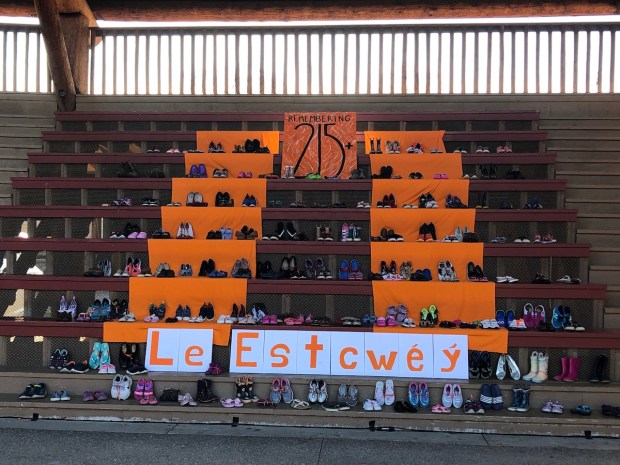
(Image: Mel Rothenburger)
An editorial by Mel Rothenburger.
IT’S THE NATIONAL DAY for Truth and Reconciliation, an opportunity to honour residential school survivors, acknowledge the trauma caused by the schools, and advance reconciliation.
It fulfills Call to Action 80 of the Truth and Reconciliation Commission, which asked for such a day to be established as a statutory holiday to “ensure that public commemoration of the history and legacy of residential schools remains a vital component of the reconciliation process.”
It’s also Orange Shirt Day, which raises awareness of the concept that “Every Child Matters.”
These dual celebrations are an important acknowledgement of the need to continue working to resolve the many grievances surrounding residential schools and their negative impacts. Today, though, many of us will be reflecting on what happened just a few days ago in our own community of Kamloops, when a group of masked men showed up and acted in a most disrespectful way.
Their appearance near the residential school and he banner they hung on an overpass railing with the words “GOT BONES?” were incredibly hurtful things to do. Their actions spurred a huge amount of discussion within the community and on social media.
Some people defended the event as an example of free speech. Others used it as an opportunity to vent their prejudice against First Nations. Still others reacted with outrage, including a renewal of demands to make “denialism” a criminal form of hate speech.
It should be made clear that freedom of speech doesn’t make everything expressed under than mantle acceptable. Making an argument for one side or another of an issue doesn’t give free licence for how that argument is made. The guys in masks did a cruel thing and that shouldn’t be condoned in any sense.
On the other hand, some of the ways in which condemnation was framed need a response, especially around the specific issue of what have become known as “unmarked graves.”
Currently, Tk’emlúps te Secwe̓pemc describes the possible existence of unmarked graves near the Kamloops residential school as “anomalies” but some folks remain convinced that the bodies of children are buried there under nefarious circumstances.
They are unshakeable in that belief and oppose excavations that might reveal empirical evidence. One commenter on social media compared excavating the “anomalies” to excavating cemeteries in town. “How would you like it if we excavated the graves of your ancestors?” or similar words were used.
Certainly, it’s a highly sensitive prospect but there’s a big difference between gravesites in official cemeteries and the case of the “215” in which there’s suspicion that crimes were committed. Crimes demand that evidence be gathered and proof be provided.
So, asking that every effort be made to determine whether claims around the “215” is perfectly legitimate, and shouldn’t be seen as threatening. It’s a big mistake to call those who seek that certainty “racists.” If excavation proves burials, long-held claims of the burials will be upheld. If not, it should be a cause for celebration since fears and suspicions would be allayed. Either way, what has become a destructive point of divisiveness would be resolved.
Demands that “denialism” be declared a crime require that a very specific definition of “denialism” be applied. The proper definition of denialism is the active rejection of established facts and scientific evidence. The quest for empirical evidence of unmarked graves is, therefore, the exact opposite of denialism.
Equating academic and scientific research with the guys in masks is simply unfair and undemocratic.
The goal of the Truth and Reconciliation Commission was to document the truth. The search for the truth of truth and reconciliation shouldn’t be restricted to confirming one particular view.
Many painful realities of the unhappy legacy of residential schools have been confirmed with ample evidence. The case of unmarked graves should be no different. On this day, we should all re-dedicate ourselves to uncovering and acknowledging truth as we continue along the often bumpy path to reconciliation.
Mel Rothenburger is a former regular contributor to CFJC-TV and CBC radio, publishes the ArmchairMayor.ca opinion website, writes for the Kamloops Chronicle and is a recipient of the Jack Webster Foundation Lifetime Achievement Award, and was a Webster Foundation Commentator of the Year finalist. He has served as mayor of Kamloops, school board chair and TNRD director, and is a retired daily newspaper editor. He can be reached at mrothenburger@armchairmayor.ca.


Men of conscience can both object to the actions of the white nationalist group while also strongly supporting free speech and expression. Free speech must inherently also mean that we allow for speech that may run contrary to our own morals and ethics, and sometimes spits right in the face of what we think is right.
We have had these battles before and it still kind of shocks me when we have reactionary calls like “take off the mask” (we allow covid face masks and law enforcement to cover their faces without much objection, yes it was cowardly but it was not illegal), “check the ID of everyone coming into town” (like a free country could ever set up ID checkpoints on our highways and roads?), “you’re not welcome here, get out” (like the RCMP or elected officials can forbid a private citizen from the city), and calls to criminalize denialism (go to jail for questioning the claims made by the KIB when as of today there is still zero confirmed evidence that there are over 200 child graves on the reserve). Science has served us well in the past. We ask a question and seek proof. What is criminal about that? Two things can be true at once – you support our indigenous friends but also expect proof of claims at the same time. Our systems don’t function based on unsubstantiated claims (courts, medicine, health and safety etc).
We saw this with Larry Flint in the states. Before that it was rock n roll. Before that it was witches and the crusades. There’s always someone out there who thinks they have the moral authority to make decisions for you.
There are bad people out there ready to justify clamping down on rights and freedoms in the name of “protecting” you. That is the real boogeyman here. We cannot let a bunch of sensationalist racists break all the things our forefathers fought and died for. Freedom is the greatest gift. Some are oblivious to it and fundamentally don’t understand how it works. How it has to work.
The thing we must do when confronted with challenging situations is speak with each other, forcefully condemn those things we find objectionable, and commit to upholding the values that forged this country, a country that allows indigenous assembly and protest, remembrance, and criticism of the very country we live in. We are lucky to have these freedoms. Many do not, yet some Canadians are quick to throw them out the window in the pursuit of some kind of false security.
LikeLike
In my opinion, the Canadian government and its provinces have been treating First Nations very fairly as of late, say about the last ten years and building. However at some point, and soon I hope, First Nations will need to start setting a more conciliatory tone and acknowledge most of their concerns and cries have been heard and addressed. It is inequitably wrong to long for a way of life that we all well know was a life of little fun and full of difficulties at best of times.
LikeLike
In the variety of reports of our leaders responses that I have seen nobody mentions the question. One leader speaks of unity, gratitude and strength. But two bring up intimidation, violence, despicable acts of racism, denialism and hate.
Now, in Canada, is it so difficult to ask a question that has NOT been answered that the ones asking have to hide?
LikeLike