
CHARBONNEAU – Will BC Conservatives purge populists from their party?
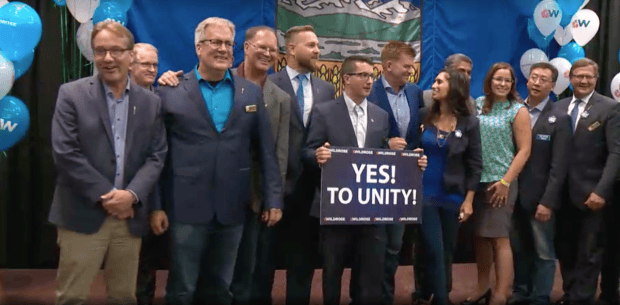
Alberta Conservatives back in 2017 during merger with Wild Rose Party.
THE NEWLY MINTED BC Conservatives face a problem similar to Alberta’s United Conservative Party. Perpetually peeved populists are determined to hijack the party and leave a trail of chaos in their wake.
 Unlike Alberta’s UPC, time and geography are on the side of the BC Conservatives.
In a gutsy move to stave off debates over her leadership, Alberta Premier Smith has given an ultimatum to separatists in her party: “I would respectfully invite them to join a different party.”
It’s a calculated move on her part to contain an internal struggle. Whether it produces lasting unity will depend on what Smith does when separatist members openly defy her.
Separatist figures have called for her removal. Her statement challenges their ability to use the party as a platform for their populist pap (paranoia over the Deep State, anti-vaccination, distrust of “others”).
In B.C., former leader of the BC Conservatives, populist Kerry-Lynne Findlay, may be gone but those who supported her are still around. People like Sharon Hartwell, MLA for Bulkley Valley–Stikin, who is associated with the party’s populist wing and Freedom Convoy sympathizers.
Smith’s concerns are more immediate.
With Albertans going to the polls next October, Premier Smith needs to quell infighting and establish herself as leader. Only bold moves will save her from the fate of former premier Jason Kenney.
Discontent grew intense over Kenney after the merger of the Progressive Conservatives and Wildrose Party. Vocal populists and moderate conservatives clashed and constituency associations demanded an early leadership review. Numerous UCP MLAs openly rebelled and called for Kenney’s resignation
B.C.’s premier designate Doerkson has the luxury of time with four years to form a stable government.
Doerkson also has the luxury of geography.
Whereas Alberta’s political divide is distinctly rural/urban, the BC Conservatives won ridings in all parts of the province. Unlike previous elections where conservative support was heavily concentrated in rural areas, the 2026 election produced a “blue wave” that swept through Metro Vancouver.
This mix of urban and rural MLAs will pull the party more to the center, more like the center/right BC Liberals that were in government for 16 years under Gordon Campbell and Christy Clark.
Populists in the BC Conservative will be a vocal minority and while they can’t be swatted away like flies, they will be a vocal fringe group.
With populists on leash, will the BC Conservatives form a dynasty as durable as the BC Liberals?
The BC Conservatives have now assembled a similarly broad electoral coalition. Whether that becomes a durable governing coalition is a separate question.
The mix of the two parties is fundamentally different.
The BC Liberals were essentially a centre-right coalition that included federal Liberals and Conservatives. The modern BC Conservatives have a more explicitly conservative identity.
That difference matters particularly in Metro Vancouver, where a party must attract voters whose social attitudes and economic priorities can differ substantially from those of its rural supporters.
The BC Liberals’ long period in office depended on maintaining a coalition broad enough to include voters who were not particularly conservative on social issues.
With the BC Conservatives being pulled in two directions, can the center hold?
David Charbonneau is a retired TRU electronics instructor who hosts a blog at http://closetproductions.ca/EyeView/eyeviewcover.htm


Leave a Reply