
CHARBONNEAU – Supreme Court gives nod to private land owners
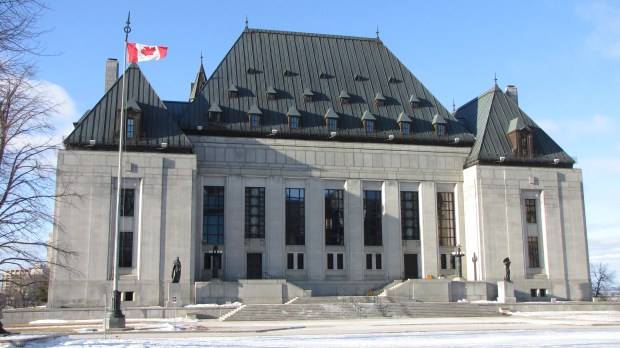
Supreme Court of Canada. (Image: Wikimedia Commons)
LANDOWNERS can feel more confident that their property won’t be seized by First Nations.
The Supreme Court of Canada has rejected an appeal by First Nations that private land should be part of their land claims.
 The court supported a lower court ruling of the New Brunswick’s Court of Appeal.
That court ruled that the Wolastoqey Nation cannot seek Aboriginal title over private property, saying the harm to private-property rights would undermine efforts in Canada to achieve reconciliation with First Nations. The justice in that case said:
“In my view, a declaration of Aboriginal title over privately-owned lands, which, by its very nature, gives the Aboriginal beneficiary exclusive possession, occupation and use, would sound the death knell of reconciliation with the interests of non Aboriginal Canadians,”
The Canadian Supreme Court’s ruling is at odds with the Cowichan decision in British Columbia where the provincial Supreme Court said that Aboriginal title holds over private lands in Richmond.
Despite appearances to the contrary, a lawyer for the Cowichan is putting a good spin on the ruling, saying it was “good news” for his clients.
The lawyer said that his clients had “argued that the Supreme Court of Canada should not decide the very important question of ‘can Aboriginal title exist over privately held lands?’ on an appeal of a pre-trial decision, as in the Wolastowey Nation case.”
In other words, the “good news” was that the Supreme Court of Canada had not actually ruled against Aboriginal title over privately held lands; the court had simply agreed with a lower court that said they couldn’t.
I don’t understand why First Nations would want title over private property, not when they have said that they would never evict private homeowners. Why claim property they have no intention of occupying?
Richmond homeowner Bal Batth wonders the same. He asked CBC News: “If the Cowichan didn’t want us private property owners involved, then why is the map involving us?,” referring to the area marked out in Cowichan claim.
After the Cowichan decision that awarded private property in Richmond to First Nations, homeowners were in disbelief. They worried that their properties could lose value over time or become targeted in future litigation.
Surely, Indigenous people would be the first to sympathize when land is being taken from traditional owners. Yet that seems to be the case in claiming private property.
Property ownership is not only a source of pride and sense of accomplishment, it has historical roots in stability. Widespread property ownership is a safeguard against political extremism, providing economic stability and connection to place -town, city, province, country.
That was not the view of the first people to inhabit North America. For them, the land was owned by no one, or seen as communal property.
Now, that view has changed for Indigenous peoples. With 95 per cent of B.C. land unceded, they want the certainty of land ownership; lands declared as exclusively theirs.
Reconciliation has to mean that property is not seized by others. It was wrong when colonizers did it and it’s wrong now.
David Charbonneau is a retired TRU electronics instructor who hosts a blog at http://www.eyeviewkamloops.wordpress.com.


I don’t think homeowners are to blame for this but at the same time one cannot ignore recent history. A lot of land was taken from First Nations and they should receive compensation for their loss. However, homeowners are not the ones who should be paying the price. We really can’t turn back the clock but we can compensate this loss in other ways.
LikeLiked by 1 person