
STV may be coming to next civic election
Armchair Mayor column, Saturday, April 24, 2010
Picture this. At the next City council election, you go into the polling station to decide which candidates you want to represent you for the next four years.
Yes, I said four years.
The ballot has the usual roster of three dozen council candidates (that’s a typical number for Kamloops).
In past years, you simply marked eight choices because that’s how many councilors need to be elected. Not anymore. You must now rank them in order, first to 36th. Hope the chair in the voting booth is comfy, because this is going to take awhile.
When the votes are tallied up, half your choices may not count. That’s because the 19th place finisher might have received more seventh-place votes than the eighth-place guy, who drops down to number 23 and waits to see if he can pick up a few votes from number 29.
Or is it, number 12’s votes are transferred to number 21, or number 11 to number 17? Who knows?
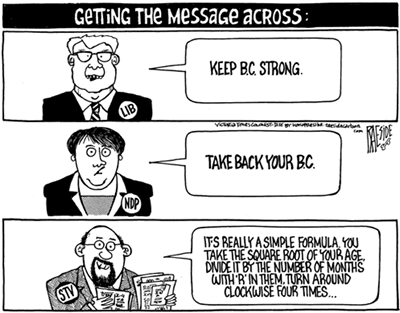 After the formula for weighting the votes is determined according to a mysterious process, and the candidate with the lowest score drops off, we move to number 35, then 34 and so on until, a few weeks later, we’ll know who we elected to City council.
It’s the Single Transferable Voting system, it’s all very democratic, and it could be coming to the next municipal election near you.
We’ll know soon enough. The Local Government Elections Task Force is due to present its recommendations May 30 on changes to the way we vote for City councils, and the STV system is just one of the proposals under consideration. You may remember the STV, the one that got trounced in not one but two referenda as a way of “reforming” provincial elections.
Say what! One day, Mr. Mayor, you’re expanding our political vocabulary with terminology that would have gotten our mouths washed out with soap in our younger years; the next day everything is hunky dory and we’re all good friends over the transfer of administrative power from RIH into the clutches of our rival to the south?
But back to the STV. I really can’t imagine how it would work for civic elections, but Fair Voting B.C., aided and abetted by the Green Party of B.C., can’t let it go.
“The GPBC recommends that the task force propose use of an alternative vote or preferential ballot system in local government elections,” states the Greens’ submission.
“This would mean that every candidate will have received at least 50 per cent of the vote. Knowing he will have to work to get the support of voters who may select another candidate as their first choice will promote more respectful discussion of issues during the campaign period.”
As a matter of interest, only three of the Kamloops councilors — John O’Fee, Pat Wallace and Marg Spina — elected in 2008 received more than 50 per cent of the vote. Nancy Bepple, John De Cicco, Jim Harker, Tina Lange and Denis Walsh were all below the threshold.
Seriously. Is that all it takes — an exchange of business cards and a few nice words about how RIH will always be independent in spirit even if the boss lives in Kelowna — and suddenly “it’s a brand new relationship”?
Four-year terms for mayors and councils — a bad idea if there ever was one — is another proposal in front of the task force, one that’s supported by our own mayor and council.
It’s a great idea for local politicians who savor the thought of being guaranteed another year in office, not so good for the public or for candidates who just don’t want to commit for such a long period of time.
Not all City councils support four-year terms. Kimberley and Tumbler Ridge, for example. But Richmond sides with Kamloops.
So Royal Inland Hospital will remain “an independent tertiary facility.” How can the place be independent until the local community — either through a local hospital board, representation on the IHA board, or an autonomous administrator — has veto power?
Not all the ideas being considered by the six-member elections task force are bad. Capping campaign expenses is one of them. While I’ve never agreed with the idea of eliminating lawn signs, I certainly think a reasonable limit on expenses would help level the playing field.
(The B.C. Civil Liberties Union, on the other hand, believes spending caps would “limit speech and distort the political process,” contending that candidates with less name recognition need more expensive campaigns.)
Campaign donations should be tax deductible for civic elections the same way they are for provincial and federal elections. The inequity makes no sense, yet many councils have opposed it for a long time. (Kamloops council is in favour of the change).
Within the several dozen submissions to the task force, there are proposals on everything from the date on which civic elections are held, to limiting the campaign period, to bringing back the business vote (which, by the way, John O’Fee, the NDP and the Canadian Labour Congress are all on record as opposing), and implementing mandatory ward systems.
How will Royal Inland ever be anything but a poor cousin, a little brother, a weak sister to Kelowna General when Kelowna is the centre of decision-making? We need co-operation, we need efficiency, but, if you’ll excuse me, Mr. Mayor, the system that IHA has come up with is, well, bullshit. If you’ll excuse the expression.
None of the recommendations before the elections task force is guaranteed to be included in the task force’s report to the provincial government and the Union of B.C. Municipalities, and the report has no assurance of being accepted in full.
But, along with some needed reform, there are enough whacky ideas to make one very, very afraid.

 ArmchairMayor.ca
I don’t mind if you’re opinionated about the issues the Local Government Elections Task Force is dealing with, but I would appreciate it if you were accurate. To correct the misimpressions that a casual reader may come away with from reading your column, I’d like to make the following points:
1. Fair Voting BC is not directly advocating that STV be adopted for local elections. Rather, our #1 recommendation is, in line with the recommendation of Justice Tom Berger, who chaired Vancouver’s 2004 Electoral Reform Commission, that BC communities be granted the right to choose which voting system best meets local needs. Local control over local issues. Seems reasonable, right?
2. FVBC does support STV as one example of a voting system that is markedly fairer than the systems which currently exist. By fairer, we mean that councils will more accurately reflect how voters actually vote. Under the current system, all seats on council can go to candidates supported by as little as 35-40% of the voters, and the remaining 60-65% of voters could find themselves unrepresented. Do you really want to defend a system that gives unopposed control of council to a group representing barely a third of the voters?
3. Your characterization of STV is incorrect in so many ways that it would take more space than your readers have patience to read through to correct, so I’ll merely say that (1) you would only have to rank as many candidates as you’re comfortable supporting (as few as 1 or 2 if you’d like), and (2) the reason for doing this is that if your #1 choice doesn’t have enough support to be elected, your vote is not thrown away, but your opinion about the next best candidate is taken into account in determining the outcome. Much better than your vote being ignored, no?
Antony Hodgson
President, Fair Voting BC
LikeLike