
CHARBONNEAU – The center-left of politics is up for grabs in Canada
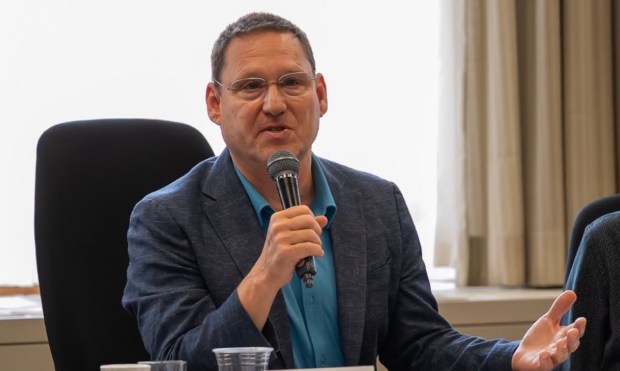
Federal NDP leader Avi Lewis. (Image: Facebook)
WITH THE MOVE of the federal Liberals to the right and the election of American Democrats, room is opening up for a center-left party to govern.
In Canada, that would be the NDP under the leadership of Avi Lewis.
 Prime Minister Carney looks more and more like a Red Tory, characterized by social responsibility, fiscal prudence and pragmatism over ideology. It’s a party that former Conservative prime ministers John Diefenbaker and Joe Clark would feel comfortable in.
It’s a party that finds Conservative leader Pierre Poilievre uncomfortable. Pushed from the center-right, there is nowhere further to the right to go and be elected.
The shift in Carney’s Liberals, compared to Justin Trudeau’s, is dramatic.
Carney eliminated consumer carbon pricing and placed greater emphasis on industrial competitiveness and energy production. He canceled proposed capital gains taxation on higher gains, tightened immigration; placed greater emphasis on oil exports, pipelines, and critical minerals.
Carney is still enjoying a honeymoon with the electorate. His approval ratings remain high and it seems like he can do no wrong. But in a few years, cracks will appear in his grand plans.
The NDP should prepare for that eventuality but a radical platform is not the key.
On the surface, it looks like American voters were prepared for a radical move to socialism. Eight members of a group within the Democratic Party, called the Democratic Socialists of America (DSA), were elected to the House of Representatives.
Many of those ran on policies such as universal health care, affordable housing, public childcare and greater taxation of wealthy Americans. Some even advocated more contentious policies such as ending military support of Israel, defunding the police, abolishing prisons and the nationalization of fossil fuel and electricity production.
But it would be a mistake to think that DSA candidates were elected on socialist platforms.
Successful DSA candidates ran in districts that were already overwhelmingly Democratic. Their victories demonstrate support for whoever would have run, be they moderate Democrats or more radical ones.
Voters in competitive Republican–Democratic districts did not embrace socialism.
In fact, voters at the national level tended to reject Democratic candidates who were supported by DSA. Three DSA candidates, who were expected to flip seats in non-Democrat strongholds such as Florida lost their bid.
The challenge, then, is for the NDP to develop a broad-based platform that will appeal to a majority of Canadians.
The NDP has a number of things going for it.
Traditional NDP voters only switched to the Liberals because the Conservatives were dramatically ahead in the polls. The insubstantial Poilievre was about to become prime minister at a time when Canada needed substance.
NDP supporters have parked their vote temporarily with the Liberals and Liberal voters who are concerned about climate change and economic inequality are moving toward the NDP.
Lewis’s personal approval is improving. Research Co. reports that his approval increased three points to 35 per cent; in B.C. it’s 47 per cent.
Young voters support the NDP. An Abacus poll indicates that 43 per cent of them aged 18 to 29 would consider voting NDP.
The NDP is the only progressive party that could form a government. It’s an opportunity that awaits.
David Charbonneau is a retired TRU electronics instructor who hosts a blog at http://closetproductions.ca/EyeView/eyeviewcover.htm


Leave a Reply