
CIVIC ELECTION ISSUES – Is Dever’s ‘co-build’ plan a silver bullet for high taxes?
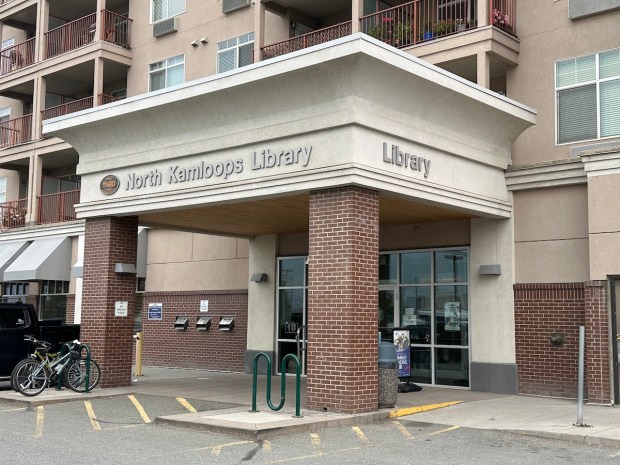
Library Square was the city’s first P3. (Image:Mel Rothenburger.)
Part of a series on some of the major civic election issues being raised by candidates running for Kamloops City council.
By MEL ROTHENBURGER
Publisher, ArmchairMayor.ca
MAYORAL CANDIDATE Nelly Dever wants to “stabilize taxes and meet infrastructure needs,” according to the platform on her campaign website. A key to doing that, she says, is to launch what she calls a “Co-Build Initiative” using public-private partnerships for land acquisitions and construction.

Mel Rothenburger.
Public-private partnerships are commonly known as P3s. Dever has been touting them since she opened her campaign in May, and mentions them frequently whenever the question of taxes and fiscal responsibility comes up.
It sounds new and fresh, but the P3 model has been around at least since the 1800s in one form or another. In fact, Dever has been a fan for more than a decade. “I truly believe in P3s,” she said as she prepared to run for re-election to her council seat in 2014. She was defeated in that election, so didn’t get a chance to act on her vision, but P3s have been looked at in connection with several civic facilities, and used in at least a couple.
One P3 isn’t necessarily like another. In some cases, a private developer builds and pays for, then operates a public utility. That was the model considered for the $48.5 million Kamloops Centre for Water Quality that opened in 2005. The City would have owned the asset but not controlled its operation.
Developers lobbied strongly for a P3 but there was strong opposition from within the community, including the Canadian Union of Public Employees. Ultimately, the City council of the day decided it didn’t want such an essential public utility — nor the rates charged — under private control, and opted to build it on its own.
It was the right decision, with the plant coming in under budget and on time. While not a P3, the water quality centre was teamed with Thompson Rivers University in a public-academic partnership for a Water Education and Research Centre.
The water plant has won top environmental awards and immediately became an oft-cited example of how a municipality can build and operate its own infrastructure successfully.
Dever’s “co-build” model, though, leans to the City partnering with private industry on projects that would include both a public and private component, with the aim of splitting up air space and benefitting taxpayers financially and in construction efficiency.
Library Square on Tranquille Road is an example of this approach. Opening in 2010, it was hailed as the City’s first true P3. It is an air-space parcel subdivision — private money built the apartment building and commercial units while the Thompson-Nicola Regional District owns and operates its library independently on the ground floor.
Remember the three-storey parkade the City tried to build in the Heritage House parking lot in Riverside Park? It was once considered for a P3 but, of course, public opposition doomed the project altogether.
And when the City was looking at options for a new performing arts centre in 2014, Hotel 540 was briefly considered in a possible P3 scenario after the hotel’s casino moved up to Aberdeen.
If you’ve ever flown in or out of Kamloops Airport, you’ve passed through a type of P3. The airport is publicly owned by the non-profit Kamloops Airport Authority Society, which is an arm of the City. But the airport is operated by Kamloops Airport Ltd., a subsidiary of Vantage Airport Group, under a contract that runs through 2062. It’s similar to what Prime Minister Mark Carney is now proposing for the country’s major international airports.
So what’s left for possible P3 projects in Kamloops? Dever’s platform calls for a P3 to be considered for the arena multiplex on the edge of Kenna Cartwright Park by adding a hotel, restaurant and retail space. The City would maintain control over its civic amenities.
The new RCMP station would become multi-use with the addition of commercial space. Dever’s plan also foresees a public parking structure combined with commercial parking and a seniors activity centre in the downtown-Columbia Precinct area, and partnering with a developer who would build residential and commercial units in a multi-story building on the North Shore with the City owning and operating a new community hub and plaza space.
Since the ship has sailed on a P3 for the Kamloops Centre for the Arts, Dever’s platform simply calls for “rigorous, real-time risk-management oversight.”
As shown by the earlier examples, P3s are possible in Kamloops, depending on the situation. They can bring capital into a project and shoulder the developer with some of the risks. On the other hand, developers incur higher borrowing costs than municipalities do, and they expect to make money. Civic government doesn’t always run on strict business principles because, if it did, a lot of amenities would never be built.
And, as was judged to be the case with the Kamloops Centre for Water Quality, allowing private enterprise into the management of public facilities has risks of its own.
So P3s aren’t a silver bullet for high taxes. But, although they aren’t magic, they’re an option in the right circumstances.
Mel Rothenburger is a former regular contributor to CFJC-TV and CBC radio, publishes the ArmchairMayor.ca opinion website, writes for the Kamloops Chronicle and is a recipient of the Jack Webster Foundation Lifetime Achievement Award, and was a Webster Foundation Commentator of the Year finalist. He has served as mayor of Kamloops, school board chair and TNRD director, and is a retired daily newspaper editor. He can be reached at mrothenburger@armchairmayor.ca.


Yep they are options in the right circumstance.So is working with the KIB and building on Native Land.Both the Police Station and the long discussed Convention Centre.RCMP on native land would be a huge collabotoray step in the right direction for both Kamloops and KIB.Not to mention save Citizens of Kamloops huge amount in tax payer savings.Convention Centre on the Reserve again would benifit Kamloops without a huge increase in taxes as well.
LikeLike