
CHARBONNEAU – The Great Erasure: what happened to those ‘data centres’
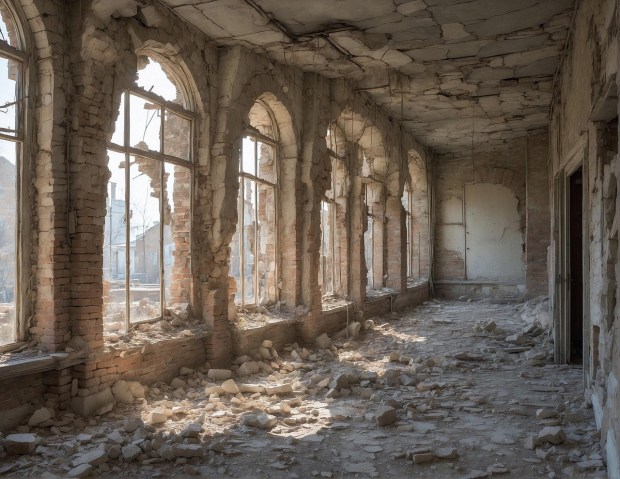
(Image: Pete Linforth, Pixabay)
NOVEMBER 13, 3026 — Ancient North American Civilization, Lecture 17
Professor Elara Venn waited until the murmuring in the amphitheatre died down.
“Good morning. Today we return to one of the great mysteries of Ancient North American Civilization: the enormous concrete structures known as data centres.”
 A hologram appeared above her. It showed a vast windowless building surrounded by fences, power lines and the remnants of electrical substations.
“Thousands of these structures existed around the planet during the twenty-first century. Many survive today because they were extraordinarily well built. We know enormous amounts of electricity flowed into them. Beyond that, their purpose remains a mystery.”
She changed the image. Now the students saw blackened ruins of what was a library.
“The problem, of course, is the Great Erasure.”
Archaeologists had uncovered the remains of libraries but many contained little more than ashes. The civilization apparently stored most of its important information electronically.
Then, almost overnight, it vanished.
Financial records disappeared. Nobody could prove who owned money, houses or land. Governments lost tax records and lists of citizens. Banks failed. Transportation networks stopped. Food distribution collapsed.
Within decades, one of history’s most technologically sophisticated civilizations had largely disappeared.
Then Professor Venn displayed an image of an Egyptian pyramid.
“The ancients of Egypt carved words into stone. Five thousand years later, we can still read them. The people who built data centres apparently believed invisible electronic information would last forever.”
A few students laughed.
“So what were data centres for? We have several theories.”
The first is the Teleportation Theory.
Data centres existed across the globe and were connected by mysterious networks. Some archaeologists believe a person could step in one centre and instantly be reassembled in another.
“This would explain the enormous electrical consumption,” Venn said. “Reassembling a human being in Kamloops after disassembling them in Tokyo would presumably require considerable energy.”
The second theory was more disturbing.
“Some scholars believe the centres were constructed by a mad ruler who attempted to become an all-seeing god.”
They found scratching on prison walls that a despotic mad ruler wanted powers greater than that of pharaohs, who were considered god-kings. The tyrant wanted to be a god: omnipotent with no limits on what they can do or control; omniscient: knowing everything in the past, present, and future.
One student raised her hand.
“Professor, wouldn’t people have objected?”
Venn grimly replied:
“Any objections were met by government thugs. Protesters were thrown in jail.”
The mood in the class turned dark.
“And finally, we have the Extraterrestrial Portal Theory.”
Perhaps the buildings were gigantic electronic temples, constructed to contact intelligent beings elsewhere in the universe. The tremendous electrical power might have generated signals or opened portals through space.
“Perhaps,” Venn said, “the ancients were waiting for visitors who would bring wisdom, intergalactic brotherhood and advice for their troubled civilization.”
She paused.
“Unfortunately, if the aliens ever replied, the message was erased along with everything else.”
“For next week, read Chapter 23: The Mysterious Handheld Rectangles. We will examine the theory that twenty-first-century humans worshipped small black objects they carried everywhere, consulted hundreds of times a day, and became extremely distressed when separated from them.”
The mood in the class lifted as students gathered their things and left.
Professor Venn walked back to her office and heard the telephone ring behind the locked door. She fumbled for her keys and as she opened the door, the phone stopped ringing.
David Charbonneau is a retired TRU electronics instructor who hosts a blog at http://closetproductions.ca/EyeView/eyeviewcover.htm


Leave a Reply