
JOHNSON – The art of Angine de Poitrine
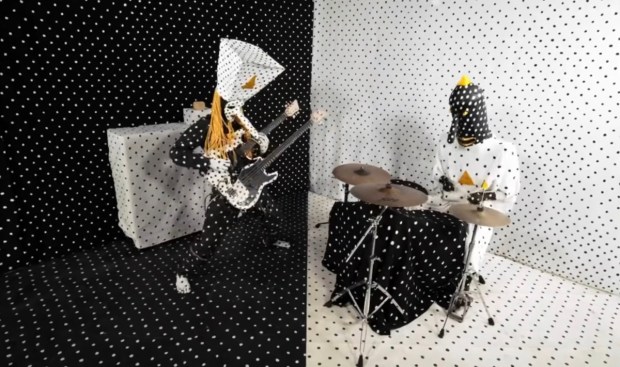
Angine de Poitrine. (Image: YouTube)
I SPENT a healthy chunk of my life, not just listening to music, but it being a part of my world from the perspective of creating it in many, many performance musical cultures and genres.
 From singing in church as a child, a warehouse band in Vancouver, and a long collection of group singing and performing bands in Kamloops and elsewhere, including symphony orchestra choruses, virtual choir collectives online, barbershop quartets and community choruses.
My tastes have always been on the move, full on classical, classic and prog rock, punk and new wave back in the day, with a thousand offshoots into specific styles and artists that caught my ear, grunge, metal, opera, Japanese Nō and Kabuki, The Hu Mongolian throat singing, Aurora, Tanya Tagaq, Anoushka Shankar, Jacob Collier, to name just a couple.
If anyone reads that list as moving from standard to esoteric, that’s how its been for me. As my ear has gained experience and technical and theoretical knowledge , my desire to find and hear sound that transcends historic norms, has only grown.
Today, I report on a new sound, and some of the alien wizardry that creates it.
Angine de Poitrine – literally translates to angina of the chest. I have no idea either.
Two polka-dotted masked musicians from Quebec questioning every assumption about music and what it can be. They have firmly asked the questions, why 12 notes, why 4/4 time, why show your face and what principles first innovation actually looks and sounds like.
In February 2026, two figures in oversized papier-mache masks and polka-dotted costumes, painted skin and contrasting backgrounds walked onto a stage at KEXP in Seattle. One sat behind a drum kit. The other stood over a custom double-necked instrument that resembled a guitar and bass until you looked more closely at it. The stringed instrument had twice as many frets as a standard guitar and played notes that just don’t exist on any piano.
Over the next 25 minutes, they produced sounds that 7 million people watched on YouTube. In their potentially ridiculous costumes, and odd alien language, they stand out in a Daft Punk kind of way. It seemed as it they should be committed for their own good … and then they started to play. You suddenly realize you’re in the presence of genius.
There were no lyrics, no verses, no choruses. Just two people building a cathedral of sound in real time, one loop at a time. You’re hearing notes that usually come from a piano or guitar that’s horribly out of tune, but it works. Time signatures like 5/8, 7/8, 10/4, 17/4, and 28/4. Never 4/4. Multi keyed melodies playing at the same time. Layers and layers of looped cycles, each song crescendos into a hard driving rock, punk or metal riff of energy … but what you heard was not any of those genres.
This was actually new.
In a world of popular music where one could seriously consider that every chord structure HAD been played … Angine de Poitrine has broken that mold.
This … is actually new, and deserves deconstruction … and why does this work?
Right off the top, what they profess they are doing is an anonymous art project. They post that “any speculation regarding the identity of its members is unverified, is not endorsed by the group, and may constitute an invasion of privacy.”
It’s not the first time a public facing artist, including musicians, have chosen to do their art, while remaining anonymous … these days, it’s not a bad idea.
Their personal statement on their website is “Disciples of planet Earth’s rock deities, space-time voyagers Klek and Khn de Poitrine gaze in wonder at hot dogs, pyramids, and rock music in all its glorious excess.”
From a performance art perspective, all this allows them the breath to run with a character, or art motif without the mainstream desire to know who is behind the statement. The art just stands on its own.
These two call themselves aliens from another world and speak a made-up language in interviews that needs to be translated by their manager. On stage they play music, and then make pyramid finger signs over their sewn pyramidical symbols on their costume, make alien sounds, a few calisthenics in polka-dotted pj’s, then play again.
The mechanism at play here is deindividuation. Research on masked performance shows that anonymity changes both performer and audience. The performer, freed from identity management, takes greater creative risks. The audience, unable to project parasocial attachment onto a face, redirects attention to the music itself.
The mask doesn’t hide the musicians. It reveals the music.
That’s just the distraction. We’re here for the music. And it’s interesting, but what’s more important is what Angine de Poitrine are doing to music, this is what principle first thinkers do to every domain they touch. They don’t iterate.
What they’re intentionally messing with is the structural foundations of western music.
That foundation is the 12-Note equal temperament (12-TET) of centuries ago.
The octave – a 2:1 frequency ratio, the only truly “pure” interval – is divided into 12 logarithmically equal steps. Each step is a semitone. Every piano, every guitar, every synthesizer plays only these 12 notes.
This was a choice that approximately 80% of the world’s traditional music systems never made. Arabic maqam, Indian raga, Turkish makam, Indonesian gamelan – all use intervals that fall between the piano keys.
The West chose 12 notes because they enable free modulation between keys. The trade-off: every interval except the octave is slightly out of tune. The perfect fifth should be a 3:2 ratio (702 cents). In 12-TET, it’s 700 cents. Close enough that most Western ears don’t notice.
It has been said that because of this modulation, western music is broken, incomplete, and inherently error prone. Angine de Poitrine is one of those artists that sees this and pushes us to hear outside the box, as an attempt to fix this system.
Their custom double-neck instrument has twice as many frets as a normal guitar.
What you get is a microtonal guitar, which operates in a 24-tone equal temperament (24-TET) system, using quarter-tone intervals (or 50 cents) alongside standard notes. In plain musical language, you get half-sharps and half-flats (such as D half-sharp or E half-flat), for every 12 regular notes on the neck. The result is twice as many notes … 24 per octave.
The double-neck design forced a specific style: one neck – the guitar, plays microtonal melodies, the other – the bass, plays standard harmonies. Some call this “horizontal microtonality” – quarter-tone intervals appear in the melodic dimension while harmonic intervals remain conventional.
This is a regular harmony potentially rooted on a microtonal note. This is structurally ingenious.
The ear receives familiar harmonic information (consonance) while the melodic movement drifts through pitch-space that no Western instrument can normally access. The occasional moments of actual microtonal harmony – where stacked layers create intervals like the gap between D natural and C half-sharp – are brief flashes of alien dissonance. Their masked characters start to make sense as a visual representation of the type of resonance, consonance and dissonance their music creates, where quarter tones make chromatic approaches up or down the scale twice as long as usual, and build tension, not as decoration but as the language itself.
The problem with playing notes that don’t exist in western music is that western-trained ears hear them as mistakes. A quarter tone above D sounds like a badly tuned D. The question is not whether you can play these notes. It’s whether anyone will hear them as music rather than error.
To answer that, Angine de Poitrine use conjunct motion – moving between pitches in tiny, stepwise increments rather than large leaps. When quarter tones are played in succession one step up the neck at a time, the ear tracks them as distinct notes. If the same pitches appeared via large intervallic leaps, the ear would snap them to the nearest familiar 12-TET interval and hear them as out of tune.
This is not just music theory. This is adoption physics.
Eighty per cent of traditional global music does not conform to 12-TET so quarter tones may not need any perceptual accommodation at all. The stepwise gate is a Western-listener problem, not a universal one. In other words, if Angine de Poitrine sound out of tune to you, it’s not them, it’s your experience.
The rest of their musical definition is how they structure songs.
The structural backbone is a Boss RC-600 loop pedal. Every cycle, a button is pushed which repeats what was just played as a layer, and subsequent layers can be added every cycle.
The loop length never changes. What changes is the time signature painted over it.
For clarity let’s focus on one song.
In “Sarniezz,” the loop is 48 eighth notes long. In 12/8 time, this creates 4 bars. When the drummer pivots to 4/4, the same 48 eighth notes become 12 bars. The loop is mathematically identical. The perception of meter is completely transformed. They simply painted a completely different time signature over the top of it.
Remember, humans search for patterns, we are good at it. Even when we don’t understand it, we know when it works. Their fixed loop is doing more cognitive work than any individual time signature; the anchor that allows the conscious mind to experience complexity as groove rather than chaos. The math constrains the madness, and keeps it accessible in a way that free-form experimental music never achieves.
We can tap our toes and headbang to this, but we may not know why.
The last detail about their structure and arrangements is that there are no lyrical based defined song structures; no verses, no chorus, no middle 8, no bridge, no coda. The only available operations are to add a layer, or mute a layer. This produces a form built on phases rather than sections:
Bass riff is looped. Drums enter. Guitar layers stack. Density builds.
The drummer shifts time signatures while loops are added and subtracted.
The texture transforms completely. The underlying loop length has not changed.
Once a loop is recording, every layer must fit the same fixed duration.
THAT is the restriction, the frame that makes us listen for more … a restriction of time.
It inevitably leads us into an aesthetic territory reminiscent of techno music, but the form is closer to process music or a DJ set construction, than to rock songwriting.
So, that’s the basics, if curious what all this sounds like, check them out, they are all over YouTube as they are on a world tour. Don’t be dismayed by the costumes, pyramids, glowing eyes and alien language, that’s the artist statement for a couple guys who just want to be anonymous but still share what they hear with the world.
… and these guys need to be heard.
David Johnson is a Kamloops resident, community volunteer and self described maven of all things Canadian.


Leave a Reply