
EDITORIAL – What is the actual number of ‘missing’ at the residential school?
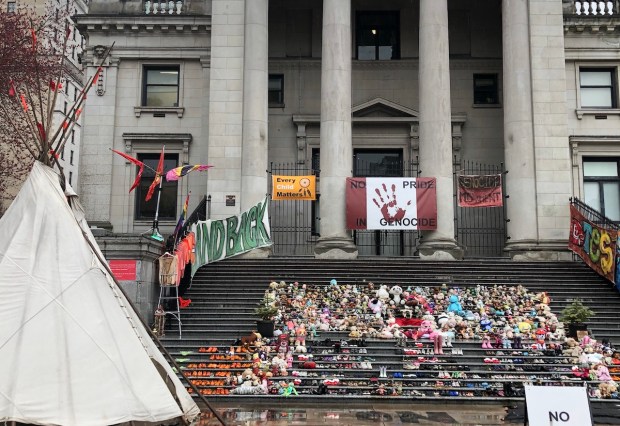
(Image: Mel Rothenburger)
An editorial by Mel Rothenburger.
IT’S FAIR TO SAY comments by Kúkwpi7 Chief Rosanne Casimir last week about suspected unmarked graves at the Kamloops Indian Residential School have raised more questions than they answered.
My editorial Feb. 17 contended that her news release provided scant new information about research into 200-some “anomalies” in a former orchard at the school. It also expressed concern about Casimir’s comment that the question of the possible gravesites may never be resolved.
If the former orchard at the school simply remains a sacred site and is never excavated, how are we to know if there are actual any burials there? If they do exist, how many?
At the beginning of this sad situation five years ago, it was asserted by Casimir that ground penetrating radar had “confirmed” the orchard contains the remains of children, and even, for a time, that it was a “mass grave.” The number of 215 was attached to the suspected number of gravesites.
The description of the GPR findings has been re-defined as “anomalies” and the 215 has been adjusted downward to 200, or thereabouts. So the question is, is that still the official number? Despite the adjusted number, the situation is still commonly known as “the 215.”
Casimir’s news release said three methods were being used in the continuing search: GPR, LiDAR scanning, and cadaver (or Human Remains Detection) dogs. We know GPR can’t confirm whether human remains are present. LiDAR can’t penetrate the ground. HDR dogs, though, have an amazing ability to scent human remains buried at considerable depth even if interred decades ago.
The three methods, the news release said, have overlapped in some locations, with some areas being ruled out and others not. Does that mean the number of 215 has been reduced, or simply that the search of grounds at the school has been expanded without any findings?
This question is of immense important to the public, since a recent survey indicated that the majority of Canadians, including indigenous Canadians, want excavation to be done in order to provide empirical evidence on whether the gravesites exist. They also want to know how many gravesites are suspected — the issue is not only whether the burials are real, but the extent of them.
Wanting to know is not a racist or denialist reaction. It’s a case of desiring to confirm or remove suspicions that have done huge damage to Canada’s international reputation and have become central to reconciliation.
Casimir states she will not agree to be interviewed following up her news release. That’s unfortunate; the time has come for Band officials and their consultants to call a meeting, open to the public, to reply to questions involving the search.
Mel Rothenburger is a former regular contributor to CFJC-TV and CBC radio, publishes the ArmchairMayor.ca opinion website, writes for the Kamloops Chronicle and is a recipient of the Jack Webster Foundation Lifetime Achievement Award, and is a Webster Foundation Commentator of the Year finalist. He has served as mayor of Kamloops, school board chair and TNRD director, and is a retired daily newspaper editor. He can be reached at mrothenburger@armchairmayor.ca.

 ArmchairMayor.ca
Just some examples where bodies were uncovered.
Muscowequan Indian 19 uncovered
Battleford Industrial School 72 uncovered
Dunbow Industrial School 34 Uncovered
Some bodies were burned others just thrown into the rivers. Some on this blog deny the existence of children as I’d by radar, that is not evidence that they don’t exist. Many of you ignore oral history an inuendo that the chief is lying. The catholic church refuse to provide documents so by the same reasoning are they lying? Why don’t you question that?
LikeLike
It’s true there was a high death rate among kids at the residential schools but we should be careful not to confuse excavations or discoveries at recognized cemetery sites with allegations of secret burials. As well, some suspected burial sites have been excavated with nothing being found. In the case of the Kamloops school, you’re correct that
GPR findings don’t disprove the existence of burial sites; they don’t prove it either. That’s why empirical evidence is needed.
LikeLike
In the cases of the Muscowequan, Battleford, and Dunbow schools, the presence of remains was physically confirmed through accidental discovery or excavation, rather than through ground-penetrating radar alone.
Specifically:
– Muscowequan Indian Residential School: 19 bodies were uncovered during construction work in 1992.
– Battleford Industrial School: Unmarked graves were identified by archaeology students during an excavation.
– Dunbow Industrial School (St. Joseph’s): Remains were revealed in 1996 following the erosion of the Highwood River banks.
A significant challenge in identifying these sites remains the refusal to release archival records, particularly those held by the Catholic Church. Furthermore, off-site burials in public or hospital graveyards, often resulting from illness or escape attempts, which add complexity to the identification process due to poor historical record-keeping and a heavy reliance on oral traditions.
LikeLike
Wow, Esquire. You’re getting pretty personal with me for someone hiding behind a nickname. It’s almost as if you object more to my civic activism than my position on the issue at hand. Ad hominem is the lowest form of argument.
LikeLiked by 1 person
Yes, we need more information. However, it’s interesting and says a lot about the lack of trust and respect that in all of the dialogue and commentary here and elsewhere, two important parts from the statement are not addressed.
1) Documentation from government and churches – “Obtaining 88 years of government records and sacramental records from the Roman Catholic Church of Canada is critical to confirming the identities of the children who attended the school and those who never returned home, along with the community to which they belonged. Our progress has been hindered by government restrictions on certain records and slow response.”
2) The issue of excavation and respecting First Nations cultural protocols – “We have a responsibility to work with and honour all 38 Indigenous nations in 119 communities across BC. Each Nation upholds its own cultural and spiritual protocols for how ancestral remains must be treated. We also understand that full consensus may never be achieved. Possible future outcomes could be to preserve the orchard as a Sacred Site – a place of memory and healing – or excavate. Any remains would need to be repatriated to their home communities, an extremely complex and sensitive process involving extensive consultation with the Nations, DNA analysis, forensic expertise, and adherence to appropriate laws and protocols.
It’s unfortunate that there isn’t more dialogue and information forthcoming, and it certainly leads to a lack of trust about the situation. Perhaps if the dialogue and tone of the inquiries from the public generally was more respectful, there may be more transparency.
LikeLiked by 1 person
The Secwepemc suffered greatly under colonialism. Whether or not the orchard yields graves, it’s well known that all children in that residential school were routinely abused by having their customs denigrated. Their hair was hacked off, they were punished for speaking their language and they were isolated from their parents and families, sometimes for years at a time. Some were sexually abused. All suffered corporal punishment for supposed infractions of the rules imposed by guardians who did not have their best interests at heart. Some never came home from the school–they died running away, they died of disease, they died of neglect, and some, likely, died of abuse. And after that, the abuse lived on in alcoholism, domestic abuse and suicide.
The point isn’t whether there are the “right” number of graves in that orchard. Nor is it about a few million dollars from a rich country that benefitted from lands that were solely aboriginal 150 years ago.
Haven’t we colonials learned anything from our nasty past practices? Do we still not understand the horror and despair the Secwepemc and other nations still feel about the fairly recent past? Now we don’t even want them to deal with their issues the way they feel is best?
Shame on us all.
LikeLike
Yes, abuses did occur at residential schools but we shouldn’t conflate that with the issue of whether or not there are unmarked graves. We can deal with it and still try to address the rest at the same time and in other ways. To suggest it’s “their issue” alone, ignores the responsibility of the system for what happened, and the fact the entire country has a stake in the outcome.
LikeLike
Isn’t saying that “their issue” includes the responsibility of the system and the impact on the country as a whole conflating cause and effect? Their issue is the effect on their personal and social well-being caused by colonization. Canada’s role should be trying to mitigate the effects as much as possible. This mitigation will not affect Canada as a whole in any major way–certainly a minor fraction of how Canada affected aboriginal communities.
As for where the graves are located: We know some children died. Where are their bodies? Some may have been buried on-site, though others may have been buried elsewhere or their bodies disposed of in some other way.
Too bad record-keeping by the abusers is suspect. It would be good to know how many graves there may be. Maybe this number will become known in future. Maybe the Secwepemc people will decide to do more digging at some point.
What’s the hurry? Why should the Secwepemc people have to adhere to a timeline not of their choosing? Why do we have to have the answers right now? Besides the fact that we white people are always in a hurry, that is.
LikeLike
Five years isn’t exactly “in a hurry.” The quest is, after all, for the truth in Truth and Reconciliation, not the “truth” of people’s biases.
LikeLike
You are absolutely correct BBS. At the same time much has been done to correct an infamous past. Can much of the distress still currently witnessed amongst First Nation people be caused by their leadership negligence in being truly inclusive in their own terms?
LikeLike
We understand clearly the injustices and inhumane treatment done to First Nations at the hands of the Crown. We treated these people terribly. We owe them the dignity and respect of closing the loop and making amends. We do not owe them the lowering of basic standards like evidence, facts and truth.
Demanding proof and transparency does not undermine our understanding of our cruel history. Recall the claimed goals of Truth and Reconciliation? Truth isn’t a one-way street. But in this case it’s a one-way conversation from a party that clearly knows they severely overstepped on this issue and listened to a reconciliation industry far more concerned about narratives than rigorous evidence.
I am concerned with the truth and facts above everything else. Full stop. Nothing can ever be above that. The mental gymnastics being performed to give a pass on this simple concept central to democracies to a particular ethnic group is frankly disgusting. No one is above the truth. No one is about the facts. The same people railing against Trump’s lies are the same ones willing to accept untruths provided they come from someone or some group aligned with their tribal worldview. Anyone claiming you’re a racist denialist for asking questions and demanding truth is a bigger threat to our way of life than anything in generations.
How does history excuse the deflection, obfuscation, millions of taxpayer funds issued for one purpose that is not being fulfilled, and the substantial public interest of understand the facts after claims of mass child graves sent shockwaves around the world? All of this doesn’t discount or somehow absolve the individuals making these claims from proving them. If your standard of evidence is “just trust me”, you have no business being critical of this council. We live in a rules-based society. People died for that. For the very things and principles some people are attempting to take from us. In this country, we don’t just take claims of atrocities based on flimsy evidence and PR stunts to conform to a narrative. This claim demands evidence to either confirm or deny. We should all be seeking the proof that this did or did not happen.
You would hold Kamloops council responsible for irresponsible spending and undemocratic spending of tax dollars. You would hold council accountable for telling you to “just trust us” when you submit a FOI. You demand a say over AAPs. You are demanding truth (a public mandate for those spends) yet impose no demand for the 215.
Why the double standard based only on ethnic background? You want to talk about racism, isn’t that the definition of racism? I don’t recall the definition of racism including asking questions and demanding rigorous evidence when atrocities are claimed.
LikeLike
Since you seem to agree with the points Mel raised in his editorial, “What is the actual number of ‘missing’ at the residential school?”, you cite examples of my public opposition to city council activities, and you mention comments I made in response to Mel’s editorial, I assume the “you” in your argument refers to me and not Mel.
Of course I have a “double standard” where this issue is concerned. “Irresponsible spending” by “this council” at city hall didn’t kill one of my children. AAPs didn’t make me lose my language or abandon my culture.
Is your problem whether the claim of 215 burials is accurate? Maybe the 215 ground-penetrating radar anomalies that could be evidence of graves in the orchard north of the school raised overwhelming past pain and anger for the Secwepemc people. Maybe the anomalies were taken as proof in the heat of the moment and in the powerful hope that their lost children had finally been found. So what? The number doesn’t negate the fact that children died while in the “care” of the residential school.
Maybe 215 is correct. Or maybe it’s 467. Maybe it’s 10. Maybe the school used lye for more than making soap. Maybe, like the remains recently found in a Kamloops backyard, child burials will be found elsewhere. Will you demand an apology if they don’t find enough graves in the former orchard to suit you? If the number is “wrong,” do you feel the need to humble the Secwepemc more than they’ve already been humiliated throughout recent history?
Is it about the money? Isn’t it hypocritical to be concerned about $12million in federal funds the Secwepemc received to investigate potential burial spots while ignoring why the recent PAC AAP fine print didn’t inform voters that a $65 million leap in PAC costs would drain the city’s reserve funds, or why the $7 million PAC design didn’t account for the slope of the site? Oh—they’re entirely different issues? Yes, they are.
Or is the timeline your main complaint? My belief stands that in light of the terrible injustices the Secwepemc suffered, they can approach the issue of residential school deaths and possible grave sites in their own way and on their own time. Five years may seem a long time to you and Mel, but where child deaths are concerned maybe it’s a short time to the Secwepemc.
Maybe you take issue because the claim “sent shockwaves around the world” and now you’re hoping a finding of fewer than 215 graves will somehow make Canada’s well-known racist past look better internationally. Newsflash: the world has already moved on to significantly “bigger threat[s] to our way of life than anything in generations.”
LikeLike
Ms. Scott, you are focusing on the number when that is not the issue here. I am not concerned with the number as you imply. It could be 400 or 30. One more is too many for me.
What I am concerned with is substantiating a claim of atrocities after it was made. $12M is a small amount in the end but it’s still an amount that was paid to produce an expressed purpose. When people contort and avoid the most direct and easiest way to the truth, that becomes a problem for me.
You appear to have a standard for one ethnic group and a standard for others when it comes to basic principles like justice, fairness, accountability and tax dollars. As if being of a certain ethnic background absolves one from meeting those standards. And this is really the root of the problem. We will never move toward true reconciliation by carving out exceptions for ethnic groups when it comes to (criminal) justice, truth, science, and basic accountability.
I cannot respect individuals who attempt to enforce double standards, particularly when that double standard is based on ethnicity. Particularly when you so voraciously point out the lack of accountability on council, with PR releases of detailed research and the minutiae of foibles from city hall. It is completely hypocritical to hold one group to account and on the other hand willingly give a pass to others because you gravitate to that particular cause.
What the heck happened to people conducting their lives and behaviours based on principle? What principle do you operate under? Would you hold your tongue if a majority Métis were elected council and used AAP? Absurd.
The examples you raised are difference scenarios yes, but they describe the same principles.
You would not stand for someone accusing your family of murder based on flimsy evidence and produce nothing but conjecture over 5 years. You would demand evidence. You seem very comfortable with the concept of making claims of atrocities without evidence after an extended period of reflection and patience.
215 or not doesn’t extinguish the horrors perpetuated against indigenous people. But untruths, half truths, lies and politicking hurt us all. Again, are we for truth or are we not? That should elicit a simple response.
LikeLike
For “Truth and Reconciliation” to be effective it needs to be a two-way street, under Casimir’s leadership she’s trying to make it a one-way thoroughfare and the result is that it’s becoming a dead end.
We’re missing the “Truth”, no matter how ugly it is without the truth we’re at an impasse to which we can never move forward.
LikeLike
They did the digging and found nothing. Pine Creek First Nation in Manitoba had the courage to dig. And it doesn’t appear no where else mass graves were found, despite what the CBC leads us to believe.
LikeLike