
MEDIA STATEMENTS – Discovery of ‘ancestral remains’ raises rights issue
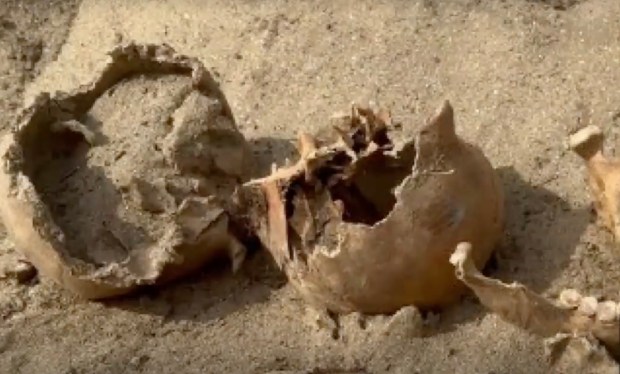
A Kamloops North Shore land owner says an $80,000 bill has been submitted by Tk’emlúps te Secwe̓pemc — which has declared the property a “sacred site” — for archaeological and related work done on the discovery of two human skulls on the owner’s property. The situation has once again raised the question of private property rights. TteS Kúkwpi7 Rosanne Casimir responded to media coverage today (Jan. 20, 2026) saying the matter must be approached “with dignity and respect” but didn’t explain why the land owner should be expected to pay $80,000. Meanwhile, the BC Conservatives also commented on the matter today. Both statements appear below:
January 20, 2026
Tḱemlúps te Secwépemc (TteS) would like to acknowledge the publicity regarding
the discovery of ancestral remains on private property within Tḱemlúps ancestral lands and thank the media for bringing forward this controversial matter.
The discovery of remains is a widely shared human value of a serious and sensitive nature that must be approached with dignity and respect. For TteS, ancestral remains are our relatives, and our responsibilities to honor and care for them are guided by Indigenous laws, cultural protocols, and established processes.
Kúkwpi7 Rosanne Casimir states that, “for Tḱemlúps te Secwépemc, the discovery
of ancestral remains is not a matter of property or debate rather it is a matter of responsibility. These are our relatives, and our laws and cultural protocols obligate us to care for them with dignity and respect.”
In British Columbia Indigenous ancestral remains are protected under the BC Heritage Conservation Act, [RSBC 1996] and any fortuitous discoveries, especially on private land should be reported to the authorities immediately. Although the Act provides protection of Indigenous ancestral remains, there are other important ethical factors and decision-making processes which require respectful coordination with authorities, local governments, and land owners to ensure remains are treated with dignity and accountability while balancing private property rights and human rights.
In essence the discovery of Indigenous ancestral remains does not alter
private property ownership; rather, it draws attention to the need for more inclusive and sustainable policies that recognize the rights of private land owners and First Nations.
This approach reflects the broader work of Tḱemlúps te Secwépemc (TteS) to educate and engage with local governments and the public when cultural heritage may be encountered. This includes collaborative public‑facing archaeological and educational work such as the joint interpretive and educational efforts between TteS and the local municipality.
These initiatives are rooted in education, early communication, and shared responsibility, ensuring that culturally significant discoveries are understood and addressed with care, respect, and transparency.
This recent discovery has offered yet another opportunity to reassess the current regulatory approach to protecting and managing Indigenous heritage sites on private land of which TteS is willing to engage in advancing respectful dialogue that incorporates Indigenous perspectives, ethical responsibilities, and an understanding of Indigenous values as part of respectful coexistence.
Tḱemlúps te Secwépemc remains committed to inclusivity, cultural education and building equitable relationships in ways that honour our people, our lands, and our ancestors.
Respectfully,Kúkwpi7 Rosanne Casimir
Tk ̓ emlúps te Secwépemc
Conservative MLA Scott McInnis on NDP Pause of Heritage Conservation Act Rewrite: “Put certainty first for builders, landowners and communities”
VICTORIA, B.C. — The B.C. government’s decision to postpone its Heritage Conservation Act (HCA) overhaul confirms what municipalities, industry and private landowners have been saying for months: changes of this scale must not proceed without clear rules, defined liabilities, and predictable timelines.
Delaying the introduction of these changes is welcomed – however, the NDP continues to create massive uncertainty with their secret land-use agreements, and failure to properly manage the fallout from DRIPA (the Declaration on the Rights of Indigenous People Act).
Conservative Critic for Indigenous Relations MLA Scott McInnis said British Columbians need a framework that protects heritage while also affording industry and homeowners certainty and predictability. The NDP’s rushed amendments did neither.
“People deserve to know, before a shovel hits the ground, who is responsible for what, how long it will take and roughly what it will cost,” said McInnis. “That’s true whether you’re running a small landscaping job, building housing, or advancing a major exploration program.”
Recent events highlight the stakes. In Kamloops, routine landscaping work led to the discovery of ancestral remains; the property owners now face an estimated $80,000 in archaeology-related costs and lingering uncertainty over next steps and responsibilities.
The case underscores why clear guidance, cost expectations and role clarity are essential for private owners and small contractors, not just large developers.
Across the resource sector, groups have also warned that the HCA amendments proposed by the government would slow permitting, expand liabilities and deter investment unless key issues are fixed.
The Association for Mineral Exploration (AME) has flagged risks to exploration timelines and recommended pausing to address fundamental concerns with direct input from impacted sectors and local governments.
“The goal should be a system that is transparent, timely and fair,” McInnis added. “The government continues rushing through major changes without proper planning and consultation. It’s creating uncertainty and uncertainty is costing our communities jobs.

 ArmchairMayor.ca
But really were the human remains truly from indigenous individuals or from some other group/ethnicity individuals?
LikeLike
This is nothing new. Just another serious overlooked issue which has been ignored by our provincial government. And really saddling a private individual with a large bill is unreasonable and unacceptable.
LikeLike
First Nations have severely overplayed their hand. Let’s call this what it now is – grift.
Forced to hire First Nations security at twice the prevailing rate? Grift. Forced to pay for religious/spiritual ceremonies? Grift. Talk about privilege. Imagine having the privilege and entitlement to bill someone for what should be 100% your own expenses?
The property owner needs to make sure they don’t let anyone from the reconciliation industry to radar scans of their property. They could find over 200 anomalies and the band won’t attempt to verify and they will be on the hook for decades of security costs at double the rate.
BC is a sideshow. Conferring extreme privilege based on race. Want to enjoy this public park on Crown land? Sorry, you’re not the right race so you can’t enter. First Nations had to “allow” FIFA to play their tournament in Vancouver. Of course at a cost of 18 million. Grift. Reverse racism is happening right now. BC is implementing an apartheid system. That wasn’t right back then and isn’t right now.
White privilege? Yea OK.
LikeLike
the cost should never be borne by the homeowner. This has all gotten so out of hand.
LikeLike