
CHARBONNEAU – BC Hydro rations future electricity use
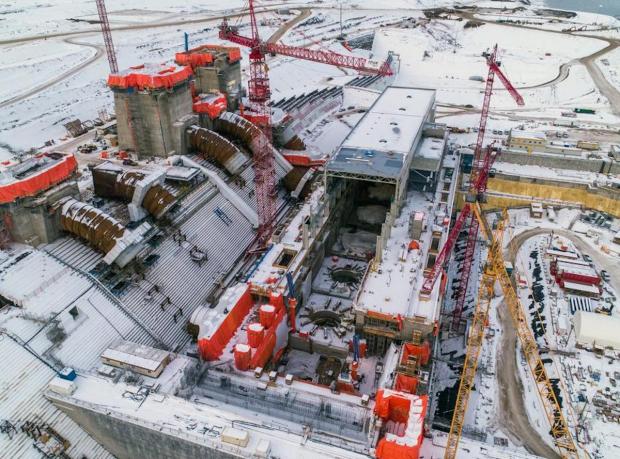
Site C powerhouse under construction. (Image: sitecproject.com)
WHAT A DIFFERENCE a decade makes.
Ten years ago, I argued that we didn’t need Site C dam because we had all the electricity we needed.
 In this column, I quoted Prof. Marvin Shaffer, research associate with the Canadian Centre for Policy Alternatives, who argued that Site C dam wasn’t needed:
“Put another way, BC Hydro doesn’t need more supply per se; it needs greater ability to produce electricity in the specific hours when needed.”
And a study from the University of Washington back then indicated that winter power needs will decrease due to global warming, and that power from Site C dam would likely be sold at a loss.
The world has changed significantly since then.
Now that Site C is built and pumping power into the grid, we need to set priorities on who gets it.
Demand is increasing. BC Hydro says that electricity needs are expected to increase by about 15 per cent between now and 2030.
We don’t have enough electricity to meet demands on the grid. The transition to heat pumps and the switch to electric vehicles, the expansion of Liquefied Natural Gas projects, data centres, and mining for critical metals (lithium, copper, nickel), are all placing demands on the grid.
Future projects will have to demonstrate advantages to B.C.’s economy.
Cryptocurrency mining doesn’t make the cut.
The province is banning any further cryptocurrency mining. The existing operations will remain. If the requests from 21 crypto-mining projects had been approved, it would have equaled 20 per cent of BC Hydro’s total consumption.
(Cryptocurrency mining uses massive amounts of electricity to power computers. They perform complex mathematical calculations that secure and validate transactions in exchange for newly created digital coins.)
Data centres also require massive amounts of power to fuel the growing appetite of Artificial Intelligence. They generate jobs in the building of the centres and employ some in their maintenance.
But they will have to compete for electricity needs. The competitive process for AI and data centres is expected to be launched in January. Projects will have to submit proposals when the competitive call opens.
This is a shift from the previous “first-come, first-served” grid-connection model to an allocation process.
And in a move to divorce ourselves from our former partners to the south, priority will be made to nation-building projects.
The federal budget, released this week, has targeted such projects. The fed’s Major Projects Office has allocated $50 billion for them, including expedited construction of the North Coast Transmission Line in remote parts of B.C..
The transmission line is essential in the mining of critical minerals.
Construction of the 450-kilometre line between Prince George and Terrace is expected to start next year.
Canada has identified 34 minerals and metals as critical to the country’s economic or national security. B.C. has supplies of more than a dozen of those minerals and metals.
We can’t have it all. Our public utility has to ration our power for the greater good in terms of employment and national security.
David Charbonneau is a retired TRU electronics instructor who hosts a blog at http://www.eyeviewkamloops.wordpress.com.

 ArmchairMayor.ca
If we want to be realistic we should actually be glad to be rid of the “free trade ” deal with the US. I may be wrong but I think we are not allowed to charge the US more for energy than we charge ourselves. This was idiotic when Mulroney signed it and it is still wrong. WAC. wanted hydro to be cheap in BC. to encourage industry. Let’s do that and charge what the market will bear to all others.
LikeLiked by 2 people
It was not Mulroney but BC Liberal premier Gordon Campbel who In 2001 appointed his campaign advisor Larry Bell as chairman and chief executive officer of BC Hydro who made sweetheart deals that cost us billion. https://thetyee.ca/Analysis/2020/05/14/BC-Hydro-Mismanagement-Paying-More/
LikeLiked by 1 person
SMRs are cost-effective for addressing BC’s shortages by providing firm power at costs comparable to new renewables with storage, but sanctions eliminate options, and domestic SMRs would need subsidies or incentives to compete with BC’s hydro SMRs incorporate advanced safety features typical of Generation III+ designs, including passive cooling systems that rely on natural circulation to prevent meltdowns without power or human intervention, even in extreme scenarios.
SMRs. are safe, resistant to earthquakes (up to magnitude 9-10), floods, and extreme weather, aligning with the province’s seismic risks. SMRs in general produce less waste than large reactors and have lower cyber risks due to distributed deployment. SMRs meet IAEA standards, making them as safe as or safer than fossil fuels, with no CO₂ emissions or air pollution hazards. One can power Highland Valley or a city like Kamloops cheaper than new Hydro, more reliable than solar or wind where storage is a cost factor and transmission lines as well. The best option for remote areas in BC mining towns and Arctic regions. Available but we and USA don’t have them, working on them now but China and Russia have them.
LikeLiked by 1 person
You are referring of course to Small Modular Reactors.
LikeLike
Yes. Small Modular Reactors. Needs an area of a football field as opposed to Williston Lake a reservoir in northeastern British Columbia that is 250 km long and covers an area of 1,761 square kilometers (680 square miles) behind the WAC Bennett Dam. Produces huge amount of CO2 due to decomposing vegetation. In my calculations above I did not include this cost or loss in prepetuity of timber and agriculture. We are working on With the exception of a partial replacement of the W.A.C. Bennett Dam’s turbines completed last year, much of the generating capacity on the Peace River is original hardware. but are years behind the Russia that has two and China one. Agreements with African states to construct. With the exception of a partial replacement of the W.A.C. Bennett Dam’s turbines completed IN 2015, much of the generating capacity on the Peace River is original hardware with upgrades, built in the Soviet Union in the 1960’s. WAC Bennett Dam $750 million to build Site C 16 + billion. SMRs about $1.5 billion
LikeLiked by 1 person