
EDITORIAL – Has MLA Stamer been living under a rock regarding prop rep?
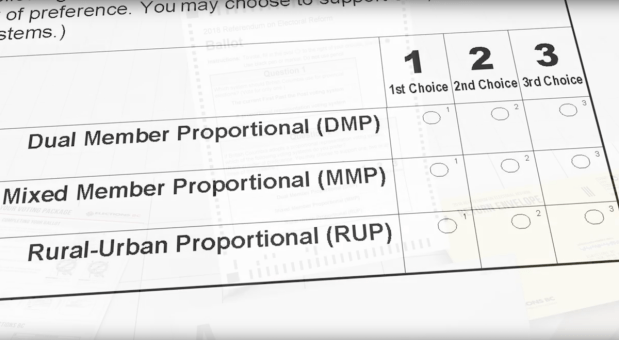
(Image: Elections BC file photo)
An editorial by Mel Rothenburger.
WILL WE NEVER be free of so-called ‘electoral reform,’ code words for proportional representation?
“Most of the people will obviously be proponents of changing our electoral system,” Kamloops-North Thompson MLA Ward Stamer is quoted by CFJC Today as saying.
“There are a lot of people who are not happy with the first-past-the-post (system),” he told the TV station, commenting in his role as deputy chair of a provincial government committee looking into the way we vote for our politicians.
“ They would look at other jurisdictions where you have a mix of either a single transferable vote or a combination of different ways of electing your official. We went through all the scenarios.”
Good grief. Whatever is MLA Stamer talking about? “There are a lot of people who are not happy with the first-past-the-post system”? Obviously, he’s been living under a rock for the past couple of decades. British Columbians have already solidly defeated proportional representation in all its forms — single transferable vote and variations — three times. Yet it keeps coming back.
Proportional representation, a.k.a prop rep, pro rep or PR, is supposedly more democratic that the current first past the post system. It isn’t. Prop rep throws all votes into a big hat and picks winners based on various complicated, confusing formulae that ignore the wishes of voters in each riding.
Proponents like to say that first-post-the-post elects governments that garner a minority of the popular vote but receive “100 per cent of the power.” Sounds good but it’s nonsense. What it does is recognize the wishes of each riding, while prop rep allows high-population urban areas to dominate the outcome.
There are practical problems with prop rep as well. More coalition governments and, therefore, stagnation, for example. Higher government spending and larger deficits, more debt and taxes. An increased likelihood of fringe parties with fringe ideas gaining a foothold.
As for his opinion that prop rep should be tried in municipal elections as a test run, I can hardly wait to see how that’s supposed to work. Using civic voters as guinea pigs is fraught with its own problems, but that’s a conversation for another day.
Stamer seems to have already made up his mind that proportional representation is going to rule the day in B.C. His multi-party committee is due to make recommendations to the legislature in early October. Before it does that, it needs to look at the many downsides of prop rep, and Stamer needs to brush up on the history of what British Columbians think of it.
Mel Rothenburger is a former regular contributor to CFJC-TV and CBC radio, publishes the ArmchairMayor.ca opinion website, and is a recipient of the Jack Webster Foundation Lifetime Achievement Award, and a Webster Foundation Commentator of the Year finalist. He has served as mayor of Kamloops, school board chair and TNRD director, and is a retired daily newspaper editor. He can be reached at mrothenburger@armchairmayor.ca.

 ArmchairMayor.ca
Mel is obviously upset that this issue won’t just go away. He should ask himself why. The answer is, people aren’t satisfied with the current unfair, dysfunctional system. And they’re only going to get more dissatisfied over time.
No Mel, this issue ain’t going away. Sorry. I know it’s tiresome to keep hearing about it over and over again.
The good news is, there is a way to shut us up: get PR done. Then you’ll get some peace.
It’s the right thing to do. After all, 94% of presentations to the latest electoral reform committee advocated PR. That’s a remarkable consensus. And let’s not forget the 59% who voted yes in that first referendum.
LikeLike
I’m so done it’s this, NO once again to to PR, and I’m confused about Stamers claims.,The opposition must be really grasping at straws
LikeLike
The article claims are flawed, Proportional Representation (PR) ensures seats reflect vote shares, making it fairer than FPTP, which often distorts outcomes (e.g., in Canada’s 1993 election, the Liberals’ 41% vote yielded 60% of seats). PR systems like mixed-member proportional (MMP) balance local and national representation, countering the article’s urban dominance claim.
Mel’s complexity argument is exaggerated; since we know that countries like Germany and New Zealand use PR without widespread confusion. The article’s assertion that PR causes stagnation, higher spending, or fringe party dominance lacks evidence, studies show no consistent link between PR and fiscal irresponsibility, and thresholds prevent extreme fragmentation. The fact is the FPTP minority rule is rife with fiscal irresponsibility
The claim that British Columbians “solidly defeated” PR oversimplifies history. In 2005, 57.7% voted for single transferable vote (STV) but missed the 60% threshold; in 2009, support fell to 39% due to poor public education and complex ballots; and in 2018, 61.3% chose FPTP, but multiple PR options confused voters.
A 2018 Angus Reid poll showed 44% favored reform versus 26% for FPTP, suggesting support with better understanding PR is more democratic because it aligns seats with votes, reduces wasted votes, and gives voters more choice through systems like STV or MMP. It promotes inclusivity by representing diverse voices, as seen in Germany’s Bundestag, and supports stable governance through coalitions, as in New Zealand.
By prioritizing fairness over FPTP’s simplicity, PR enhances voter trust and representation, making it a superior system for democratic governance.
LikeLiked by 1 person
Proportional representation doesn’t guarantee “fairness” but confusion and delays. On this day and age of ultra-hypersensitivity we can’t afford to have endless meetings filling the room with hot air…
LikeLike
The comment is flawed because it asserts proportional representation causes confusion and delays without evidence, relying solely on opinion. It also uses vague, emotionally charged terms like “ultra-hypersensitivity” and “hot air,” which lack specificity and undermine its credibility.
LikeLike