
STONIER-NEWMAN – Let’s celebrate B.C. Day by remembering our rich history
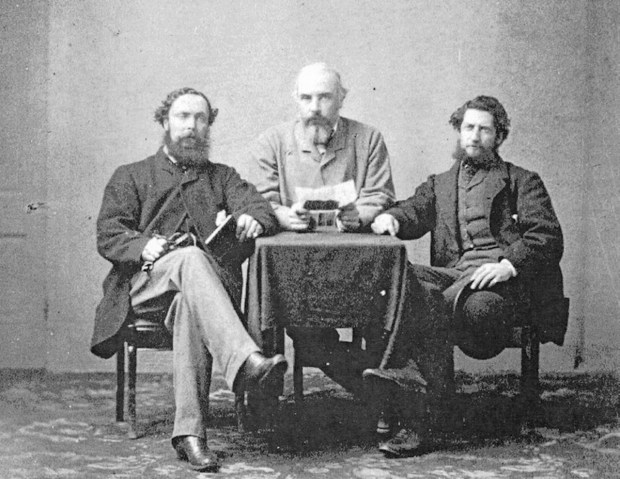
Peter O’Reilly (left), fellow county court judge Henry Ball (right) and Chief Justice Matthew Baillie Begbie. (Image: A-01102, Royal B.C Museum and Archives.)
HOW ABOUT IF we share with our families and friends our own B.C. heroes? Do you remember who influenced you and your family? Who are the public individuals you’ve admired over your years? Let’s talk about those people and share their stories.
And … how about celebrating by doing that instead of berating or swearing at some public person who doesn’t “measure up”?

Lynne Stonier-Newman.
British Columbia is our home and we benefit by recognizing it is worth celebrating. On a total land base of 95 million hectares (235 million acres) we have islands, varied lands and coastlines, a feast of mountains, rivers, lakes, forests, plains and with a wealth of animals, birds, fish and sea life plus a richness of resources, minerals and agriculture.
As of 2025, we have over 5,700,000 people and our diverse histories, talents and skills have, and will continue to, shape and reshape how we manage our magnificent and powerful province.
Knowing and sharing our history with each other matters, as does remembering who and what shaped our own roots. Who do you respect today and in your earlier decades? Who are the historical and current public individuals you admire for who he or she is … or was?
Do we celebrate our heroes enough? Perhaps within the sports culture and industry we do … But do we recognize and celebrate individuals within the broad arts, business, communications, education, industrial and agricultural fields for what they add to our province?
As each era has had, currently, we British Columbians have many bumps to overcome. Certainly I agree ours are big bumps … archaic public systems not functioning and some poorly planned current ones! Some inefficient governance sucking up our era’s increasing taxes! Too few services for too many people! An aging population and not enough workers to replace them … the list is long.
Someone has to do something soon!
Do you know we’ve been singing that song since 1871? And if you don’t, why don’t you know?
Because our history is our joint identity, it matters. Knowing about the resilient people who also had to change frustrations into action is what has shaped us, created our roots. We do come from a diversity of people who used their talents, determination and strengths.
Talking about those earlier challenges and how we resolved them helps us to remember how strong we are, and how resolving the bumps is core to evolving our systems to efficiently serve our joint wants and needs.
We have come a long way in our first 154 years …
To celebrate B.C. Day, I’m sharing some of a colonial pioneer’s history:
PETER O’REILLY: The Colonials who decreed and imposed British Columbia’s Indian Reserve Lands
by Lynne Stonier-Newman:
Creative Non-fiction: 2010 TouchWood Editions
EXCERPT FROM CHAPTER FOURTEEN: Confederated … Or Seceding?
… when O’Reilly returned from his journey to the distance Osilinka River on August 15, 1871, he discovered to his pleasure that John Trutch had just arrived from Manson Landing.
“The Giscome Portage is now open,” his brother-in-law announced. Their big freight canoe had been loaded with tons of merchandise plus six paddlers, one trader and himself, yet it had taken them just four days to make the trip. They had come up the portage to Salmon River, Summit Lake, Crooked River, McLeod Lake, Parsnip Reach and, finally, down Manson Creek to the landing.
Trutch told O’Reilly that he had recently received a letter from Carry and all was well at Point Ellice House and with his own dear Zoe. He then passed over a satchel of letters, along with an apple pie and a bottle of wine which he had exchanged for two gold nuggets in Fort George.
“To celebrate Joe and Confederation. Did you know it was delayed for three weeks? Quesnel residents are afraid that is a sign that Canada won’t treat British Columbians justly.” …
They raised their tin mugs and laughed aloud when they considered each other’s scraggly beard and worn-out clothes. Neither appeared a suitable relative for BC’s first lieutenant-governor, they agreed, before repeatedly toasting the Honourable Joseph Trutch, official representative of the British Crown.
O’Reilly later lit a precious candle in his tent and arranged Carry’s three letters by date, then read them. He missed her in so many ways. She told him how, since Joe and Julia had become BC’s senior dignitaries, she was dining out often. Everyone she ’d visited with had been annoyed when Confederation was delayed from July 1 until July 20, 1871. However, once Queen Victoria had belatedly signed the imperial Order-in-Council, the celebrations were enthusiastic:
Joe arranged for considerable funding and much is happening . . . picnics, races and dances. The Royal Navy will fire a 21-gun salute, which the children are most excited about as the roman candles will be exploded in The Gorge …
In her next letter, she reported that Kitty, Pop and Frank and their new nanny had watched the festivities on the Gorge while she had attended the grand party at Cary Castle. Hosted by Governor and Mrs. Musgrave to both say goodbye and celebrate Joe’s appointment, it had been an elegant evening.
Carry had been seated beside BC’s interim premier, John McCreight, a very quiet man, but as Matthew Begbie had been on her other side, she had enjoyed the dinner. She had danced often and received many compliments on her dress, which she’d had hand-sewn and studded with pearls. It was made from some soft peach silk she had brought from India all those years ago. O’Reilly chuckled when he read, “Yes, my dear, it was costly—but well worth it.”
She reported there had also been a few noisy demonstrators near the governor’s mansion; they still questioned the sanity of joining a country four thousand miles away. This time, each sign had had either “Equity?” or “Justice” scrawled on it. They had been gone by the time she and the other guests departed, to her relief.
O’Reilly had a restless sleep after reading Carry’s letters and rose at four a.m. to find that John was already up, throwing evergreen boughs on the fire to make smoke. “Peter, these bugs are the worst I’ve ever endured. And their noise! Awful.”
O’Reilly said unsympathetically that he usually had to start his days before the insects began their dawn feasting, and he passed John the clipping Carry had sent him from the Colonist: (July 20, 1871)
Today is the last in the life of British Columbia as a distinct colony of the British Crown. Tomorrow by the Grace of God and Royal proclamation, this colony becomes a Province of the Confederation in the Confederated Empire of British North America. It is about to lay off the chrysalis shell of the Crown colonial existence and don the garb of a full-fledged self- governing people.
In the following weeks, O’Reilly continued to wonder whether he could ever identify himself as a Canadian; saying he was a British Columbian rather than an Irishman had taken him years. On the other hand, now that BC was part of Canada and would supposedly be connected to the eastern provinces by rail, he hoped its ongoing financial problems would lessen.
Each time he thought of the costs and physical challenges involved with laying the track, he mulled its feasibility and decided that when, and if, it was built, he and Carry would take the family across.
On October 15, 1871, he closed mining in the Omineca district and left for Port Simpson in an Indian canoe while Fitzgerald took their horses back to Quesnel. To his frustration and disappointment, O’Reilly had to return to the coast and meet the HMS Zealous; there had been a possible murder reported in the Nass area and he was considered to be the nearest official …
……..
Being raised a British Columbian does mean we’ve deep and complex roots. And many of us go wandering afar, then come home and tell each other: “Fun to visit but there’s nowhere quite as special as BC.”
Have a fine BC Day, my fellow British Columbians!
Lynne Stonier-Newman is a resident of Kamloops. She’s a social marketing and communication consultant, and a B.C. historian and author.

 ArmchairMayor.ca
Lynne Stonier-Newman asks us to reflect on the public individuals who have shaped British Columbia and share their stories. But whose stories should we tell, Lynne? Should we focus solely on the celebrated figures, or also on the unsung, the overlooked, or even the controversial? History, after all, is not just a collection of triumphs but a complex tapestry of good, bad, and sometimes uncomfortable truths.
I believe history is shaped not by the “Great Man” theory, which elevates prominent figures like Peter O’Reilly or Joseph Trutch, but by the “common man” theory, the collective struggles, resilience, and contributions of ordinary British Columbians. While Stonier-Newman highlights colonial pioneers, I argue that the true heartbeat of B.C.’s history lies in the everyday people who toiled to build families, communities, and a province amidst challenges like those she describes: inefficient systems, economic hardships, and societal shifts.
Today, we face new challenges, rising costs, strained public services, and social divisions. Yet, as Stonier-Newman notes, British Columbians have been “singing that song” of overcoming obstacles since 1871. What’s missing, however, is a critical approach to our history. Education should teach us to question narratives, not accept them blindly. As Noam Chomsky said, “It’s not important what we cover in the class; it’s important what you discover.”
When I taught history, I began with John Lennon’s “Imagine” and Boney M’s “Rasputin” to spark discussion about history’s multidimensional nature. True education fosters critical inquiry, encouraging us to ask: Whose stories are told? Whose are erased? And why?
The danger lies in complacency. Too often, we conform to narratives that gloss over difficult truths, whether it’s the impact of colonial policies like those O’Reilly enforced or modern issues like homelessness and urban density debates.
History has meaning when we celebrate the perseverance of ordinary people: the farmers, workers, and families who shaped B.C. through sacrifice, not just the public figures whose decisions sometimes sowed division. On this B.C. Day, let’s honor the common men and women whose resilience defines our province, and commit to questioning the past so we can build a better future.
LikeLike