
EDITORIAL – Too many names on the ballot is bad for democracy
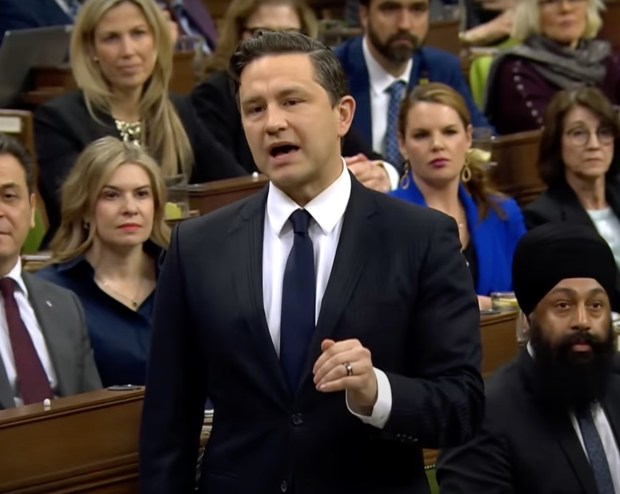
Pierre Poilievre in Parliament.
An editorial by Mel Rothenburger.
IT’S USUALLY a good thing when a lot of candidates run in an election. But not always.
At my count, almost 200 wanna-be politicians have filed their nomination papers for the August byelection in the Alberta riding of Battle River-Crowfoot. That’s the one Pierre Poilievre is parachuting into in an effort to regain a seat in Parliament after he lost his regular riding in the general election.
Poilievre is a shoe-in in the Battle River-Crowfoot, which is overwhelmingly Conservative, but he has a bone to pick with the fact he’s facing so many opponents. It’s an organized attempt to fool with the democratic process, he says, and wants future legislation to prevent it.
“It’s a deliberate attempt to manipulate the rules, confuse voters and undermine confidence in our elections,” he states.
He’s right that the huge number of candidates is a result of an organized plan. Most of them are registered as independents but they’re part of an attempt by a group known as the Longest Ballot Committee to push for electoral reform.
But whether or not voters want electoral reform, they aren’t likely to have that in mind as they wade through a ballot that’s several feet long. If anything, they’ll be very annoyed at whoever caused it.
One can understand the concerns of supporters of so-called “electoral reform,” a term commonly used to describe proportional representation or some form of it. Most Canadians simply don’t want it.
In fact, a public opinion poll this week showed that some two-thirds of British Columbians are perfectly happy with the first-past-the-post system. Indeed, they’ve twice defeated proposals to switch to proportional representation.
Poilievre would probably be smart to ignore the clutter on the ballot in Battle River-Crowfoot, though he’s probably still smarting over having lost the Carleton riding in the general election in which close to a hundred names were on the ballot.
But he does have a point. Swamping voters with an impossible number of candidates to sort through won’t change the byelection outcome, and it certainly won’t help the cause of “electoral reform.”
Mel Rothenburger is a former regular contributor to CFJC-TV and CBC radio, publishes the ArmchairMayor.ca opinion website, and is a recipient of the Jack Webster Foundation Lifetime Achievement Award, and a Webster Foundation Commentator of the Year finalist. He has served as mayor of Kamloops, school board chair and TNRD director, and is a retired daily newspaper editor. He can be reached at mrothenburger@armchairmayor.ca.

 ArmchairMayor.ca
Isn’t it stupid to split the numbers of those who want to vote
against little trump jr?
LikeLike
There are home addresses of candidates that are not even in Canada, this is a complete scam. Absolute joke!!
LikeLike
The individual who lost in a riding, and then picked a different riding that has a high likelihood of winning, in order to have a second chance, is upset that other individuals are abusing the process?
LikeLike
That is how it works bud, just like when Carney parachuted in to a safe seat in Ottawa.. Didn’t see him trying to win in his supposed hometown of Edmonton.. Cause he would have lost.
LikeLike
His house in Ottawa is a 20 minute drive from his constituency office, it was the nearest open riding to his home in Ottawa’s Rockcliffe Park neighbourhood where he’s lived since 2003 (aside from the time he spent in the UK as the head of the Bank of England). He moved from Edmonton 40 yrs ago so I don’t think you can really say he “parachuted into a safe seat”. I’m not sure but didn’t all Ottawa go to the liberals, maybe we should ask PP to confirm.
LikeLike
It’s a feature of our electoral system. The leader of the party with the most seats elected gets to be PM, but that’s no guarantee the leader of the party wins their own riding.
This happened here in BC quite recently (yet everyone seems to forget/doesn’t pay attention). In 2013 the then-Premier Christy Clark led the BC Liberals to victory, but in the process lost her own seat. So she ran in a by-election in a safe seat.
LikeLike