
CHARBONNEAU – The King’s English in America
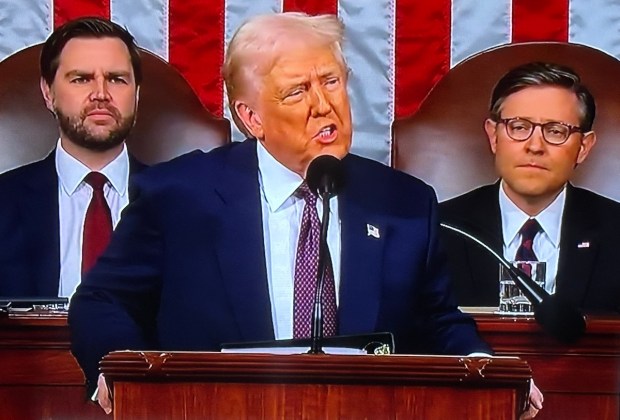
DONALD TRUMP, the self-appointed King of America, affects the way English is spoken and is responsible for the growth of misogyny.
 In his own mind, he is supreme. “I run the country and the world,” he told reporter Michael Scherer from The Atlantic.
Despite his limited vocabulary, King Trump admires well spoken English.
At a meeting at the White House, the king responded to brief remarks from the president of his Liberia and marvelled at his “beautiful” English, asking him where he learned it.
His comment resulted in much eye-rolling. English is the official language of Liberia; a country founded in 1822 as a colony for free Black Americans.
Monarchs have shaped the way language is spoken. Queen Elizabeth I spoke a version of English called “Received Pronunciation,” which became the accent of the British elite.
The accent spread to former colonies. When I visited New Zealand, I found that Received Pronunciation was thriving.
I was surprised to hear a young New Zealand woman speak with the accent of British royals. A few of my mates, who spoke with a standard New Zealand accent, thought that it was pretentious. Apparently she had learned the accent at a boarding school.
The American King’s English is simple, blunt, and repetitive.
He doubles the use of words for emphasis, such as the word very, such as: “very, very strong,” “very, very sad.”
He likes “huge” (pronounced “YUGE”).
His use of “beautiful” is being repeated by his inner circle. His former campaign manager, Kellyanne Conway, introduced the king’s inaugural address: “You’re going to hear a beautiful, elegant speech.”
Well, perhaps not elegant.
President Obama’s language was elegant. His rhetoric soared:“We are the change that we seek. The road ahead will be long. Our climb will be steep.” In contrast to the king’s, Obama’s language was designed for persuasion, leaning on shared values and national ideals.
The rules of English have not changed much under the king, but he has reshaped how language is used to encourage misogyny.
“Grab ’em by the pussy,” he was heard saying in an Access Hollywood tape.
“She had blood coming out of her wherever,” said the king, referring to journalist Megyn Kelly.
The effect of the King’s English is to normalize sexism; where a woman’s value is tied to her appearance, her submissiveness, or willingness to flatter powerful men.
The king has fans in the manosphere: that an online subculture of blogs, forums, and influencers focused on masculinity, dominance, and anti-feminism. They have embraced Trump as a symbol of “alpha male” behaviour. These insecure males see him as unapologetic about dominance and sexual aggression.
The king’s filth has spread to the would-be 51st state of Canada.
Christine Emberley, a Halifax teacher, says male students are saying things she has never heard in decades of teaching. The comments range from sarcastic sniping about a woman’s place in society to “grotesquely sexual” remarks.
They say things like: “Shut up and make me a sandwich.” “I don’t have to listen to you, go get the man in charge.”
“It’s frightening,” says Emberley.
The King’s English is pervasive and sinister. It contaminates civil discourse and appeals to the lowest common denominator.
David Charbonneau is a retired TRU electronics instructor who hosts a blog at http://www.eyeviewkamloops.wordpress.com.

 ArmchairMayor.ca
Is Mr. Charbonneau aware that his country, Canada, actually has a King?
The United States of America’s Constitution doesn’t allow for a King. Every political actions undertaken in that country is taking place within the legal and constitutional framework of that country.
So it’s a bit rich to lob accusations that are fundamentally inaccurate and impossible to achieve in that country, from a country that laps up monarchist sentiment at every opportunity.
Long live the King, and bend the knee, eh?
LikeLike