
CHARBONNEAU – After the peace dividend, the defence dividend
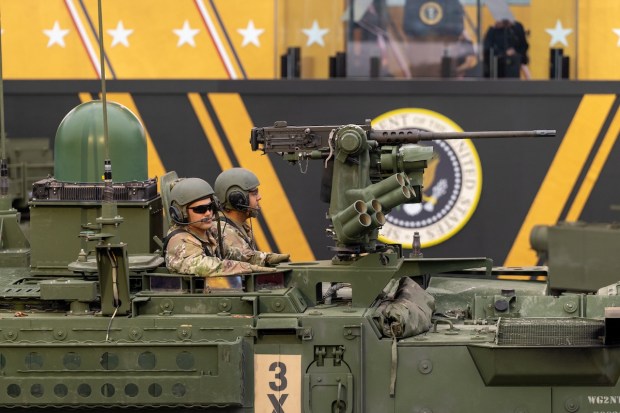
Weapons of war roll past President Donald Trump at 250th anniversary of the U.S. army. (Image: White House photo by Emily J. Higgins)
CANADA HAS LONG benefited from the peace dividend but those times are over.
With the Orange Man threatening NATO countries which don’t arm themselves to the extent that America does; with the nations of the world preparing for war; we need prepare for an era of defence spending.
 The peace dividend was a seductive idea. Remarkably, the idea came from right-wingers Prime Minister Margaret Thatcher and U.S. president George H. W. Bush.
After the Berlin Wall had crumbled and the Soviet Union had disintegrated, many wondered what the point was of spending billions on war machines.
After all, NATO had triumphed after 40 years of Cold War.
The idea of the peace dividend was simple. With peace upon the land, defence budgets could be slashed; swords could be beat into ploughshares and resources spent on social programs and tax cuts.
If only it were that simple.
America was never ready for peace. Their industry is based on preparing for war.
President Dwight D. Eisenhower understood this when he warned of the “military-industrial complex.” He said that the close relationship between the government, the military, and the defence industry could pose a threat to democracy and national objectives.
Eisenhower understood the significant economic and political power wielded by defence contractors and the military establishment. He worried that this power could lead to excessive military spending, influence over government policy and a perpetuation of conflict.
So it came to pass.
Since World War II, there have been no years when the United States was not involved in some form of military operation — whether it be major wars, limited interventions, covert actions, drone strikes, or peacekeeping deployments.
Canada, however, embraced the peace dividend.
No country lived the peace dividend dream longer than Canada. In 1990 Canada’s defence spending was 2 per cent of gross domestic product. Within a decade it was cut in half by both Progressive Conservative and Liberal governments.
The peace dividend helped Canada eliminate the chronic federal budget deficit. It helped finance the largest personal and corporate tax cuts in Canadian history and an expansion of Canada’s social safety net.
With the reckless man in the White House threatening to let Russia to invade any NATO County that doesn’t meet his spending demands, the party’s over.
Not to worry.
Prime Minister Carney has laid out a new vision for Canada’s national defence that will yield its own benefits.
British Prime Minister Keir Starmer calls the spending a “defence dividend.” He says it will “create jobs, wealth and opportunity in every corner of our country.”
The magnitude of Canada’s defence spending will be transformative.
It amounts to a $9-billion-a-year increase to national defence. It is one half the value of the Canada Social Transfer to the provinces to support education and social assistance. It is more than the federal government spends on research and development and equal to one percentage point of the GST.
As we found out from the spending during World War II, spending on the materiel of war can stimulate industrial production, create full employment, diversify the economy, and forge ties with other allies.
The problem, of course, is what to do with all those weapons of war.
David Charbonneau is a retired TRU electronics instructor who hosts a blog at http://www.eyeviewkamloops.wordpress.com.

 ArmchairMayor.ca
The article makes a case for increased Canadian defense spending by tying it to economic benefits, but it has significant flaws. It contextualizes the peace dividend’s end and leverages Trump’s influence as a catalyst, making the argument timely and grounded in realpolitik.
However, it lacks evidence for the Russian threat, ignores historical lessons of wasteful defense projects, and doesn’t address Canada’s role in global instability. Charbonneau’s shift in tone on Trump feels opportunistic.
Maybe Charbonneau needs to revisit the failed Maginot Line, Canada’s radar systems (billions on the DEW, Mid-Canada and Pine tree Lines) , and Western culpability which does not critically assess militarization and spending tie to the military industrial compels. In Canada alone the Military sector is the largest spender in terms of budgets, The article assumes a need for spending without proving examples of that need. Such policies are misguided or driven by external agendas.
Without evidence of specific threats, a plan for spending allocation, and acknowledgment of historical missteps in defense investments, the article is speculative. The Russian threat and our responsibility for instability presents a gap in the article’s logic, suggesting Canada should prioritize strategic, evidence-based defense policies over reactive spending. We can only justify the wasted expenditure if Charbonneau assumes that USA and Russia have a collective wish to commit suicide and take all of us with them.
LikeLike