
RESIDENTIAL SCHOOLS – Why does CBC refuse to admit it got Kamloops wrong?
(Image: Mel Rothenburger)
By MARCO NAVARRO-GENIE
Frontier Centre for Public Policy
RECENT COMPLAINTS to the CBC Ombudsman about Rosemary Barton’s misleading April 16 statement, and renewed scrutiny of the CBC’s 2021 reporting on the Kamloops residential school, demand careful public attention. At stake is the credibility of Canada’s public broadcaster and the integrity of our national discourse on a subject as painful as residential schools.
Marco Navarro-Genie.
During a live panel discussion following the French-language federal leaders’ debate on April 16, Barton claimed, “Yes, there have been remains of Indigenous children found in various places across the country.” Her statement, made in response to a question about anti-Christian sentiment linked to the residential school narrative, has since been widely criticized as inaccurate and emblematic of the CBC’s failure to properly verify critical information.
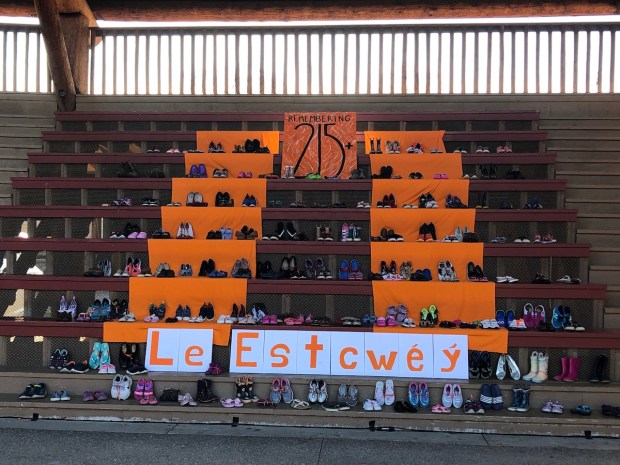
In May 2021, reports of the discovery of 215 children’s remains at the Kamloops Residential School site triggered national mourning and drew international headlines. Flags were ordered to half-mast for months, the Trudeau government established a new statutory holiday for truth and reconciliation, and Parliament passed the United Nations Declaration on the Rights of Indigenous Peoples (UNDRIP) in June 2021, despite prior opposition from six provinces. The passage of UNDRIP alone may reshape Canada in ways not yet fully understood.
The Kamloops story quickly became a defining moment in Canada’s reckoning with the legacy of residential schools, transforming public life almost overnight.
The Frontier Centre for Public Policy has long advocated for rigorous standards in public communication and the media’s duty to ensure that truth prevails over sensationalism. The CBC’s role in amplifying the unverified Kamloops claim—and its ongoing failure to properly correct the record—raises serious concerns about journalistic integrity and the unchecked spread of misinformation, particularly when it shapes national memory, reconciliation efforts and policymaking.
On May 27, 2021, the Tk’emlúps te Secwépemc First Nation issued a press release claiming the “confirmation of the remains of 215 children” at the former Kamloops Residential School site, based on ground-penetrating radar. The CBC, like many outlets, reported this claim as fact. Its headline that day read: “Remains of 215 children found buried at former B.C. residential school, First Nation says.” Yet no physical remains have been recovered, and the original claim has since been widely questioned.
In the face of mounting public concern, the CBC’s recent “correction” regarding Barton’s statement attempts to sidestep accountability. Rather than acknowledging its pivotal role in creating the narrative, the broadcaster now claims it consistently referred to “potential burial sites” or “unmarked graves”—a claim demonstrably false, as archived headlines and reports show. This failure to directly confront its reporting errors amounts to institutional gaslighting, further eroding public trust.
Compounding these concerns is emerging evidence that suggests the CBC may have had advance notice of the Kamloops announcement. According to The Knowing by Tanya Talaga, “select journalists” were given embargoed details to ensure “sensitive and impactful” coverage. CBC journalist Angela Sterritt admitted she was in contact with the Tk’emlúps te Secwépemc the day before the announcement and was one of only a few journalists granted access to the June 4, 2021, video conference, where live-streaming was prohibited. This raises serious questions about whether the CBC acted as a passive reporter or an active participant in promoting an unverified claim.
These facts warrant immediate investigation. Canadians deserve to know whether their publicly funded broadcaster was complicit in promoting a narrative it failed to scrutinize, and whether this reflects a broader failure of editorial oversight. The implications extend beyond journalism; they affect national policymaking, reconciliation efforts and the public’s trust in institutions during times of crisis.
This controversy also vindicates the few institutions, including the Frontier Centre for Public Policy, that called for caution and demanded evidence when the Kamloops claim first surfaced. For this, we were often maligned, including by Winnipeg MP Leah Gazan in the House of Commons. Yet the emerging facts confirm that skepticism rooted in evidence is not denialism; it is a democratic imperative.
As Canada continues to wrestle with the legacy of its residential school system, we must do so with compassion, evidence and a commitment to truth. Upholding rigorous journalistic standards is not merely a professional obligation; it is essential to preserving public trust and democratic accountability.
The CBC must fully correct its earlier reporting, disclose whether it had prior knowledge of the 2021 Kamloops media release, and recommit itself to journalism’s foundational duty: to tell the truth, even when it is uncomfortable.
Marco Navarro-Genie is the vice president of research at the Frontier Centre for Public Policy. He is coauthor, with Barry Cooper, of Canada’s COVID: The Story of a Pandemic Moral Panic (2023). With files from Nina Green.

 ArmchairMayor.ca
Many other journalists participated in this – James Peters from CFJC-TV. He commented to me on X that because the Chief said it, it was good enough for him to believe it was true. Our media is putting their thumb on the journalism scale and participating in the national gaslighting. I have no idea why the belief that doing so leads to better understanding among their consumers.
The story of residential schools is both sad and enlightening. The sad needs to be treated with kindness and grace for those who endured it and those who were directly affected by it. The enlightening needs to be told as well – read Len Marchand’s book.
There will never be reconciliation without the full truth.
LikeLike
As if the locals here didn’t know what kind of things happened at the residential school. The crippling effects have been obvious.
Some years ago I became friends with an indigenous fellow who attended the residential school. Just a couple of years ago, we were having a coffee together and he trusted our friendship enough that he spoke of some of the things he experienced. Everybody knew. Kids were mistreated. Some went missing and never came back. He had been beaten for being a trouble maker. My God, he was just a kid.
Denial, bias and unbalanced journalism is our enemy. Truth can only be veiled for so long.
I sent an email to a local “journalist” who seems to like bashing a local politician. I suggested she try “balanced journalism” for a change. The response was almost immediate. Maybe she should try writing some personal attacks against the politician’s wife but I don’t think she has the courage to do so.
Has the CBC shown a bias and a hiding of the truth about our local Residential School? Shame on them if that is the case.
LikeLike
The CBC is no longer representing the interests and aspirations of at least half of Canadians. I so want it defunded that almost shaped my vote in the last federal election. There is an agenda behind its reporting which is seriously skewing the narratives. Please make the CBC go away!
LikeLike
CBC falls down regarding the pesticide issue too.
CBC Kamloops refused to air stories about the City of Kamloops’ pesticide use in public areas, even though the evidence given came from City and provincial records.
CBC did not report on the federal ruling of Health Canada’s blatant negligence to assess 61 new scientific studies and the CBC did not report on Health Canada’s corruption of Christy Morrissey’s research on neonic insecticides. Nor has the CBC properly reported on 12-year glyphosate contamination of our forests nor have they reported on how Health Canada authorizes spraying to 1 meter of lakes and rivers with helicopters.
LikeLike
There are lots of why’s on this topic. The Catholic Church’s role is undeniable, with apologies issued (e.g., Pope Francis in Canada, 2022; Irish bishops in 2021). However, withheld records and limited cooperation hinder full accountability. Canada’s GPR findings are compelling but unverified without exhumation.
The National Centre for Truth and Reconciliation (NCTR) in Canada has been seeking records to document the full scope of these abuses and deaths, with estimates of at least 4,118 children having died at these schools. Experts like Ry Moran, a Métis archivist, argue there is a “very high likelihood” that the Vatican holds records, given the Church’s historical practice of maintaining detailed accounts under canon law, often sending duplicates to Rome.
Ireland’s Tuam case is confirmed, but other sites need further investigation. UK and global evidence are patchy, relying on survivor accounts and limited records. Denialism like this, particularly in Canada, exploits gaps in physical evidence to downplay abuses, but survivor testimonies and TRC findings counter this.
These institutions were products of colonial and religious ideologies aiming to “civilize” or control marginalized groups. High mortality stemmed from systemic neglect, disease, and abuse, not necessarily intentional mass killings.
Evidence supports the existence of unmarked graves at Catholic-run institutions in Canada (e.g., Kamloops, Marieval, St. Bernard), Ireland (e.g., Tuam, Bessborough), and to a lesser extent the UK (e.g., Smyllum Park). Canada’s residential schools saw thousands of Indigenous child deaths, with GPR identifying hundreds of potential graves, though exhumations are pending.
Ireland’s Mother and Baby Homes confirmed infant remains in Tuam and suggest similar patterns elsewhere. UK evidence is limited but points to unmarked burials in orphanages. Globally, similar patterns exist in Australia and the U.S., but investigations are less advanced.
The Catholic Church’s role in neglect and abuse is well-documented, but the exact scale of graves requires further forensic work. Survivor testimonies, TRC findings, and limited excavations provide strong evidence, despite gaps exploited by denialists. Rosemary Barton like most CBC comentators are just readers. For deeper insight, review the TRC’s 2015 report (Canada) and Ireland’s 2021 Mother and Baby Homes report, available through government archives.
The Vatican’s refusal to release documents, despite repeated calls from Indigenous communities and Canadian officials, suggests a reluctance to fully engage with the truth-seeking process. Media is famous for reporting by omission.
While the Church has acknowledged abuses and issued apologies, the framing of these as individual failings rather than institutional policy can be seen as an attempt to soften the narrative of its role in a system that many, including the United Nations, have called genocidal.
LikeLike