
BRIDGING THE GAP – Ensuring equal opportunities for all Kamloops students

(Image: Pixabay)
By PETER TSIGARIS
Thompson Rivers University
Prelude: This editorial is a continuation of the book series I co-authored with my senior undergraduate students, titled In the Shadow of the Hills: Socioeconomic Struggles in Kamloops, published by TRU Open Press. This editorial focusses on the disparities in elementary education across the city, conducted by Alaa Awad and featured in Chapter 2: Bridging the Gap: Ensuring Equal Opportunities for All Students in Kamloops. Below, I summarize her research and key findings. For full details, visit the chapter at https://shadowofthehills.pressbooks.tru.ca/chapter/ensuring-equal-opportunities-for-all-students-in-kamloops/
Addressing Educational Disparities in Kamloops
Education is the most powerful driver of personal growth and economic development. The benefits of education are not only beneficial to the student but to society at large. Also, the societal returns from education are the greatest at the beginning of a child’s schooling.

Alaa Awad.
Yet, disparities in access to high-quality elementary education seems to persist in Kamloops, shaped by factors such as school type, resource availability, and strangely socioeconomic status of location. This commentary highlights the research undertaken by Alaa Awad, a student at Thompson Rivers University, who examined how neighbourhood demographics and school choice impact educational equity in Kamloops. As Alaa stated in the introduction:
“This investigation is driven by a critical question: Does the type and location of a school within different neighbourhoods influence the educational opportunities available to its students? Given Canada’s commitment to equitable access to quality education, this inquiry is not only relevant but essential.”
Using data from the Fraser Institute, the 2021 Census from Statistics Canada, and survey responses from over 260 Kamloops parents, she identified key factors contributing to the educational divide.
The Impact of Socioeconomic Status on Educational Outcomes
Alaa’s research found that schools in higher-income neighborhoods consistently achieved better performance scores. Schools in wealthier areas had higher literacy and numeracy scores, correlating with higher parental education levels and engagement. Schools in lower-income areas, meanwhile, faced more significant challenges, including lower parental involvement, higher rates of English Language Learners (ELL), and fewer extracurricular opportunities.
The presence of independent schools, which often serve diverse student populations, mitigated some of these disparities but remained out of reach for many families due to cost barriers. Public schools of choice—such as Montessori, French immersion, and arts-focused institutions—often performed better but were not evenly distributed across Kamloops, limiting access for students in lower-income areas.
Using the Fraser Institute’s 2022 school ranking, which evaluates standardized test scores in numeracy and literacy, independent (private) schools ranked the highest, followed by schools of choice (e.g., French immersion, Montessori, and arts-focused schools). Traditional public schools ranked last, on average, with some schools in high income neighbourhoods performing just as well as schools of choice or independent schools.
However, such ranking has limitations, as it narrowly focuses on test scores and does not account for socioeconomic conditions or broader measures of educational quality, such as school resources and extracurricular opportunities.
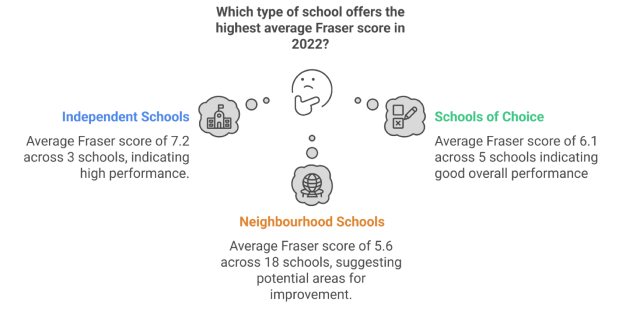
Figure 1: Average Fraser score across type of schools, Image created by Napkin AI
Parental Involvement and Community Engagement
Parental engagement emerged as a critical factor in shaping student success. According to the survey, each parent dedicated on average of 4.7 hours per week to assisting with homework, and 7.4 hours per month to volunteering at schools. Each parent’s effort in homework assistance is estimated to have an economic value of approximately $273 per week (i.e., ~$9,828 per school year) while volunteering at school events translates to an economic value of about $429 per month (i.e., ~$4,290 per school year). Such efforts significantly supplemented school resources, highlighting the importance of fostering strong school-community relationships.
In an interview with Principal Karen Currie of Kamloops Christian School, the highest-performing school in the study, she emphasized that parental involvement is central to their success:
“Our parents are highly engaged, from volunteering in classrooms to serving on the school board. This creates a strong sense of community and accountability.”
However, parental involvement varied across neighborhoods, with lower-income areas reporting fewer opportunities for engagement, further exacerbating educational inequalities.
Alaa’s research also revealed a moderate negative correlation between the percentage of English Language Learners (ELL) in schools and their performance scores. Language barriers hindered academic success, and 25% of surveyed parents expressed concerns about inadequate ELL resources. Similarly, 63% of respondents cited a lack of sufficient support for students with special needs.
Extracurricular activities contribute significantly to students’ social and cognitive development, yet 44% of surveyed parents reported concerns about the lack of such activities. While independent and schools of choice offered a variety of enrichment programs, traditional public schools often struggled to provide similar opportunities. Expanding extracurricular programs, particularly in lower-income neighbourhoods, could help bridge the educational gap.

Figure 2: Parental satisfaction with Child’s education, Image created by Julius AI
Recommendations for Educational Equity in Kamloops
To promote equal educational opportunities for all students, Alaa’s study outlines several key recommendations:
- Address Socioeconomic Disparities: Schools in lower-income neighbourhoods should receive targeted support to mitigate funding and resource gaps.
- Use of AI technology: The potential of AI technology in personal learning is enormous and can only get better with time. It can reduce the disparity not only within schools but also between schools.
- Expand Access to Extracurricular Programs: Public funding should support school extracurricular activities to provide all students with enrichment opportunities.
- Increase Parental Engagement: Schools should actively encourage parental participation through workshops, advisory councils, and volunteer opportunities.
- Enhance Support for ELL and Special Needs Students: Additional funding and resources should be allocated to ensure equitable educational experiences.
Conclusion
Education has positive benefits not only to the students but to our community. Alaa’s research highlights the need for systemic reforms to ensure that every child in Kamloops, regardless of their socioeconomic background, has access to high-quality education.
By investing in parental engagement, resources including AI technology, and extracurricular opportunities, the community can take meaningful steps toward closing the educational divide. The findings call on policymakers, educators, and community leaders to take action, reinforcing the belief that all students deserve an equal chance to succeed.
References available in Chapter 2: Bridging the Gap: Ensuring Equal Opportunities for All Students in Kamloops by Alaa
Tsigaris, P., Awad, A., Forbes, C., Izett, P., Kadaleevanam, U., Mehta, G., Noor, S., Simms, O., & Thomson A. (2024), In the Shadow of the Hills: Socioeconomic Struggles in Kamloops, TRU Open Press, https://shadowofthehills.pressbooks.tru.ca/

 ArmchairMayor.ca
As a parent deeply invested in my child’s education, I found Alaa Awad’s chapter both eye-opening and reassuring. It highlights the real challenges families face in Kamloops, from the impact of socioeconomic status to the differences in school programs. I appreciated how the author didn’t just point out the problems but backed them up with solid research, making it clear that where a child lives can shape their educational opportunities.
What stood out most to me was the emphasis on parental involvement. It’s a reminder that our role in our children’s education isn’t just about homework, it’s about being engaged in the school community and advocating for equal opportunities for all students. The suggested solutions, like transforming schools into community hubs and improving access to resources, feel practical and necessary.
This chapter reinforced my belief that every child, regardless of background, deserves a high-quality education. It’s a must-read for parents who want to understand the bigger picture and be part of the solution.
LikeLike
I appreciate the perspective that genetic differences contribute to variations in academic performance. While natural abilities vary, systemic barriers-such as access to quality schooling, nutrition, stable housing, and educational resources-impact students’ ability to reach their full potential. Equity in education does not seek to guarantee identical outcomes but rather to ensure that all students have the necessary support to succeed based on their individual needs. Additionally, investing in education has long-term economic and social benefits, making it an important and sustainable policy choice rather than an unattainable goal.
LikeLike
Great article! After working in a school with a high population of ELL and lower income families these numbers are not surprising. We try hard to help them all.
LikeLike
Excellent article, Alaa! I love how you broke down the statistics on the average time parents spend volunteering in schools and supporting with homework.
LikeLike
Pierre, how do you know that this goal is unattainable? In this case, attempting to do something is better than not trying to do something because you think it unattainable. At least this study shows that under-performance can be attributed to more than just socioeconomic status. Perhaps if more resources were directed to those under-performing schools and toward those students who are struggling, performance would begin to improve. I agree that all students have different abilities, but also believe that we need to provide more help to those struggling students. Teachers cannot do it by themselves.
I never had to go to school hungry, nor had to worry about whether my family would have a home when I got back from school. Children experience a lot of negative things in their lives, and those who live in the poorer areas of Kamloops often deal with these things that seem to be pretty important, in my mind. Those schools they attend work very hard to provide safe, structured, and caring places, while also trying to help students who often need help but can’t get it.
A while ago, I taught in the system for about 35 years, some of it in the schools that were considered under-performing. Despite all the hard work done by teachers, they get more and more piled onto their backs with less and less support.
I agree with you that change is not likely going to happen during the economic times in which we find ourselves. But please be aware that this is (and likely always has been) what many of these children and families deal with, some for all of their lives. That is not an excuse for the under-performance, but a reality many of these children having to deal with more “negative” issue than what those in higher performance (socioeconomic status?) school likely do.
I appreciate the study that was done, and the suggestions that were provided. However, without higher levels of government agreeing to provide more supports, I also think that the improvements that were suggested won’t happen. I do know that the School Board fights for funding every year, and that they get the blame (which flows down to the schools and is felt by teachers) when things don’t improve.
LikeLike
Good points Brian. As you know teachers question their ability, particularly if during the lesson the student does not respond as the teacher expected. These teachers immediately question their skills without taking into consideration that Johnny might have had a fight on the bus, Susie argued with her sister before she left for school, Billy’s father came home drunk, or Mary’s dog died last night. Students are not numbers, they are people with feelings and if we miss that its hard to understand how to connect with the student. . There are myriads of reasons why a specific lesson might not go over well for a student, and a good teacher will see the reason in the broader context of the classroom dynamics, and will adjust, review, add, and not jump into conclusion that it is the lesson.
LikeLike
Educational “equity” is a myth that should be immediately dismissed. Regardless of socioeconomic factors all pupils have different genetic traits some beign more “gifted” than others. With all governments running consistently high deficits it would be disingenuous clamouring for even more money to address an unattainable goal.
LikeLike