
CHARBONNEAU – The ugly American v2.0 is very different than the original
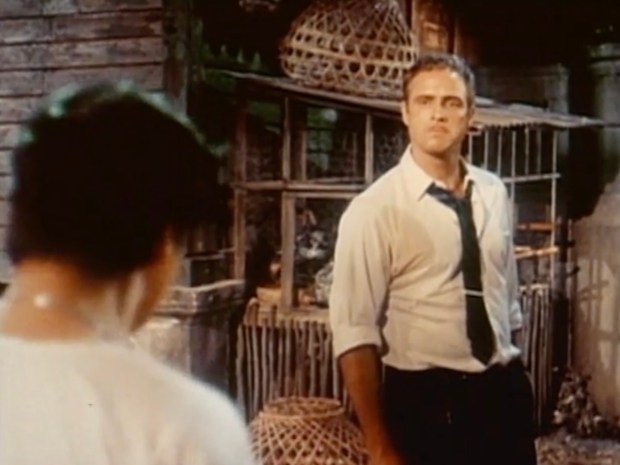
Marlon Brando in scene from The Ugly American, based on the book of the same name.
AS A RESULT of the first version of the ugly American, the U.S. president at the time took measures to improve the impression of Americans abroad.
The second version reverses the order of things: instead of global opinions shaping government policy, government policy and arrogance is turning global opinions against Americans.
 American political capital, built up from repercussions of the first ugly American incident, is being spent faster than government handouts during a pandemic.
I saw the resentment that all Americans suffered, as a result of the actions of a few, when I travelled abroad in 1966.
I cringed when I saw the ugly Americans — arrogant, loud, culturally insensitive, and ignorant of local customs. They complained that people in other countries didn’t speak English and they despised local food.
Good American friends I met were embarrassed at their loud, obnoxious countrymen and sewed Canadian flags onto their luggage.
Hiking around Europe, mild-mannered Canadians and Americans were indistinguishable.
Some Americans went to other lengths to avoid the ugly American label, such as avoiding bright clothing, baseball caps, sneakers, and Hawaiian shirts. To blend in, they wore muted, European-style clothing.
Ironically, the ugly American tag was the result of a 1958 political novel in which the protagonist was not obnoxious. He was a physically unattractive man who immersed himself in local culture and helped villagers – ugly in appearance but attractive in his manner.
U.S. President John F. Kennedy took several steps to counter the ugly American image by promoting cultural diplomacy, grassroots engagement, and a respectful approach to foreign relations.
Kennedy’s measures included the Peace Corps in which young, idealistic Americans went abroad for community service projects in education, health, and infrastructure.
In version 2.0 of the ugly American President Trump has taken the opposite approach in projecting America’s image; belligerent and confrontational to friends and warming up to former enemies.
Trump revels in making Americans seem arrogant and isolationist – perhaps as revenge for him being regarded internationally as a buffoon.
He dismisses allies, such as when calling the European Union a trade “foe.” The resulting insults make Americans targets of criticism in Europe.
Americans in Canada, Europe, and Asia have reported being insulted or shunned in social settings.
Some Americans feel pressured to clarify that they didn’t support Trump, to avoid hostility.
The hostility towards Americans living in Canada is truly regrettable. I know of Americans living here and they make significant contributions in the areas of social justice, charity, and business.
Trump’s lashing out is an indication of his insecurity.
He equates compromise with weakness and avoids admitting fault. He is obsessed with “winning.”
His fragile ego means that criticism, even minor, requires a disproportionate retaliation such as his personal attacks on allies such as Justin Trudeau or Germany’s Angela Merkel.
Trump’s father, Fred Trump, instilled in him a “killer instinct” — to never be a sucker. This explains his belief that NATO allies “owe” the U.S., that China and Mexico are “cheating,” and that America is always being “ripped off.”
Americans abroad are being unfairly tarred with a megalomaniac’s brush.
I urge Canadians to continue to welcome our American friends.
David Charbonneau is a retired TRU electronics instructor who hosts a blog at http://www.eyeviewkamloops.wordpress.com.

 ArmchairMayor.ca
We could do better than some two bit grandstanding by our Premier in putting tolls on US trucks going to and from Alaska. We should not get all huffy and name cally to our neighbours. I emailed Premier Eby to tell him to grow up. The tariffs have to either,make us buy Canadian, or they are the problem,not helpful. Export taxes are another issue…
LikeLike
There is a historical duality in the American Dream, a beacon of hope for the poor and disenfranchised, as it was for my grandfathers in the early 20th century, who saw the U.S. as a land of freedom and opportunity, contrasted against the modern “Ugly American” stereotype—arrogant, exploitative, or culturally insensitive. Despite this negative image, the enduring allure of prosperity and liberty continues to draw people, suggesting that the core promise of America still resonates, even as its flaws are more visible in a globalized world. This tension highlights how perceptions of America are shaped by both its ideals and its contradictions. The term “Ugly American” has been stretched over time to fit broader critiques of American behavior, from imperialism to cultural cluelessness and the attitude by many Americans that they are first among equals.
LikeLike