
ROTHENBURGER – Why Sugarcane didn’t win a Best Documentary Oscar
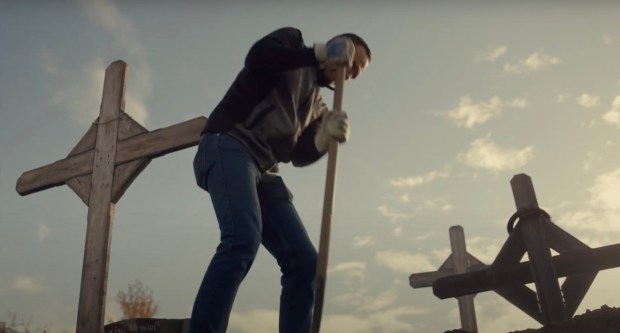
(Image: Screenshot, official trailer, Sugarcane)
KAMLOOPS HAD A PART in Sunday night’s (March 2, 2025) Academy Awards. A small one, but we were there in a film called Sugarcane that was nominated under the Best Documentary Feature category.
 It didn’t win, though it was an accomplishment to make it that far, and the nomination will undoubtedly draw even more attention (it’s received several other awards) to this small movie inspired by the “215 missing” at the Kamloops residential school.
Sugarcane is a local name for the Williams Lake Band Reserve. In the wake of the “215” discovery at Tk’emlúps in May 2021, Sugarcane undertook its own research, funded by the federal government, into possible unmarked graves. That resulted in an announcement in January 2022 that the first phase had found 93 “reflections” that could be unmarked graves in and nearby the graveyard at St. Joseph’s Indian Residential School.
Chief Willie Sellers accompanied the announcement with dramatic claims about torture, rape, suicides and babies being tossed into incinerators.
This was the impetus for the film Sugarcane. It’s beautifully filmed, with plenty of pensive scenes of graveyards, tall grass and old buildings, and pained conversations between those who are featured, including survivors of the school. It’s also amazingly disjointed — it jumps back and forth in time, between locations and storylines, hopping between road trips, a pizza party, a sweat lodge, looking through photo albums and other scenes that aren’t stitched together, making it difficult to grasp its message.
One thread shows former band chief Rick Gilbert and his visit to the Vatican for a First Nations delegation’s audience with Pope Francis, as well as raising a question about whether Gilbert was fathered by a priest.
Other pieces of the film focus on an investigation by activist Charlene Belleau into wrongs committed at the school. And then there’s a son-father reconnection between Edwin Archie NoiseCat and his son, Julian Brave NoiseCat, a co-director of Sugarcane.
Archie NoiseCat, as a newborn, was left in the school’s incinerator by his 20-year-old indigenous mother but was rescued by a staff member. It’s a heart-wrenching story but it’s the only documented case of a baby being put into an incinerator at St. Joseph’s. The incident was well reported at the time.
While there are references to vague memories of actual infanticide at the school, they’re never proven out.
The scrambled segments of these storylines make it almost impossible to understand the genesis of the main conclusion attempted by Sugarcane, which is that infanticide was common at St. Joseph’s.
At the end of the film, a written statement appears on screen declaring that “The ongoing investigation at St. Joseph’s Mission has uncovered a pattern of infanticide” and “Ed Archie NoiseCat is the only known survivor of the school’s incinerator.”
If any investigation has uncovered a pattern of infanticide at the school, it certainly isn’t reflected in Sugarcane, though the claim continues to be made in the context of suspected unmarked graves. More possible gravesites were found in the second phase of radar testing, and actual evidence of specific atrocities may yet be uncovered. Sugarcane, though, struggles with what it wants to be as a movie.
Independent researcher Nina Green, who has thoroughly analyzed Sugarcane, takes particular exception to the infanticide narrative. She contends that not even the Archie NoiseCat case can be regarded as infanticide, since he survived, and his mother testified at the time that she thought the baby, whose father was also indigenous, was already dead.
Green notes that NoiceCat’s mother, Antoinette Archie, appears frequently in the movie but is never identified by name and is never interviewed about placing her infant Archie in the school incinerator.
And if you’re wondering where Kamloops comes into it, there’s a sequence showing Julian NoiseCat winning a dance contest at the Kamloopa Powwow grounds, and video archive clips of life at the Kamloops school excerpted from an old CBC documentary. These scenes, however, aren’t identified in the film as being Kamloops.
Indeed, in a number of places in the movie, the viewer might think the scenes are from St. Joseph’s when, in fact, they’re from somewhere else.
Green contends that Sugarcane should never have been considered for the Oscars because it doesn’t qualify as a documentary. She has compiled a line-by-line, minute-by-minute fact check on the film to back up that assertion.
It’s for the film’s makers to refute such criticisms, if they wish. But, fact is, Sugarcane was accepted into the documentary category despite efforts to stop it. That a great deal of pain remains with survivors of St. Joseph’s for the harsh treatment they received there, there’s no doubt. Sugarcane is a muddy collection of fragments revolving around that.
I heard a CBC radio host refer to Sugarcane as “powerful” during an interview last week with Chief Sellars. If it’s powerful, that power squandered an opportunity, though it does deliver a general sense of the impact of residential schools on indigenous communities. The reason Sugarcane didn’t win an Academy Award isn’t the questions about its veracity, but simply that its patchwork editing, incohesiveness and vague assertions fail to fulfill its premise.
Mel Rothenburger is a former regular contributor to CFJC-TV and CBC radio, publishes the ArmchairMayor.ca opinion website, and is a recipient of the Jack Webster Foundation Lifetime Achievement Award, and a Webster Foundation Commentator of the Year finalist. He has served as mayor of Kamloops, school board chair and TNRD director, and is a retired daily newspaper editor. He can be reached at mrothenburger@armchairmayor.ca.


Leave a comment