
IN THE SHADOW OF THE HILLS – Navigating challenges in Kamloops
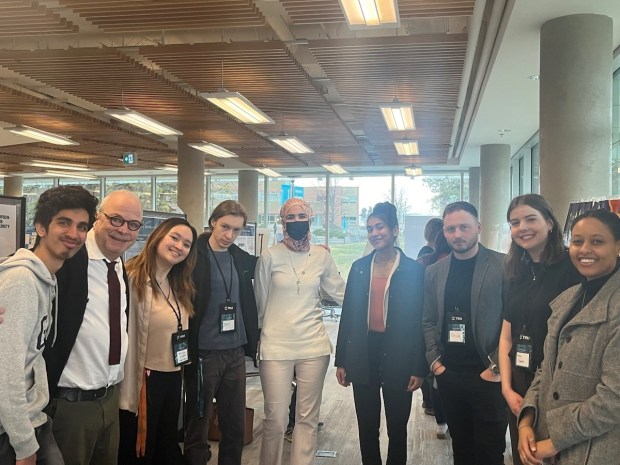
(Left to right), Kris Kadaleevanam, Peter Tsigaris, Olivia Simms, Colin Forbes, Alaa Awad, Garima Mehta, Patrick Izzet, Ashley Thomson, and Samreena Noor. CC BY-NC-SA 4.0
By Dr. PANAGIOTIS (Peter) TSIGARIS
Thompson Rivers University
THIS EDITORIAL is to introduce to the readers a book I wrote with my senior undergraduate students entitled In the Shadow of the Hills: Socioeconomic Struggles in Kamloops. Over the next two months, I will be writing editorials on each of the findings from the book. The book it is available online at: https://shadowofthehills.pressbooks.tru.ca/

Dr. Peter Tsigaris.
Last winter, eight students and I embarked on a journey to research various socioeconomic issues affecting Kamloops. The project stemmed from a fourth-year undergraduate capstone course. We turned the course into a collaborative research initiative which allowed us to examine local challenges through a critical lens. Each student picked a topic that held significant importance to the community.
Each chapter in the book explores a specific aspect of Kamloops’ socioeconomic environment, providing insights and analyses to foster a deeper understanding of the city’s unique situation.
Alaa Awad explored the factors that influence the quality of elementary schools and the role of parental involvement in such education within Kamloops. She quantified the economic value of parents’ contributions to their children’s schooling and discussed the challenges and successes of ensuring equal educational opportunities for all students.
Colin Forbes conducted a comprehensive analysis of the public transportation system in Kamloops, discussing its current inefficiencies, the economic benefits of improving the system, and the various challenges it faces. His research aims to offer insights into how enhancing public transit can lead to better environmental outcomes, economic gains, and improved quality of life for our residents.
Patrick Izzet compared the economic implications of different policing models for Kamloops, focusing on the transition from the RCMP to a local police force, and explored a hybrid system. He evaluated the cost-effectiveness, community engagement, and potential long-term benefits of establishing a municipal police authority.
Kris Kadaleevanam examined the accommodation challenges faced by international students in Kamloops, particularly at Thompson Rivers University. He discussed the impact of housing instability on students’ academic performance and well-being and considered the effectiveness of homestay programs as a potential solution.
Garima Mehta analyzed the contemporary issue of homelessness in Kamloops. She explored the root causes, societal impacts, and potential solutions to reduce homelessness, including policy recommendations and community initiatives aimed at supporting vulnerable populations.
Samreena Noor examined the economic and cultural impacts of the proposed performing arts center in Kamloops. She discussed the potential benefits of the center on the local economy and community life, emphasizing the role of philanthropy and public support in cultural development.
Olivia Simms studied inequality in Kamloops by exploring changes in income distribution and the role of government transfer payments, in the context of pre- and during the COVID-19 pandemic. Her chapter provides a critical look at the impact of transfer payments on economic disparities during the 2020 COVID-19 pandemic relative to the 2019 calendar year.
Ashley Thomson addressed the pressing issue of healthcare wait times in Kamloops, exacerbated by the COVID-19 pandemic. Her analysis focuses on measuring the economic cost of waiting time and the strain it has on the local hospital, highlighting the broader implications for public health and economic productivity.
I provided an in-depth analysis of unemployment rates across 25 neighborhoods in Kamloops. The chapter explored the socioeconomic and demographic factors affecting these rates and offers policy recommendations aimed at reducing high unemployment areas. Factors such as educational attainment, family demographics, ethnic diversity, and public transportation availability are shown to significantly impact unemployment.
“The aptly named In the Shadow of the Hills — Socio-economic Struggles in Kamloops tackles several key challenges facing this city we know and love as Canada’s Tournament Capital. Some chapters offer new insights into long-standing issues; others break new ground. All make us think about the socio-economics of Kamloops in new ways.”
— Mel Rothenburger, former Mayor of Kamloops, retired Editor of the Kamloops Daily News, currently publishes “The Armchair Mayor” blog, which tackles issues pertinent to Kamloops residents, such as those in this book.
The series at Armchairmayor.ca will kick off by examining the issue of healthcare wait times in Kamloops. It is an issue that has touched many of our lives, perhaps more acutely during the pandemic. But that’s just the beginning. In subsequent editorials, I will cover each chapter in more depth. Each editorial will not only outline the problem but also highlight innovative solutions proposed by my students, aimed at fostering sustainable development and enhancing quality of life in Kamloops.
“From public transit and homelessness, to policing and the importance of culture, these analyses plumb the depths of the issues facing many modern cities and provide students with an insight into the complexities of the intersection of economics, politics, and sociology.”
— Terry Lake, former Mayor of Kamloops, former Environment Minister of British Columbia and former Minister of Health.
I invite you to engage with each piece, reflect on the discussions, and join the conversation. Your input is invaluable. How can we, as a collective, address these socioeconomic challenges? What steps can we take to ensure a prosperous and equitable future for all residents of Kamloops?

 ArmchairMayor.ca
This is such a powerful and well-illustrated reflection, Professor. I’m based in Nepal—working both as a full stack developer and running a trekking company that specializes in Everest and Himalayan adventures—and I must say, many of the same challenges described in Kamloops are deeply felt in Kathmandu too.
From public health struggles and housing instability to growing inequality and transportation issues, urban life here also carries a complex weight. It’s incredible how these socioeconomic patterns cross borders.
And yet, like Kamloops, our cities sit in the shadow of the mountains—literally and symbolically. The Himalayas, especially Everest, offer inspiration and livelihood to many here, but they also remind us how rugged, challenging, and unequal life can be beneath the beauty.
This project is a perfect illustration of local research with global meaning. Thank you for bringing such depth to these issues—your work resonates far beyond Kamloops.
LikeLike
This is a truly inspiring post. The work by Dr. Tsigaris and the students shows a deep understanding of real community issues. It reminds me of how, in Nepal, especially around the Everest Base Camp region, we also face challenges like infrastructure, access, and inequality. Seeing students take the lead here gives hope — just like how local communities in the Himalayas are working for better, more sustainable futures. Thank you for sharing such meaningful work. It really connects across borders.
— Hari, Himalaya Heart Trek
LikeLike
That the local university gets seriously involved in the social and economic environment it is surrounded by, is quite a remarkable thing and potentially could provide quite a number of insights and helpful information about it. Sure looking forward to those forthcoming editorials.
LikeLiked by 1 person