
ROTHENBURGER – Waging my personal Cheezies war on Trump and his tariffs
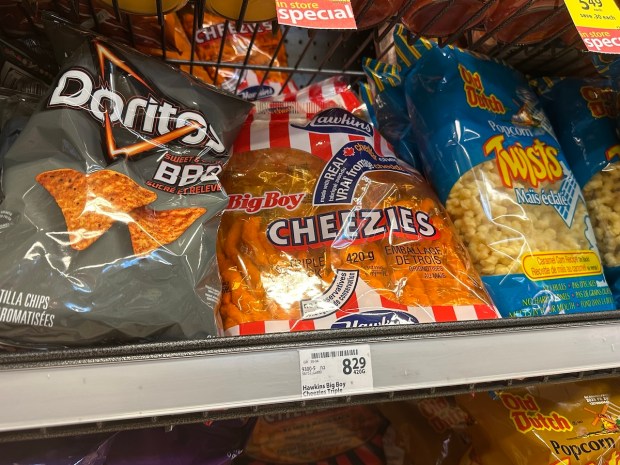
(Image: Mel Rothenburger)
THE TARIFFS ARE ON and so is my personal war against Trump’s America.
As of Tuesday, 25 per cent tariffs will come into effect on all Canadian goods, except for energy, which will be 10 per cent. So I will no longer be a customer of the U.S.
 That’s just naïve, you might say. So I say, what are you going to do, just accept it? Curl up into the fetal position and take the beating without fighting back?
All across the country tonight (Feb. 1, 2025), province after province (except Alberta, but that’s another story) is lining up beside the federal government to fight back. As Prime Minister Justin Trudeau said in a nationwide address, “This is Team Canada at its best.” I hereby sign up for the team.
Many say it won’t be easy to simply “buy Canadian” but I’m going to do my level best. It’s not just about the economy, or my own pocket book. It’s about standing up to the American bully. I’m willing to lose money doing it.
Donald Trump claims we’re letting too many criminals and too much fentanyl leak through our border into his precious land of the free. It’s BS. He knows it. We know it. He wants our water and our minerals and our Arctic and he thinks he can get his way by destroying us economically. He wants to control us.
I am, I suppose, what Trump might call a patriot, but certainly not an American one. So, I’ll do what I can to make sure he doesn’t win, and that means sending as little money to his side of the border as I possibly can.
It will take some homework. We’re told that fruit and vegetables will be hard because so much of our winter produce comes from California and elsewhere in the U.S. So, I’ll eat more fruit and veggies that comes frozen in a bag, or grown in our greenhouses, or I’ll buy it canned.
I’ve largely stopped buying dry cereals anyway but I’ll make sure to cut them out entirely unless I can find Canadian brands. Meat shouldn’t be a problem. Neither will milk, or things like honey, paper products, vitamins, pet food and tons of things like mustard, maple syrup, ketchup, bread, wine and whiskey, eggs, pickles, peanut butter (yes, we can grow peanuts in the Great White North). Thank goodness for Hawkins Cheezies made with genuine Canadian cheddar right here in Canada.
We make lots of our own clothing, dairy products, pop, frozen dinners, wood stoves, furniture, automobiles, paint and honey. When you think about it, it’s not as hard as the skeptics make out. Canadian companies abound and are ready and willing to supply us with what we need. Companies like Maple Leaf, McCain Foods, M&M, President’s Choice, Aylmer Soups, Tim Hortons (yeah, I’m aware of the argument about whether it’s actually Brazilian), Breton crackers (Dare), Urban Barn, Home Hardware, Lululemon, Canadian Tire, Schneider, Dad’s Cookies, Cineplex, Green Giant, Dollarama, Shoppers Drug Mart — name your favourite Canadian company.
Of course, some will argue it’s hard to even tell what’s Canadian and what’s not. Was the material created here, or purchased from somewhere else and manufactured here? Or did we grow it or make it here, and have it manufactured somewhere else? Is some of it Canadian or all of it?
Well, there are standards for that. A “Made in Canada” label means a product was made with at least 51 per cent Canadian material or content. “Product of Canada” means it’s 98 per cent Canadian. Check the labels carefully. Look for our flag. Still, there will be decisions that must be made, backed up with research.
And then there’s the whole “shop local” thing. If I do buy something online, it will be because it’s hard to get it in a Kamloops store. And I want to know whether the corporation that owns a store or a service is Canadian owned and operated.
Right here in Kamloops, we have more than 120 companies that manufacture and fabricate consumer goods. We make wine and great beer, grow produce and beef and lambs and eggs, build truck racks and doors and windows, and manufacture sportswear. The best guitars in the world are built in the Tournament Capital. Down the road in Kelowna, by the way, Little Creek makes excellent salad dressing.
Maybe it’s time to bring back the 100 Mile Diet. If we can’t buy a Canadian product, buy one that isn’t American, and buy it from a Canadian store. But it’s not all about food or even about the physical products we buy – as columnist David Charbonneau wrote this week, we can stop travelling to the U.S.
Tariffs? By all means. Let’s start with Elon Musk’s Tesla. That’s Chrystia Freeland’s idea and I like it. A 100% tariff.
No, it won’t be painless. If we’re willing to defend our country only if it doesn’t hurt, we don’t deserve to call ourselves Canadians. But though it won’t be without pain, it won’t be as stressful as a lot of the media are making it out to be.
Social media and Internet forums are lighting up with support for buying Canadian and standing up to Trump. There are plenty of websites, Facebook pages and other platforms promoting “how to’s” and telling the American president what to do with his tariffs. It’s a voyage of discovery about our nation. Along the way, we’ll learn a whole lot about our country and what it means to be a Canadian citizen. And you know what; it’s actually satisfying. Serious work, but rewarding.
This is truly a war. It’s not against our American friends and neighbours; it’s against Trump and his tariffs, and we can’t be in it halfway.
I know I have lots to learn. I know you’ll tell me I need to know more about the multi-national aspect of so many companies, and about where things come from and where they end up.
But if we’re going to be skeptics and doubters about what we’re capable of, we’ve lost. But I’m going to do my level best to do my part in bringing back that proud phrase from years ago — “I am Canadian.”
Mel Rothenburger is a former regular contributor to CFJC-TV and CBC radio, publishes the ArmchairMayor.ca opinion website, and is a recipient of the Jack Webster Foundation Lifetime Achievement Award, and a Webster Foundation Commentator of the Year finalist. He has served as mayor of Kamloops, school board chair and TNRD director, and is a retired daily newspaper editor. He can be reached at mrothenburger@armchairmayor.ca.

 ArmchairMayor.ca
Donald Trump likely fears appearing impotent by NOT unilaterally intimidating and/or exploiting via absurdly unjust tariffs against the comparably insubstantial nation, notably Canada, that resists his skewed concept of equality.
Here, the school-bully analogy is warranted and befitting, that about he whose expectation of his rightful fair share will always be three-quarters of the pie. He is especially angered by the relative weakling who in the least stands up to him.
And, unfortunately for Canada, this dynamic can and does extend beyond dealing with the U.S. under Trump’s presidential thumb.
There’s been a particular irritation noticeably expressed by China’s government, and lately even India’s, when our government — unlike with, say, mighty American assertiveness — dared to anger/embarrass them, even when on reasonable and/or just grounds.
Most recently, Canada dealt (at least somewhat) firmly with India’s government after Hardeep Singh Nijjar, a prominent Canadian Sikh separatist, was assassinated in Surrey, B.C., last year. Undoubtedly already aware of the diplomatic furor likely to come, even at Canada’s expense, an investigation nonetheless resulted in Canada charging three Indian nationals for the killing.
In China’s case, its leadership seemed particularly angered by the relatively weak Canada having been the one to detain (on Dec.1, 2018) and hold on (albeit luxurious) house arrest Meng Wanzhou, the Huawei executive and daughter of the tech corporation’s founder. Considering that a U.S. arrest warrant obligated Canada to detain her, why didn’t Beijing publicly express similar bluster towards Washington D.C. and, most notably, the then first administration of Donald Trump? Because size thus capability definitely matters?
It could also be that more national governments around the globe are feeling and expressing a growing sense of foreign relations and power-politics entitlement toward militarily and/or economically weaker nations, including Canada — one that we are expected to simply get used to.
LikeLiked by 1 person
Here is another economic twist. The US trade balance is not determined by tariffs on US imports alone. It depends on the relative prices of US imports to exports. Merchandise trade from a US perspective depends on these prices. Take only Canada and US trade balance. It would be
Net exports = Value of exports to Canada – Value of imports from Canada
but value depends on prices of exports to Canada and imports from Canada.
Hence:
Net exports =
Price of exports*Volume of exports – Price of imports*Volume of imports
The price of imports depends on the price of Canadian goods inclusive of the US tariff of 25% and this value is converted to US$ via the exchange rate (US$ per one Canadian$).
Hence the US tariff will make imports to the US from Canada more expensive but if the Canadian dollar depreciates this can offset the increase from the US tariff and since we are imposing a tariff on US imports, their exports, then the price of US exports will increase!
Hence are the terms of trade altered to favor producers and consumers in the US to move towards US goods and away from Canadian goods?
Maybe not in the end! It depends on our tariffs and our exchange rate! At the end it could be that the terms of trade turn into our favour!
I think Peter Navarro should go back to school!
LikeLiked by 1 person
Just check the movement of the Canadian dollar per US$. On Sept 23, 2024 the US dollar was trading at $1.35 Canadian dollars for a US$. Today the US$ hit $1.47 Canadian dollar per US$. In other words, we used to buy a US$ at $1.35 and now at $1.47 and hence US dollar has appreciated by 8.9% or the Canadian dollar has depreciated offsetting somewhat the impact of the tariff on our exports to the US.
If our economy weakens further, our dollar will do the job to soften the impact.
If you are thinking of taking a vacation in the US think twice!
As for Peter Navarro. He needs to go back to school! Holds a PhD from Harvard? Wow! Really?
LikeLiked by 1 person
I don’t think we can dismiss Navarro so fast. Trade and Ricardo model as you well know is all about comparative advantage. Comparative advantage applies to human labour. Did Ricardo account for cheaters, liars and thieves or manipulators of currency? Ricardo did not have to consider most-favored-nations (MFN) rule, which essentially requires that countries not discriminate among their trading partners, or the Commonwealth or the EU and hundreds of other trade treaties. How about labour laws, subsidies (rebates, grants, tax refunds, Chips, green home loans, depreciating allowances, fertilizers, agriculture Oil), and taxes like CO2 close to 100 billion dollars
Some 1000 or so economist during Trump’s last term criticized Navarro but I think they were the ones that were not weaned off Samuelson. This tariff issue has me asking questions about free trade when in the end its nothing more than a weapon used to bring uncompliant nations into line.
IMF and the World Bank are US main weapons in this economic war of compliance. Even Samuelson questioned Ricardo model when he said: ‘Science advances funeral by funeral.’ I just hope I’m still around to see my own economics profession advance beyond the bankrupt Ricardian model.
It took a while to move from Classical economic Theory to Keynesianism. The world that Ricardo worked in is no longer here. It worked for Industrial Revolution Britain and agricultural Portugal I thing Samuelson used in his example but flood of counterfeit goods and contraband, third-party online sources they buy 50% fakes enterfears with free trade..
If you are going to have Free Trade, it has to apply evenly world over you can’t hold all of this other stuff constant. For example, the MFN tariff applied to autos in the U.S. is 2.5 percent. Canada’s is 10 percent, China’s 15 percent, and “India’s in the stratosphere at 125 percent,” Is this free trade? As far as tariffs are concerned USA has some of the lowest tariffs in the world. What is wrong in asking the question are we the good guys and Americans are the bad guys or vice versa.
LikeLiked by 1 person
Dear Walter,
I agree, the complexities of modern global trade certainly challenge the traditional models like Ricardo’s comparative advantage. Regulatory disparities, strategic use of trade agreements, and economic tactics demands a new thinking. Given that Donald Trump is considered to be one of the best business negotiators and that his main purpose is to make his supporters happy and “America great again”, I would expect that Peter Navarro taught Trump some game theory to achieve his goal to make him look great and for Fox news to spread the praise for his “achievement”. I will expand on the game theory that Trump/Navarro played another time. As we know game theory suggests that rational actors may use threats to gain leverage in negotiations especially if they are credible. However, we know such strategies are risky and can backfire. Also, I am not sure about how credible Trumps tariff impositions were given the stock market performance that morning and given the retaliation threats from Mexico and Canada. As we know the use of threats can escalate into prolonged conflict and can damage relationships at least temporary. In my opinion, his threat doesn’t seem credible as he backed out after being informed that the stock market took a big dip that morning and then made calls to halt his tariffs….
As we also know these games are not one shot but repeated and the best strategy is to play tit-for-tat. We start cooperatively but if you defect, I will also defect and will both lose for the indefinite future. Hence, it is to the best interest of all parties to cooperate which is what will happen. Trump’s did this move only to make his voters see the “great” things he is doing for america knowing well the outcome would not be a tariff war….Yes I am not dismissing Peter Navarro but he is not the only smart economist around and seems to want to play economic games we teach our students. I can only thank him because now I have another real-life example of game theory to tell my students!
LikeLiked by 1 person
this is the price Canada pays for being complacent.
LikeLiked by 1 person
Do not forget that we also have free trade agreements with both Mexico and the EU. We can substitute many of the goods purchased from the US with those from countries and regions not waging an economic war upon us.
LikeLiked by 1 person
Spot on Mel! Never in my lifetime I would have thought that a tariff/trade war would happen between two advanced neighboring countries and major trading partners. Canada was always there when US administration wanted our help. We helped and this is what we get from the Trump administration? A bully that imposes disastrous economic policies that will only hurt his nation and ours. He made a big mistake, and he will pay a very high price for such stupid economic policy. This is just the start of his mistakes!
Yes, I hope we Canadians do not purchase products and services made in America.
LikeLiked by 1 person
The economist, Peter Navarro holds a PhD from Harvard, is the advisor to Donald Trump. He is the advocate of the tariff policy of protectionism that we face now. While Canada can’t “win” in a traditional sense due to economic size disparities, it can aim to make U.S. tariffs politically and economically costly through targeted retaliation against states that support Trump. However, the overall impact would likely be mutual damage rather than one side emerging as a clear winner. The only option for Canada is public opinion and that weapon is firing blanks as no one believes it any more.
This policy is a huge problem for Canadian and American consumers, rightly so, the people are concerned. The same people who advocated our economic policy, trade agreements and business strategies that got us here now point fingers at Trump. For years these same people outsourced our industrial base to Mexico, China, India and other low wage countries destroying our own economic base and self reliance.
Over time, both governments and businesses have advocated for outsourcing as a means to reduce costs, improve efficiency, and gain access to specialized skills not readily available domestically. Auto industry in Canada is mostly US owned with about 9% Canadian input in parts which are mostly used in Canada. If the USA car maker in Canada feels the bottom line they can use tax rules to mitigate the cost but they can also pack up and leave.
Canada, also outsourced our resources without adding value to them. Not only that we subsidized this with billions of taxpayer dollars destroying our industrial base and making our economy vulnerable to the present crisis, that we as consumers created as much as those whose policies got us here by participating in the purchase of cheap foreign goods rather than supporting domestic manufacturers. As consumers we were willingly transformed into consumers. A national somnambulance (sleep walking) has infected us and now we have insomnia.
Peter Navarro rationale for tariffs includes the idea of fair trade. Free trade works depending on national policy and marginal cost in production. Navarro believes in reciprocity; if foreign countries hurt U.S. industries, the U.S. should retaliate with tariffs. Some think its not the size of the dog its the fight in the dog. In relationship to US we are an economic puppy.
USA is in deep trouble, due to attack on the dollar, trade deficits, domestic chaos inside the country and on its borders, which they are unable to solve using foreign adventures as protectionism so they are now using economic warfare against friend and foe. Trump did this the last time; Biden did not remove Trump’s tariffs he just added his own.
Navarro feels that tariffs would force consumers to buy local products, thereby reducing the trade deficit, improve national security vulnerability due to foreign manufacturing for critical industries. One of his many goals is to incentivize manufacturing jobs to return to the U.S. by making domestic production more economically viable by taxing imports. Politically we need to clean house, the swamp in Ottawa Who have outsourced the taxpayer for self interest.
LikeLiked by 2 people
“Canada also outsourced our resources without adding value to them.” … We also allow bulk/raw/unprocessed-natural-resource-export lobbyists WAY TOO MUCH influential access to governmental decision-makers — all without a truly independent news-media willing to investigative and expose corporate lobbyists’ corrupting overreach.
After almost four decades of consuming both mainstream conservative and ‘liberal’ news media, I cannot recall a serious discussion on why our national and provincial governments will not insist upon processing all of our own oil (and lumber) here at home in Canada, instead of exporting it bulk raw abroad and purchasing it back processed at a notably higher price (as we do with the U.S., for example).
That is, without the topic discussion strongly seeming to have already been parameterized thus the outcome predetermined. And I’m not talking about just on the one and same day, open and closed topic, as I’ve witnessed two or three of those insufficient efforts.
Our governments consistently refuse to alter this practice, which undoubtedly is the most profitable for the corporations extracting and exporting en masse our natural resources.
… This topic always manages to spike my blood pressure 10-15 points.
LikeLiked by 1 person
Thank you for your wise words. I am with you 100% and I have my fingers crossed that Mr. Trudeau will place an excise tax of at least 15% on gas and oil exports to ensure the cost to the US equals the tariffs imposed on us. Now if we could just find a way to get rid of Danielle Smith . . .
LikeLike
Its time to get serious about cotton from the states. It should be replaced with hemp products grown here . Cotton uses an inordinate amount of pesticide and water . Hemp, not so much. The pipeline that Quebec won’t accept must go through for National security purposes. Time to grow up Canada
LikeLiked by 1 person
YES! Thank you Mel for your thoughtful piece. I fully agree and commit to do my homework, check labels, and ensure that I buying Canadian. I look forward to learning more about the great products produced at home.
LikeLiked by 1 person
Thanks for the pep talk, Mel.
A fellow at the coffee shop one morning this past week said, “Don’t make us come down there and burn down the White House again.”
If we don’t fight it, we’ve already lost.
LikeLike
Hear ye hear ye. Me too. No trips to the US and spending more time checking labels. I will do everything in my power not to buy American made.
LikeLike