
JOHNSON – The Arctic and new Canadian submarine procurements
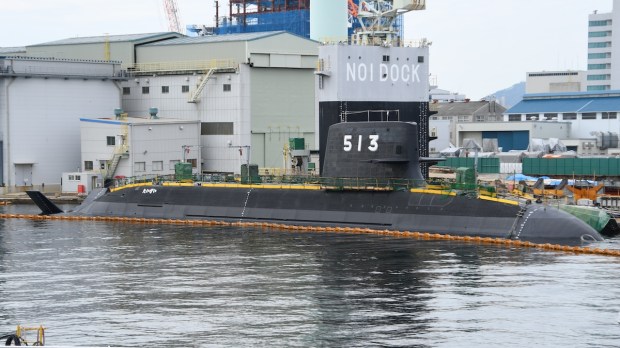
Japan’s Taipei-class submarine. (Image: Wikipedia)
TODAY WE TAKE a look at upgrading Canada’s naval submarines.
 Believe it or not, although it didn’t make many headlines above the din of the Liberal government and party trying and failing to keep itself from imploding entirely … this past autumn the government announced a major new submarine procurement program.
In July 2024, Bill Blair announced the plan to invest $60Billion CDN into 12 brand new, conventionally powered vessels designed for Arctic conditions, with the first submarine to be delivered no later than 2035, and that Canada is launching the process to formally engage industry on this acquisition.
But first some discussion about why we might need underwater military capability.
The cold depths of the Arctic Ocean have long been a stage for geopolitical maneuvering, where submarines play a crucial role in national defense strategies, including intelligence gathering, deterrence, and protecting maritime territory. True for all Arctic governments.
Canada’s vast Arctic coastline necessitates a submarine fleet capable of prolonged and stealthy under-ice operations. These operations are critical for addressing threats within the Canadian Arctic, or transiting through the region, such as potential incursions by unfriendly foreign forces or unauthorized resource exploitation.
Climate change has opened up the waters of the Arctic, increasing the region’s strategic importance and presenting challenges from powers such as China and Russia.
For Canada, modernizing the fleet is essential for addressing both current and future defense needs and maintaining a strategic edge in contested waters.
To date Canada has operated four Victoria Class Submarines, purchased second hand from the U.K. in the 1990s, which have proven inadequate for Arctic operations, frequently spending more time in dry dock than on missions. The HMCS Victoria, Windsor, Corner Brook and Chicoutimi, were all built in the 1970s.
If there is no question that northern sovereignty is important to Canada, discussion as to the value of upgrading our underwater fleet is undeniable. It just has to happen.
A definite positive to Canadas submarine operations, and the fact that these old subs are still kind of working at all … means that we have a pretty good-sized trained crew, capable of transitioning to newly built units in relatively short order. Submariners are not quickly trained, and is a specialty that is hard to come by, starting from scratch.
So, this is a good time to give them newer, better equipment.
We might ask … what about nuclear-powered submarines?
Conversations about this have resurfaced yet again, and yet these discussions will likely remain in the exploratory phase.
One simplified way to look at the nuclear-powered submarine option, is to remember that the U.S. uses its nuclear-powered sub fleet as launch platforms for nuclear missiles. The stealth capabilities of this deterrent hardware being underwater for six months at a time and capable of being anywhere on the planet, is critical to the U.S. policy regarding military deterrence.
This just isn’t a thing for Canada.
We don’t have, want or need nukes, so we don’t need to pour a massive amount of budget into a platform geared towards this ability, because we don’t operate within the same military agenda. Conventional submarines on short term, cyclical deployment, circling the arctic will do just fine to answer the surveillance and operational objectives we have for the north.
In addition, let’s remember that since the 1950s, America has dissuaded Canada from having any form of nuclear submarine capabilities, citing potential operational and strategic complications. Some would call the U.S. objective the same as always; keep Canada as backwater and therefore as subjugated as possible.
The argument against having nuclear submarines is the extreme high costs, logistical challenges, complex maintenance, potential safety and environmental risks, and training crews to operate them.
Nuclear-powered military stuff is very expensive up front, and continually expensive over the very long term … and opens up the problem that one day we would have a bunch of federal government controlled nuclear waste to deal with, which is literally an untenable situation.
We need better submarines, and considering the massive undertaking in public discourse regarding nuclear submarines that would undoubtably happen … conventional submarines it is.
In September 2024, Canada issued a ‘Request for Information’ to government and corporate representatives from France, South Korea, Spain, and Sweden, Germany and Norway, seeking data on their availability and industry capacity to deliver up to 12 submarines and provide ongoing support for long-term maintenance and upgrades.
South Korea’s second batch of KSS-III and Japan’s Taigei-class submarines incorporate key technologies for Arctic operations, such as air-independent propulsion systems and lithium-ion batteries, which offer higher power density, longer operational periods, and enhanced underwater endurance and silence, and robust ice-breaking capabilities. Both are actively promoting their conventional submarines as ideal for Canada.
Saab’s C71 ‘Expeditionary’ submarines from Sweden offer a unique blend of operational flexibility and advanced technology, designed specifically to navigate the challenges of extended Arctic operations.
France and Spain offer tailored conventional submarine models that are more adaptable in size and operational scope. The 212CD class, jointly developed by Germany and Norway, also emerges as an appealing option. This model combines Germany’s reputation for reliability and technological advancement with Norway’s expertise in Arctic operations.
Each potential partner offers distinct advantages and challenges, requiring a careful assessment of strategic, economic, and technological factors to ensure Canada’s new fleet meets its future defense needs of maintaining its status as a key player in Arctic and global maritime security.
Finally, this selection process is inherently political, with interoperability with U.S. forces a critical factor due to the close military relationship between Canada and the U.S. , beyond Trump’s rhetoric.
So where are we today? Not even close yet to a deal to buy subs.
The Department of National Defence is meeting with manufacturers and potential partners, as part of the Canadian Patrol Submarine Project (CPSP). A formal Request for Information on the procurement, construction, delivery and operational capabilities of potential bidders has been announced, and that’s the latest news.
In normal people speak … it’ll be a while, at least a year or two before we get to contract talks.
One interesting angle is the inevitability of finding ourselves in an upcoming election, before this deal is signed … and a question regarding if a future Conservative government would pull the plug on any deal, simply because it was initiated by their Liberal nemesis.
It seems likely not.
Whereas there are miles of distance between Liberal and Conservative policy ideologies in every other portfolio … that’s not necessarily the case regarding military expenditures. A little careful comparison in this area shows that when one government spends military money, the main opposition party tends to stay rather quiet, and the same vise versa, especially regarding arctic sovereignty. They recently always seem to be on the same side of the coin, military policy wise.
Poilievre’s Conservatives did not have much to say about the F-35 contract, or the military drone deal, or the Halifax Frigate replacement deal, or the ice breaker contract.
When you have an opposition that takes pleasure in slamming the Trudeau government on any move it makes, the silence regarding military procurement is deafening. It is likely that a Conservative Ministry of Defence will just continue on with the procurement process.
The facilitators of these studies and procurement negotiations are done by career military bureaucrats anyway, who (although led by the government in power) operate day-to-day beyond political rhetoric. The ball for subs is rolling, and not likely to be upset.
Maybe one day we will report back here with full budgetary details on the signing of a sweet submarine deal.
Today … it’s a bit of a coin toss figuring out where this will go.
—-
In case you missed earlier columns on Canada’s recent military procurement and expenditures:
Canada’s military and its plan to buy remote operated drones;
Is the F-35 fighter jet the right decision for Canada;
https://armchairmayor.ca/2023/01/13/johnson-is-the-f-35-fighter-jet-the-right-decision-for-canada/
David Johnson is a Kamloops resident, community volunteer and self described maven of all things Canadian.

 ArmchairMayor.ca
I think the idea of offering specialized “submerged” excursions/cruises could be offered by the Canadian navy to fundraise for the new subs…crowdfunding of sorts. Because if we want sub they should be useful…somewhat.
LikeLike
Problem is … subs aren’t much fun without windows. Once while in Mexico, we took an tourist excursion in a sub in Cozumel, great fun as it had big windows.
Not much to see in the arctic, and at depth, windows are a not so good idea.
Think I’d pass at tourist subbing in Canada, lol.
LikeLike
The Upholder Class was Not built in the 70’s, they were built in late 80’s !
I don’t want you adding 10 years to their age.
I worked on these subs from 2001-2011, my last ten years at our Canadian Dockyard in Esquimalt.
“The Upholder-class submarines were built in the late 1980s and early 1990s, but were not built in Victoria, British Columbia. They were built by Vickers Shipbuilding and Engineering Ltd (VSEL) in the UK.”
LikeLiked by 1 person
You are correct, my dates were slightly off;
The announcement for the Upholder or Victoria class design took place in September 1979 … and thats where I mistakenly added the 70’s line.
Actual construction spanned between the first keel lay in 1983 and the rest of the fleet slowly rolled out during that decade.
What I find interesting is the UK government in the mid 90’s switched towards nuclear sub investments, meaning some of these conventional subs were only a couple years old by the time of the Canadian deal in about 1998.
LikeLike
I wanted to share a story about my experiences after graduating from UBC with a degree in Economics and History. When I applied for a job with External Affairs, I was required to answer a question relevant to international affairs. Given my language skills, including Russian, I wrote about the importance of Canada cooperating with the Soviet Union in the Arctic. Unfortunately, despite the large number of applicants, I was not offered a position.
Instead, I was offered a position with Ron Basford’s new department, Consumer and Corporate Affairs, which I declined. It’s interesting to reflect on how, many years later, Canada now has numerous agreements with Russia regarding Arctic cooperation, aligning with the ideas I expressed in my application. Russia has made significant advancements in Arctic development, and the region presents numerous opportunities in transportation, mineral development, and energy. The ownership of the Arctic is a complex issue currently before the UN, with the USA and Canada both claiming large sections of each others territory.
In light of these developments, I believe that investing in outdated defense systems like the Dew, Pine Tree, and Mid Canada Lines seems misguided
LikeLike