
GUEST COLUMNIST – A candidate’s ignorance of our definitive history
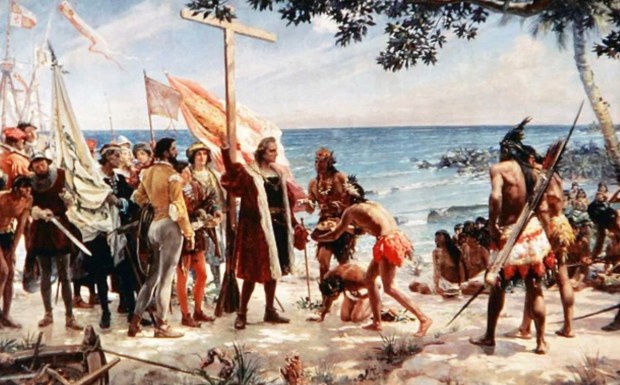
Artist’s depiction of Europeans meeting Indigenous North Americans.
By LYNN STONIER-NEWMAN
Guest Columnist
ARE WE IN BRITISH COLUMBIA so desperate for political party candidates that we no longer adequately investigate that person’s suitability to become a MLA?

Lynn Stonier-Newman.
Lynne Stonier-Newman here, author of early Canadian and B.C. nonfiction history books. I’m shocked, angered, by Dr. Marina Sapozhnikov’s ignorant comments about the First Nations history and heritage.
How did such a want-to-be-an-MLA become chosen by a political party’s well-meaning nominating committee? What rules regulate those volunteers in all B.C.’s ridings to ensure that anyone who lets his or her name stand for election fully understands, and will swear that she or he can be trusted to be knowledgable and respectful?
In my opinion, Marina Sapozhnikov abused the power she gained as a B.C. candidate seeking to be elected as an MLA. Which is why I ask, “How was the integrity and suitability of this Juan de Fuca-Malahat candidate for the Conservative Party of B.C. investigated?
Dr. Sapozhnikov’s bio (www.conservativebc.ca/marina) outlines she is a qualified medical doctor and an immigrant from Russia, Ukraine and Israel; her official bio says nothing about her former political affiliations, or her qualifications to be challenging B.C.’s and Canada’s known history about First Nations. Her reprehensible, bigoted comments about Indigenous people raise many questions about her since her interview with a neophyte journalist enraged and upset many British Columbians.
Many of us are now demanding that B.C.’s nominating process to select our future MLA’s be upgraded and tightened.
The Juan de Fuca-Malahat Riding’s Conservative nomination committee and members must be very relieved Marina Sapozhnikov wasn’t elected … as must all the Conservative Party of B.C.’s members, its leader and all the newly elected MLAs.
Because Sapozhnikov’s words sully all of us, Indigenous and non-Indigenous, they are unacceptable! During this era of working toward reconciliation when many non-Indigenous individuals are finally understanding that Canada has racist history, her comments are as archaic as those of the ignorant colonials. And how are the Indigenous individuals who are publicizing, educating and gaining wide recognition about how and what First Nation peoples have suffered deal with such a candidate?
Who is elected to become a member of the B.C. Legislature shapes all our futures.
As voters, we need to learn much more about an individual’s personal beliefs, mores and ethics before placing an X by a candidate’s name.
I agree with Conservative MLA Peter Milobar’s perceptive words after Sapozhnikov’s diatribe: “I am feeling outraged, and filled with sadness … The only way real and meaningful reconciliation can happen is with genuine conversations, shared learnings and mutual respect.”
As a historian and author whose next book is about the Dominion of Canada’s 1876 Indian Act, I’m also saddened by this probably caring medical doctor’s historical ignorance. It’s similar to all those colonials who compiled and legislated the 1876 Indian Act’s barbarous and cruel laws.
As I research those Fathers of Confederation who shaped Canada, their supporters, clerks and senior bureaucrats, I’m often stunned by those powerful, mainly church-going men who were considered pillars of their societies and communities. How could they have created and voted for such savage legislation?
Yet those colonials did. Their biased assumptions were validated by their friends and families, by biased and wrong media information publicizing the myths of those eras, and by the British Empire’s recorded history in the reams of British colonial archives Canada inherited.
That maze of letters and official reports written over many decades by the sequential British governors and generals supposedly ‘managing’ the Empire’s British North American colonies’ development and wars did shape many of the 1876 Indian Act’s clauses. As well, the Canadian bureaucrats who compiled that Act also used the Hudson Bay Company’s reports and records, written by the factors of a fort, often about the fur traders’ opinions about the First Nation Tribes and Bands.
Many of us aren’t aware it was Britain’s changing financial realities that necessitated radically downsizing the British Empire in the 1850s and 1860s. And we can’t know how many of the BNA colonies’ residents wanted to become part of a dominion within that empire rather than remain a subsidized colony. The reality was there was no choice; the British parliamentarians had decided and Queen Victoria decreed.
Thus, on July 1, 1867, Nova Scotia, New Brunswick, and the Province of Canada – comprised of Canada East which was renamed Quebec and Canada West which was renamed Ontario – became the Dominion of Canada.
The new country’s parliamentarians were charged with creating its legislation – and not only for administrating the new Canada. That legislation was also for Britain’s remaining BNA colonies who were forecast to become provinces and for Rupert’s Land’s indigenous peoples.
Canada’s 1876 Indian Act became the core governing legislation. Because of it, current and future Members of Parliament and Provincial Legislatures, and all the many bureaucrats and agents hired, legally could lie to, steal from, abuse, starve and kidnap children from the First Nations residents between the Pacific, the Atlantic and in the vast and unknown northern geographies.
In 2024 – 148 years after the 1876 Indian Act was made law – more non-Indigenous Canadians are learning about that horrendous history. Like me, many are committed to working toward a future that both recognizes and compensates Indigenous peoples. And committed to eliminating Canada’s and its provinces’ and territories’ unequal justice that continues to enable legal wrongs to be suffered by many First Nation individuals.
That process must include revising all political nomination processes for legislative offices. Unqualified or bigoted potential candidates like Dr. Marina Sapozhnikov have to be assessed better, scrutinized and eliminated before gaining a nomination.
Let’s enforce that to ensure all elected MLA’s or MP’s are informed about and respectful of our history. And of how that shapes our future.
Lynne Stonier-Newman is a resident of Kamloops. She’s a social marketing and communication consultant, and a B.C. historian and author.

 ArmchairMayor.ca
Lynne Stonier-Newman asks some very good questions. She writes “As voters, we need to learn much more about an individual’s personal beliefs, mores and ethics”. What shapes our “personal beliefs, mores and ethics” is a more important question that we need to ask?
When First Nations leaders say BC Conservative leader John Rustad was “offensive and insulting” during the leaders’ debate should he resign?
Did Marina Sapozhnikov morals and ethics on this issue come from what Rustad said or from her Russian education?
Why is it that participators in the Holocaust are invited to commemorate the 100-year anniversary of the liberation of Auschwitz but not its liberators?
Where did Selina Robinson views come from on the Gaza conflict that forced her to resigned?
Christine Freeland said that her Nazi grandfather was a “Freedom fighter” As legislators saluted a Nazi in Parliament Freeland knew well why did we not ask for her resignation? What do we do with leaders who involve Canada in illegal wars?
My master’s degree thesis is on evaluating Historical sources. For me, E. H. Carr, a British historian, who discusses history, facts, the bias of historians, journalists, educators, science, morality, individuals and society, and moral judgements in history has guided my thinking, and evaluation of historical evidence.
One of the preeminent guidelines of historical analysis is that all historians evaluate their sources to determine their quality and accuracy. Do we do the same thing with people, who are not historians, nominated to be a legislator in Canada.
E. H. Carr in the first lecture “The Historians and His Facts” concludes that history is interpretation of the facts and understanding of the mind and actions of the participants as seen by the historian through the eyes of his epoch and experience. He states that history “is a continuous process of interaction between the historian and his facts, an unending dialogue between the present and the past”. With this definition Carr deviates from his contemporaries in order to provide as he states “a saner and more balanced outlook on the future”.
Carr states that the questions about the facts are more important than the answers. Consequently, he argues “that the main work of the historian is not to record, but to evaluate.”
Carr states historians like other mortals must take a position and free themselves through understanding and mastery of the past in order to evaluate its meaning. This interpretation, he states must not be colored by one’s environment, social and political position. Interpretation of the past, Carr states, connect to the understanding of the present but more importantly it may provide a key to shaping a more just future.
LikeLike
Where to start, yes “Sapozhnikov’s words sully all of us.” Let’s start with Columbus where our education system makes him into a hero, because he was a good navigator? Columbus was a murderer. “Columbus killed Indians, Columbus “enslaved Indians, tortured Indians, he cut off their arms and fed them to his dogs. Gold motivated him? No, he’s not a hero. The heroes are the people who resisted him.” https://www.google.ca/books/edition/A_People_s_History_of_the_United_States/KBueCgAAQBAJ?hl=en&gbpv=1&printsec=frontcover
I penned this article some years ago which speaks to the issue where this comes from. I blame the education system of which I was part for many years..
http://www.swans.com/library/art16/wtrkla04.html
Look at the picture that introduces your article a good start for discussion in any classroom as are articles by Mel on the Chilcotin War.
https://www.timescolonist.com/opinion/mel-rothenburger-the-chilcotin-war-and-the-rewriting-of-history-4661043
LikeLike