
JOHNSON – There’s a proven system that could fix the housing crisis
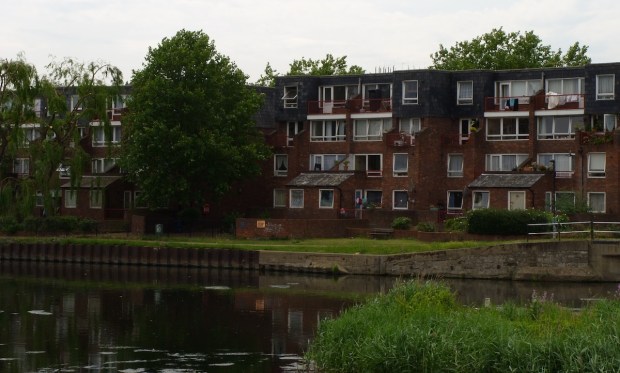
UK ‘Council Housing.’ (Image: By Iridescenti – Own work, CC BY-SA 3.0, Wikipedia)
ON A NEARLY daily basis, we hear from people with concerns about the ‘housing crisis’. Most comments are along the lines of how one level or another of government … ‘should do something about it’, ‘invest in communities’, and a plethora of other soundbites.
 That got me thinking; where in the world, and at what time, was there more people than available housing and what did the those in charge do, to actually successfully fix it?
I found an interesting example.
A solution that, if instituted with a ‘made in Canada’ approach, might actually solve the lack of affordable housing. Let us go on a bit of a history lesson — abridged, short on details, I got a word count to be wary of.
How the UK dealt with the issue in the first half of the last century.
You can google about it and get a lot more detail.
In 1914 Britain was in the midst of an acute housing crisis. Wealth inequality was soaring and home ownership was beyond the aspirations of all but the wealthiest.
As a result, around 90 percent of Brits were forced to rent in privately owned housing … the quality easily described as Dickens-style industrial wasteland tenement housing.
At the same time, Britain’s cities had expanded quickly during the Industrial Revolution as working-class people moved to factory towns in pursuit of jobs. Little care or attention had been given to ensuring the homes those workers moved to were safe or sanitary.
In 1913 it was estimated that working-class families were spending around a third of their income on housing, often for little more than a single room … sound familiar?
Between 1914 and 1918 working-class men from across the UK were sent off to Europe to war. When they returned, then PM David Lloyd George partly felt the country owed them for their sacrifice. In addition, given Russia at the time had just succumbed to revolution, he also had a genuine fear of what might happen in Britain if living standards didn’t improve.
Then a massive rent strike in Glasgow happened when landlords attempted to take advantage of a wartime housing shortage by announcing immediate rent hikes of up to 25 percent. Twenty thousand outraged rental households refused to pay any rent at all. This forced the UK government to introduce rent controls, but it was clear that this wasn’t enough.
Lloyd George promised to build 500,000 homes via the 1919 Housing Act. This legislation instructed all city and county councils across the UK to survey the number of homes that they actually needed to build to meet demand, and to make plans to fill the gap.
Crucially, the concept was that the government (federal and municipal) would no longer rely solely on private builders to own, plan and build housing, instead local councils (analogous to our Cities) would be lent interest-free money by the federal government, to build houses to rent out themselves.
These loans would be paid back to the federal government via an established and firm percentage of the rent paid, the council … or City … could keep the rest to cover operational expenses running a property management arm, as well as their property taxation losses, and all utility and infrastructure maintenance costs. It became a revenue neutral to slight profit for the local council to build … and the more they built, the more revenue they earned.
Once the loan was paid off, revenue to Cities increased, so councils could build a few nice to haves like football stadiums and other public amenities.
This was the birth of what came to be known as Council Housing. These new houses were to remain in the ownership of the local government, and to be rented out for controlled affordable amounts.
As long as they paid their rent, people could basically stay in their homes as long as they wanted. It was a win-win-win. Federal government created a long-term repayable funding model, local government built the homes and handled all the rentals and earned revenue, and renters had long term affordable housing that by legislation would not suffer exorbitant rental increases or suffer private ownership slum maintenance issues.
These first Council houses largely went to the skilled working class, those in stable employment rather than the very poorest. Over the following decades standards were thus gradually amended to allow for cheaper units which would be more affordable to those looking to escape the slums.
The cottage-style homes favored by the 1919 Act were joined by a number of smaller joined house blocks of rentals not unlike townhouses in Canada today. Between 1919 and 1938 local governments built more than a million new post-war boom homes.
A million cost-controlled/ affordable rental homes in 20 years.
In 1938, a new challenge appeared in the form of the Second World War and working-class men were once again sent off to Europe to fight. Advances in aerial bombing saw two million homes destroyed by the Luftwaffe. At the same time new house building stopped.
Once Hitler had been defeated, UK voters elected a progressive government under Labour Party’s Clement Attlee, who believed that Council housing could do more. The 1949 Housing Act specifically removed limiting qualification standards, and made Council housing available to all demographics of society, and the federal government doubled down on Council Housing funding.
A further million houses were built within this system in just the seven following years – the same amount, in almost a third of the time, as in the period between the wars.
Between 1945 and 1979 local councils in the UK built a total stockpile of 6.5 million low cost, rent controlled homes. An astonishing accomplishment.
The UK housing crisis vanished. The federal government successfully built and managed 6.5 million homes for citizens in partnership directly with local government.
Now … imagine that capability in Canada.
Lets take that experience and design a Canadian model:
First – federal legislation – A Housing Act that contains all legislation needed;
– Legislation requiring Cities by law to build low-cost, affordable housing,
– Provide lending to Cities, upon proof of plans, to built X amount of housing units,
– Including funds for buying land if privately owned to get it off the ground,
– Legislate federal rent controls by a calculation, based on that communities median income.
– Legislate that properties remain City owned … and can not ever be sold to private owners.
– The tricky but most important bit; A Constitutional amendment so housing under this scheme is locked in as a requirement of the federal government, and for housing to be added to the Charter as an essential right. This step is essential to ensure a future apposing government can not just sell off properties to private interests, and forces this housing to stay in the public sphere.
– In addition, Constitutionally bound legislation that ties cities to the responsibility of holding and managing housing directly as a function of local government, so a future federal government can not remove cities from the job of program management, so they can’t sell the activity to private property management firms … who would not be required to keep rents affordable. Every angle to this must be kept public and non profit or costs will drive up rents.
– Cities will be required to not just build homes, but manage renters via a new Housing Management Department.
– Provincial governments will be removed from any responsibility is this scheme, other than fast tracking of building code adherence and inspections. This cuts out a massive bureaucratic step and draws a direct line between federal legislation and cities where renters live.
Some of these above steps are critical if we look at what eventually happened in the British example:
Margaret Thatcher was elected in 1979, on a policy manifesto that included a commitment to building a “property owning democracy” unlike the previous Labor approach to affordable housing.
Her idea was for “more people to have the security and satisfaction of owning their own property”. Thatcher also wanted to actively reduce the strength of the council housing stock and benefit the federal government financially by selling it off.
She saw government-owned housing as an over reliance on the state, and she started to move the country away from the vision of home being essential needs, towards a slimming down of municipal governments by privatizing the stock that gave cities value and financial independence.
A year after her first election Thatcher passed the Housing Act 1980 which gave Council tenants who had been in their home for at least three years the ability to buy it. This included a discount of at least 33 percent of the market value of their home, and she even made provisions for 100-percent mortgages, meaning buyers wouldn’t even need a deposit. This policy was obviously incredibly popular, in fact it would have been ridiculous to turn it down as it basically turned rent into a mortgage payment with no additional cost.
In just the first three years of the scheme 300,000 properties were sold to tenants. So far this has seen two million units sold and removed from the affordable rental market. As many of the earlier units also aged out as time went on, today nearly half of the homes created by the Council Housing scheme are no longer rentable.
The consequences of this scheme for the country as a whole were destabilizing as all these units basically entered the private market and their value exploded, instantly driving up property values.
Then Thatcher banned local councils from building new homes to replace those that they sold off. Much of the money raised went straight to central government to fund Thatcher’s Reaganomic tax cuts and to pay down the national debt.
Essentially, the program that housed six million families for 70 years was gutted.
Today in 2024, the UK suffers the same housing crisis that we do … not enough affordable housing and, in the UK’s case, a plethora of private ownership corporations keeping rental units empty to drive up housing demand, therefore increasing land values.
This is why if we in Canada adopt some kind of mirrored publicly funded or loaned low-cost affordable housing scenario to what they did in the UK … we need to ensure full and comprehensive legislation, as well as adding the Housing Act to the Constitution as well as to the Charter. If you don’t, you can guarantee that a future Pierre Poilievre would gut a social housing program, just as Thatcher did.
“Have they no refuge or resource, are there no prisons, are there no work houses?”
Looking at Canada’s housing affordability crisis, what it takes is looking at an example like this that worked, to create housing at an affordable cost, under a financial structure that removes profit seeking private developers and land owners and empowers the local government to react directly to the cause and the effect of the housing crisis, with a real solution that they can afford.
One can read up on the UK Housing Council history and discover how successful it was.
It’s a solution that required federal law, out of the box thinking and, if considered in Canada … would definitely require safeguards to keep future government hands off of it.
Kind of like our social health care system.
Consider a future where we have housing as another locked-in social system.
David Johnson is a Kamloops resident, community volunteer and self described maven of all things Canadian.

 ArmchairMayor.ca
The British colonial empire more than anything that the British government did helped UK solve its housing problem. The Canadian Government saw its first obligation to reabsorb into its economic life of Canada thousands of WWI returning British soldiers. Consequently, Canadian immigration policy changed and became very selective in character until 1925.
Canadian government saw Britain as the mother country, so they gave British immigrants and demilitarized soldiers distinct preference and encouragement to move to Canada. This was the case of Australia, African colonies and the Americas. Huge land estates in UK limited land ownership after Confederation for the poor so fishing boats loaded with immigrants went West while fish and goods went to UK.
Immigration laws continue preference for UK emigrants to this day but that is changing as well. You just need to look at the stats to get this information This also reflected the desire of Canadian public opinion in the 20th century that the country should remain primarily British in the make-up of its population.
In 1925 the immigration policy of the government changed, due to lack of cheap labor, which allowed many Germans, Hungarians, Romanians Serbians, and Croatians from the new nations created in southern Europe, out of the old Austro-Hungarian empire, to immigrate to Canada and work as agricultural workers and domestic servants. Hundreds settled in Brocklehurst.
As the UK colonial empire declined the reverse took place the colonial poor people now became emigrants into UK. Thousand who supported colonial masters in the Middle East, Africa and Indian subcontinent fled to UK once the colonies became independent creating the present cultural crisis in UK.
In the 1990’s thousands emigrated to Canada from Southern and Eastern Europe. Since I spoke several languages, I translated free for the Immigrant services for hundreds of emigrants who were homeless here in Kamloops. I know many of them who now own several homes businesses and many are professional managers. Their children are now doctors, lawyers’ teachers, judges and entrepreneurs like the Japanese in 1949 whose property on the coast was sold for 10 cents on the dollar so they started from scratch to rebuild. You know the axiom give a man a fish —
LikeLike
Did I read somewhere in the article that the issue is to provide lower income people with a reasonably priced place to stay?
LikeLike
I totally agree, this is a way to help people and a great idea which has been proven to work.
LikeLike
Council flats in Canada? If you want to establish ghettos, and further entrench the already massive welfare state and desire to look like the worse parts of Tottenham, the sure.
Maybe we could transition to a homeless shelter and welfare based economy?
Kamloops is nearly there already.
At some point, one can no longer try to ignore gravity when it comes to economics. Not to mention our incredible medical system, which costs more per capita than nearly every G20 nation yet millions are without a doctor and care is difficult to access.
The answer to the ills of socialist policy is not more socialism.
Don’t forget your 15% utility increase.
I’m beginning to suspect that this website is a propaganda arm of the Communist Party of Canada.
LikeLike
We don’t want a welfare state nor crate ghettos but governments can still provide with boundaries and accountability. Government could also seriously cut-down on business and financial fraud. So yeah it is not “socialism” it is just good governance. Thank you very much.
LikeLike
We all have certain things in life we hate, one thing for me is agreeing with Bill, but I too see ghetto written all over this. However, it’s not all bad as once again Bill went a step too far, neglecting to mention that the American healthcare system, far from a socialist system, costs 100% more per capita than ours and ranks by far the highest in the world and 1st in the G7, whilst ours ranks 4th in the G7 and 12 in the 38 member states of the OECD. Moreover, the American system has far worse outcomes including the worst infant mortality rate in the G7 and a covid death rate 2.5 times greater per capita than ours.
LikeLike
I though it would have been obvious, but my comment applies to G20 with single payer systems. Not the American system.
The comparison with the American system is still worthwhile. Consider a Canadian paying high cost, yet does not have a doctor and has difficultly accessing hospital care for anything not an emergeny. Let’s also pretend that a first-world country like Canada doesn’t see regular ER closures across the country due to reasons.
A relatively healthy individual may be better severe by pay for service, if the tax environment is low and reflects a savings otherwise spent on expensive but shitty Canadian health care. The American also has access to world class health care, abundance of choice, and no waits.
Also, please respect my gender fluidity. It’s highly offensive to misgender individuals.
LikeLiked by 1 person
i believe the key and fear here is the rental income was still designed to be cashflow neutral at least and in the case described above was slightly profitable.
i have little to no faith in a governing agency being able to offer a product and service at a lower price than a competitive market. But wouldnt vote against trying as long as there was an escape clause (privatization)should this end up being a constant drain and not able to at least meet existing market conditions in terms of value and service while remaining cashflow neutral.
LikeLike
Other European countries did similar things…there was a will and an (easy) way was found. It could and should happen again.
LikeLike