
CITY HALL – City taken to court in challenge to AAP project approvals

Kathrine Wunderlich talks with reporters outside City council meeting. (Image: Mel Rothenburger)
By MEL ROTHENBURGER
The B.C. Supreme Court is being asked to quash borrowing bylaws for a new performing arts centre and a four-sheet ice arena approved through an alternative approval process a few weeks ago.
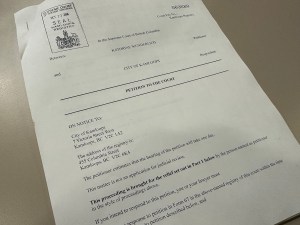
Resident Kathrine Wunderlich, with a new group called Kamloops Citizens United, served the City with legal documents during today’s (Oct. 22, 2024) regular meeting of council. Filed with the court earlier in the day, the petition alleges the City “failed to follow a lawful and transparent process aligned with the spirit and intent of the legislation,” disregarded “a significant and vulnerable elector population” and derided opponents of the projects.
 The petition says seniors and their lack of access to digital sources of information weren’t adequately considered. There should have been mail-out notices, it says.
Wunderlich also claims in the petition that the impact on property taxes wasn’t adequately explained. During the AAP, residents were told the projects would result in a $25 annual tax increase over five years. However, the petition says the increases are intended to continue in perpetuity.
Also, it was unclear what the ice multiplex will entail, it says.
The petition further questions the summer timing of the AAP. “Pushing forward with the AAP process, beginning in the middle of summer and culminating in the busiest two-week period of the school year, amid Respondent council admissions of the dubious timing and against the best practices laid down by the Ministry, suggests a process tacitly intended to exclude distracted electors.”
It questions the City’s calculations of eligible electors, and also claims the City treated residents “in a deplorable fashion” by shutting down concerned citizens during council meetings and not answering questions, exhibiting “churlish and domineering behaviour.”
Wunderlich contends decisions on the two borrowing bylaws should have been done through referenda.
None of the claims in the civil action has been proven in court. The City has 21 days to respond to the petition, with a possible hearing in November.
Wunderlich said outside chambers that the AAP was “not democratic.” Combined, the PAC and the ice multiplex will cost about $275 million.

 ArmchairMayor.ca
The AAP process was originally designed for core things like, water, sewer and roads upgrades and not a backdoor to spend hundred’s of millions on arts and crafts. This is not the core of a cities infrastructure.
LikeLike
This matter was discussed in extensive detail on every news outlet in Kamloops, including radio, local television and websites.
There was plenty of time to become informed and involved in the process. The fact that the AAP was started over the summer is a red herring. Do people take month long vacations and shut off all access to information during summer? How is it that citizens are distracted in summer but not so at any other time of year? Ridiculous assertion.
The City of Kamloops website had all the information that is required to allow people to decide on how to vote.
It’s unfortunate that people who don’t want the Build Kamloops projects to proceed are misleading the public on several aspects of the projects and cannot accept the result of a legitimate, lawful process.
The people who are proceeding with this petition are now wasting time and taxpayers dollars requiring the City to defend a petition that appears to have no merit.
Time to move forward in a positive way to build facilities to enhance the lives of a growing and diverse community.
LikeLike
You clearly have not read the provincial guidelines of either the Assent Voting process (referendum, pg2 https://www2.gov.bc.ca/assets/gov/british-columbians-our-governments/local-governments/governance-powers/assent_voting_best_practices_guide.pdf) or Alternative Approval Process (AAP, pg7 https://www2.gov.bc.ca/assets/gov/british-columbians-our-governments/local-governments/governance-powers/alternative_approval_process_guide.pdf) otherwise I’m sure you wouldn’t have written such a clearly misinformed comment.
LikeLike
Yes, I’ve read it. Why don’t you enlighten us as with specific reference as to how the AAP is not legitimate and lawful as I’ve asserted?
The province approved the AAP run by the City.
LikeLike
“AAPs help local governments better understand whether or not the community views a particular matter, such as borrowing to upgrade a water treatment facility, as “significant” and if the matter then warrants being taken to assent voting for broader citizen engagement.” pg 2 Accent Voting Best Practices Guidelines
“If an issue is controversial, requires a significant contribution of taxpayers’ dollars, or is significant in scale or impact on the community, local governments may decide to proceed straight to assent voting. However, if the public has been actively engaged and there are reasonable indications that citizens are in favour, the proposal may lend itself better to an AAP. In this case, an AAP can be an effective time and cost saving tool to obtain approval of the electors.pg 3 assent voting best practices
As I stated earlier and forwarded a link to the AAP guidelines,
“principles of transparency, neutrality, engagement and stewardship of the public trust that underpinned the counter-petition process.pg 4
recommendations when not to have a AAP include summer holidays
“The decision to hold an AAP when many electors are absent during the summer months or other holiday season could result in an artificially low response rate that falls well short of the required 10% threshold.” pg7
“When the public has been actively engaged and there are reasonable indications that citizens are in favour, the proposal may lend itself better to an AAP rather than to assent voting.”pg 7 Clearly this was not the case in Kamloops.
“local governments may consider establishing a longer than 30-day timeframe for an AAP when it is held during a holiday season or time when a high percentage of the electorate are absent from the community.”pg 7
“Information-sharing vs. “Promotion” Transparency and stewardship of the public trust are key principles that underpin the legislative requirements of the AAP”,pg8. Care to explain the $25 tax increase, is this for one yr, 5 yrs, perpetuity and is it a single $25 or does this increase annually?
Where a project or proposal varies from what the community might consider a routine matter (e.g., boundary extension or change in municipal classification), proceeding directly to assent voting may be more appropriate than first conducting an AAP and then holding an assent voting event if more than 10% of eligible electors signed and submitted elector response forms” pg 5
“Scale
The scale of the proposal may have bearing on a local government’s decision to hold an AAP or conduct assent voting. Since the AAP is intended to test the waters around the council or regional district board’s decision to proceed with a particular bylaw, they would want to consider whether or not the matter would be viewed as significant or “sizable” in cost, scale or scope from the community’s point of view” pg 6.
“If the proposal is contentious, or it seems likely that 10% or more of the electorate may sign elector response forms, local governments may decide to proceed directly to assent voting to reduce the overall time and costs involved in securing elector approval” pg 6.
LikeLike
As a senior, I find the AAP process deplorable. My questions were not answered, there were a number of ambiguities and outright incorrect information; even the formula used to find the threshold for “no” success was based on incorrect data and bad maths.
Every other senior I know feels the same.
LikeLike
Actually, your questions were answered, many many times. You just didn’t like the answers so round and round and round it goes. Your echo chamber whiners club can cry to the courts as much as you want until they declare this vexatious and give you something new to cry about.
LikeLike
I paid for the photocopying of 200 sets of AAP ballots and went door to door with them. Through the feedback I got from people, there is an alignment of what has been presented by this group in their case filed with the Supreme Court of BC.
In short, I feel the citizens of Kamloops were duped by this process.
LikeLike
As a senior I find this deplorable. This senior was not treated badly and I had plenty of access to information, as did every other senior I know.
LikeLike