
CHARBONNEAU – Remove oil sands from the equation and Canada’s economy is comparable
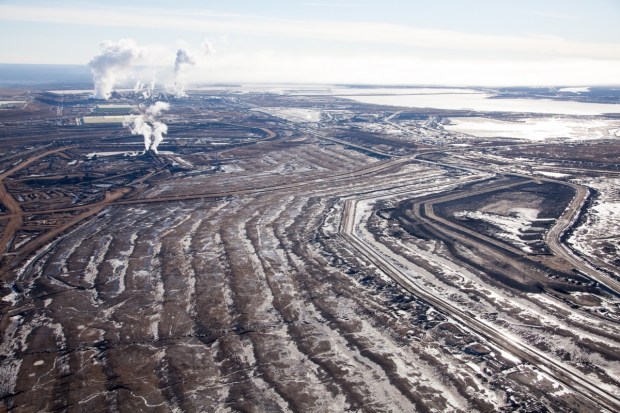
Oil sands. (Image: Alex MacLean, DeSmog Canada)
THERE HAS BEEN a lot of hand-wringing about the state of Canada’s economy. You would think the sky was falling.
But depending on how you measure the economy, it’s not as bad as some would have you believe.
 In an unusually blunt speech, Carolyn Rogers, Senior Deputy Governor of the Bank of Canada was alarmed:
“I’m saying that it’s an emergency – it’s time to break the glass,” she told a business audience.
She is worried that Canada is slipping behind the United States and other countries when it comes to economic output per hour worked. That’s one measure.
There are good reasons why our economy, calculated as goods and services (GDP) for each hour of labour worked, is less than the U.S. That puts us at just 79 per cent of the U.S. economy.
Another measure yields different results.
Economics professor Pau S. Pujolas and doctoral student Oliver Loertscher at McMaster University say that if a different benchmark is used, our economy is comparable to the U.S. Their research was originally published in the Canadian Journal of Economics. They say that capital should be included as an input:
“’Productivity’ should refer to total-factor productivity (TFP), which measures output relative to the inputs used (labour and capital). TFP is consistent with national accounts, vastly used in modern macroeconomic theory, and provides a useful benchmark: In healthy economies it grows at 2 per cent a year (Globe and Mail, August 13, 2024).”
Using this measure, Canadian productivity has grown at the same rate as in the United States once the oil sector is excluded from the calculation.
Using the measure of productivity as a ratio of GDP for each hour worked, growth in the oil sector is phenomenal. The oil sector uses far less labour to produce the same economic output as others.
But when you use total-factor productivity, productivity in the oil sands is dismal. Since the oil sands are less productive than traditional oil sources, more capital must be poured into the oil sands to produce increasingly less oil. As a result, productivity is reduced.
“The oil sector,” say Pujolas and Loertscher, “like any extractive industry, is akin to selling family heirlooms. Having cash on hand (income) is better than keeping old silver in a drawer, but it doesn’t mean you’re more productive.”
There are good reasons why Canada’s productivity, as measured as GDP for each hour worked, is less than the U.S.
Canada invests only about 1.6 per cent of its annual GDP research and development. That places us at 26th in the world, below the 2.7-per-cent average in the Organisation for Economic Co-operation and Development.
However, when it comes to basic research, Canada excels. Governments and universities contribute anywhere from 2 per cent to 6 per cent of the world’s output. That’s substantial considering that we have only 0.5-per-cent share of the world’s population and 1.9-per-cent of the world’s economy.
And Canadian businesses are continually using new technologies, products, markets and organization innovations according to a Statistics Canada survey. That puts us on par or better than our competitors.
The sky is not falling. Canada is not a basket case.
David Charbonneau is a retired TRU electronics instructor who hosts a blog at http://www.eyeviewkamloops.wordpress.com.

 ArmchairMayor.ca
“The oil sector,” say Pujolas and Loertscher, “like any extractive industry, is akin to selling family heirlooms. What exactly have we been doing for the past 100 years but outsourcing –selling family heirlooms. Land, labour and capital plus entrepreneurship are input factors in production of goods and services. We have become an economic dependency of USA, Mexico, China, India and other emerging economies due to outsourcing extractive resources while we remain “drawers of water and hewers of wood”.
Capital, banking and credit must remain a public utility which is the most important sector in productivity and production of goods and services.
When economic planning is done by the stock market and the bankers planning is done in favor of the finance, insurance, and real estate sector who seek to make capital gains for wealthy families We should be using finance to build up domestic industry and infrastructure and make Canada independent.
LikeLike
Your article sidesteps a crucial issue – Canada’s ratio of economic output that is funnelled into housing. Idle housing does not an economy make. Canada’s economy is about 10% more dependent on housing than the US at the peak of the 2006 bubble. Canada has some of the highest prices for housing in the world. Canada is over leveraged in housing, and that alone would qualify it as a basket case among developed nations. Canada is a productivity laggard and is focused far too much on the redistribution of wealth. Combined with a debt of our magnitude would be ruinous for the country if the dominos tumble.
LikeLike