
IN THE HOUSE – Why are Liberals misleading Canadians on drug policy?
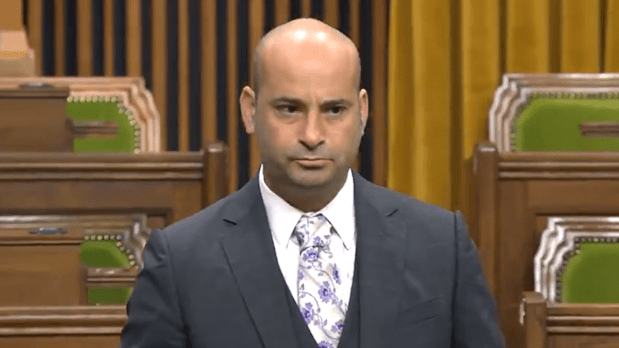
MP Frank Caputo. (Image: House of Commons)
Excerpt from debate during Question Period in the House of Commons on Thursday, May 2, 2024:

Frank Caputo Kamloops—Thompson—Cariboo, BC
Mr. Speaker, the Liberal minister responsible for legalizing hard drugs is misleading Canadians. Yesterday she told Canadians that the Liberals were waiting for further information from British Columbia in response to B.C.’s request to end the legalization experiment. However, just yesterday, the B.C. minister responsible told us that it had responded to the government in just a few hours. This has happened when B.C. had 2,500 overdoses in just one year.
Why are the Liberals misleading Canadians, and will they end their radical drug policy?

Ya’ara Saks Minister of Mental Health and Addictions and Associate Minister of Health
Mr. Speaker, the opioid crisis is affecting communities and families across this country, and it is a tragedy. That is why the B.C. government approached the federal government for a three-year pilot program. B.C. communities are facing extremely serious challenges. People are dying from deadly street drugs, and public consumption is a concern.
B.C. is amending its proposal, and we are supporting it in this work because that is what we do; we partner together to save lives. What is the Conservatives’ plan?
Frank Caputo Kamloops—Thompson—Cariboo, BC
Mr. Speaker, they did partner together. They partnered together for a radical policy that has led to countless deaths. Imagine an elderly woman in hospital having to lie beside somebody who is smoking crystal meth—
Some hon. members: Oh, oh!

The Speaker Greg Fergus
I would ask the hon. member to start again. I am hearing voices from the far end of this room, and I cannot hear.
The hon. member for Kamloops—Thompson—Cariboo from the top.
Frank Caputo Kamloops—Thompson—Cariboo, BC
Mr. Speaker, the minister is correct. The Liberals partnered with the provincial NDP to create a crisis of unprecedented proportions that led to people dying due to the government’s radical policy. After nine years, the Liberal-NDP government is flooding the market with free drugs. This is happening to our brothers, our sisters, our fathers, our mothers and our children. They are all being fuelled with addiction to the free drugs.
Will the Prime Minister reverse course and end his radical experiment of legalization?
Ya’ara Saks Minister of Mental Health and Addictions and Associate Minister of Health
Mr. Speaker, on this side of the House, we work with our provincial jurisdictions to ensure the health and safety of Canadians in the face of the toxic drug supply. We are treating the matter with urgency, and all partners are working together to find a path forward as fast as possible to provide operational clarity for law enforcement, health care services and all those involved in saving lives.
We want the same thing: public safety and access to public health care services for those who need it. Conservatives would cut everything; we are here to save lives.
Source: OpenParliament.ca

 ArmchairMayor.ca
Theres actually an intelligent, respectful conversation happening in this thread, regarding a very difficult and equally two sided issue. Nice to see: no one name dropping individual politician name slurs or crude rhetorical prophetics, or trying to slam each other over an assumed voting preference … its all about the issue, and listening to each other … nice.
Problem here is … I’m not entirely sure if our two proponents are necessarily disagreeing with each other, even if the route or track they would take initiate a solution might be different.
LikeLike
It is a mess inside parliament outside parliament and Caputo. Sad.
LikeLike
I would like to ask Mr. Caputo, a former prosecutor in Kamloops, why he is misleading the people in Kamloops. In Alberta in 2023, 1706 persons died due to drug overdose while in BC 2500 died in the same year. If my math is correct BC has 767 thousand more people so the difference in the number of deaths per 100 thousand is not significant as statistics go but as human tragedy is concerned its tragic for both jurisdictions. Mr. Caputo knows that once you criminalize the use of drugs you just push the problem elsewhere into the bureaucracy which has grown ineffective and exponentially bloated. With decriminalization the user will purchase street drugs, he will steal to get them, he will rob to get them he will kill to get them, they will prostitute to get them and, in the end, the real reason is ignored in a political debate to win votes. https://summit.sfu.ca/item/34837
LikeLike
B.C. “has decriminalized drugs, offers universal health care, and provides a range of health services to drug users, including clinic-provided heroin and legal provision of powerful opioids for unsupervised use,” write Caulkins and Humphreys.
“And yet its rate of drug-overdose fatalities is nearly identical to that of South Carolina, which relies on criminal punishments to deter use, and provides little in the way of harm-reduction services.”
Decrim, particularity this concept of reducing stigma of hard drugs, is completely ineffective at addressing the drug crisis. What it is exceptional at, is destroying communities.
LikeLiked by 1 person
North America is in the midst of a toxic drug crisis but most of our costs (62%) are associated with alcohol and tobacco addiction while opioids account for 14%. Bill in most USA states illicit drugs are illegal so moving from North Carolina to South Carolina (42.8 death per 100,000) is not a benefit for a drug user.
BC is the only province that has decriminalized illicit drugs so it become attractive place for drug users to move to, This impacts our illicit drug user numbers. About 225,000 people are estimated to use illegal drugs in BC, and it’s the toxic street drug supply – laced with fentanyl and other products – places each of them at risk of death. BC (45 per 100,000), Saskatchewan (41 per 100,000), Alberta (41 per 100,000)
Once you criminalize substance abuse the drug user will ingest toxic street drugs – laced with fentanyl and other products.
SFU study shows that many drug users have no idea that licit drugs have been decriminalized so knowledge is a problem. I am not sure what you want the government to do here. This is a national problem and we need a national policy.
China had a national policy that worked. Due to the British opium imports from India into China, they hooked over 100 million Chinese on opium. In 1949, in 2 years, Mao ended opium addiction . His draconian method was a bullet in the back of the head of drug dealers.
LikeLike
I think the figures are an attempt to show that decrim, and the billions poured into it are ineffective, as much as a criminal/jail approach. The point being, is that drug addicts will do drugs no matter what.
We have a choice to make – whether that means we let them destroy our communities in the process or not. I firmly choose the “not” side.
What I quoted is taken from the article “Douglas Todd: Anti-stigma campaigns need a complete rethink”. I would go so far as to call for the stigmatization of decriminalization and safe supply supporters, until evidence is produced that it produces outcomes more favourable than any other approach. And further still, continue to stigmatize them for any approach that spreads chaos. Proponents – please don’t quote Portugal, their model is nothing like ours, and they have walked it back in recent years due to spiralling problems.
It features quotes from Dr. Jonathan Caulkins, a stigma proponent, an expert is his field, and the doctor currently writing a report for Bonnie Henry. Stigma has served a useful purpose in society for millennia. Here came a bunch of liberals thinking they are smarter than history… It’s worth a read.
Drug addicts are incompatible with society. We must recognize that. I’ve discussed my proposal for addressing it many times here so no real need to do so again. But it boils down to tough love, and if you can’t follow the program, you should not be out on our streets.
LikeLiked by 1 person
It’s getting damn difficult these days to keep the decriminalization charade going.
I am committed to meeting the remaining decrim advocates where they’re at, encouraging a four pillar approach to get them back to being contributing members of society. Let’s get you away from this whole “advocates for chaos” thing. It’s a bad look. And you’re not doing yourselves any favours – the blowback and pendulum swing is going to be more severe than is necessary.
LikeLike
I am not here defending drug users and certainly I am opposed to what effect they have on society, however like other addicts who are hooked on alcohol, are sick people whose costs to society are several times higher than drug addiction.
The point here is not that one is higher and the other is lower the point is that use of addictive substances drugs, and alcohol kills people and destroys families.
We have ample evidence that many addicts are a product of broken homes where alcohol was abused so why don’t we stigmatize alcohol, but no that is OK more pubs, more booze, more outlets which is PROFIT for some disaster for others.
Alcohol during Prohibition was bootlegged just as drugs (marihuana and opioids) was when criminalized. Again, this was driven by PROFIT for some and misery for others.
Decriminalization by itself will not work unless treatment and a national program is in place which was the case in Portugal for drug addiction and in Finland for alcoholics. Unless we provide a safe environment a home and an address rather than fear of police, we may have a chance to save lives.
My reading on Portugal is different “Portugal had the lowest drug-related death rate in Western Europe, one-tenth of Britain and one-fiftieth of the U.S.” Please provide your evidence where “Stigma has served a useful purpose in society for millennia.”
May I suggest a book “Wasted” by Pond and Palmer and a SFU study on how what you propose works in real life on the streets. https://www.sciencedirect.com/science/article/abs/pii/S0955395923001731
LikeLike
BC is not advocating to stop decriminalization. It is asking for the right to determine where addicted people may openly use drugs so that there’s not so much chaos on the streets and unseemly activities in playgrounds and parks. Big difference.
LikeLike
I would like to ask Mr. Caputo and Mr. Falcon to tell us about the success of alcohol Prohibition 1920-33, which was based on the belief that drinking was responsible for many of society’s ills which of course it was and still remains as does drug abuse.
Unlike the United States, which imposed a nationwide prohibition on alcohol from 1920 to 1933, which did not work, Canada never had a country-wide ban on alcohol and it does not have a country wide plan for decriminalization of drugs that is why we have an influx of users into BC.
The only way to deal with the drug issue is to take the PROFIT out of drug use and provide treatment. Ask any doctor, any lawyer, any policeman, and social worker if what they do makes a difference in what we see on our streets and they will tell you that it does not. It costs Canada over $30 billion to deal with t5his problem much swallowed up by the bureaucracies.
With Prohibition Samuel Bronfman Seagram’s, Hiram Walker, the Kennedy clan, Winston Churchill, and the Trumps made their money but let’s not forget the crime families like “Scarface Al” who they partnered with.
We need a nation-wide policy which does not mean giving the drug user a free ride in a low-income home, it means a contractual agreement to live in this home and work towards becoming independent and eventually self-reliant in a non-sponsored housing like everyone else.
LikeLike