
CHARBONNEAU – How will history write this age of tumult?
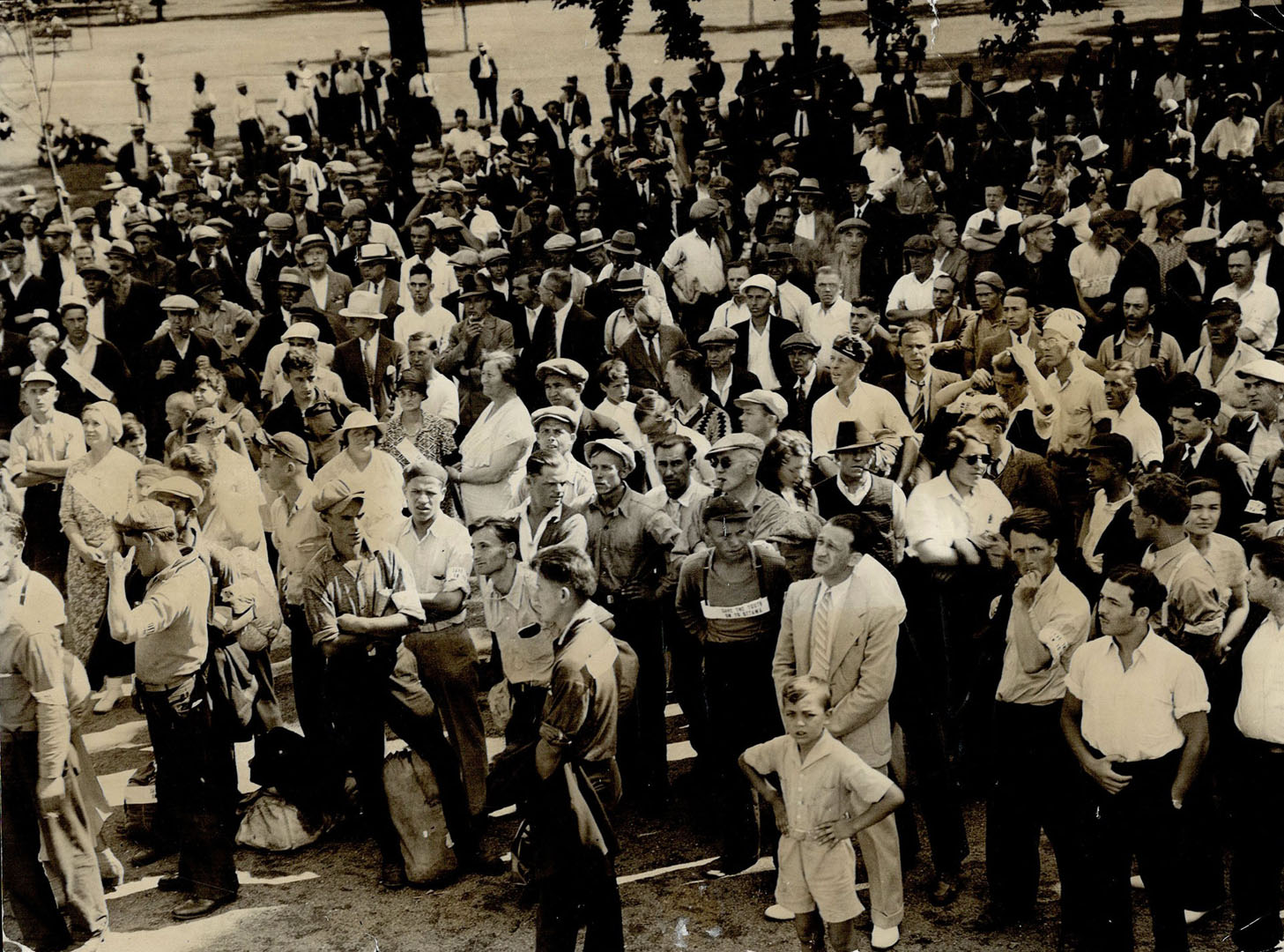
On To Ottawa trekkers, 1,000 strong, left B.C. relief camps in 1935 to board boxcars to take their demands for work and wages to the federal government. (Toronto Public Library)
WE LIVE IN AN AGE of upheaval and uncertainty. How will it end? What was the start?
Did our current epoch start with the havoc of COVID: supply chain disruptions with panic buying and hoarding; hatred of tough health measures such as vaccines; the spread of misinformation?
 Was it the Russian invasion of Ukraine; Israel’s war in Gaza and the threat of conflict spreading like wildfire? Crazy things like former president Trump inviting Russia to invade countries that don’t pay their fair share of NATO defences?
The invasion of homeless: the lives of a generation wasted; the divided sympathy of their plight; the strain of living rough adding a further strain on our health care system already stretched thin to the point of tearing?
Or the deadly drugs that are killing thousands: unregulated drugs concocted by amateurs with fatal results; the plight of the homeless made worse in an attempt to make their dismal lives tolerable?
The widening gap between the rich and poor: those owning homes becoming real estate millionaires while those working at menial low-wage jobs who can’t even afford rent, let alone buy a house?
Unnerving weather caused by climate change: drought and flooding; the lack of water is reducing the capacity of hydro electricity dams; the increasing cost of food; stressed fish in low rivers; dried forests going up in smoke?
How will this era conclude? It’s hard to tell when you’re living inside an era. How the age began and ends is only clear in hindsight.
The Great Depression began in August 1929, when the economic expansion of the Roaring Twenties came to an abrupt end.
Poverty and drought sent young men in search of the next meal.
I find parallels between now and the dirty thirties when my dad, before I was born, ended up in a make-work project building Jasper National Park. It was there that he met my mom who was vacationing there.
The homeless camps that I see along Kamloops’ riverbanks are reminiscent of the dirty thirties.
Ruth Balf provides a graphic view of Kamloops during the depression in her book: Kamloops 1914 – 1945. Because Kamloops was at the junction of two railways, thousands of homeless young men drifted through the city.
Evocative of our current earnest mayor, Hamer-Jackson, C.T Dierks of the Free Methodist Society reached out to the homeless drifters. Unlike the current mayor, Dierks worked with Kamloops city council to secure funding for the Ebenezer Mission that housed 15 to 30 men a night and gave out a total of 2,500 meals.
By 1933, the Province established work camps throughout B.C. Men had to register for the relief program and 750 men registered in Kamloops for work camps. No Orientals were permitted.
The camps, referred to as “hobo jungles,” were set up along the North Thompson. Citizens complained that the men were all degenerates and would not work if they had the chance.
The era ended with World War II when the government stimulated the economy with large expenditures in war.
How will this chapter of history end? In World War III? In the mass construction of homes? Dramatic expenditures in restoring the middle class?
David Charbonneau is a retired TRU electronics instructor who hosts a blog at http://www.eyeviewkamloops.wordpress.com.

 ArmchairMayor.ca
A thoughtful article. There was also an interesting article in the NYT recently where a number of homeless people were interviewed. The article assails the common assumption that these people are homeless by choice. In fact, most of the people interviewed simply did not have the economic means to live under a roof.
The Great Depression illustrates that it doesn’t take a lot to become homeless — for many it’s losing one pay check. Paradoxically, we have the right to an education and health care, but no right to a place to live.
It is sad to see people who are down on their luck scapegoated for the many ills of our society. They’re easy victims because they are defenseless.
LikeLike
You know, there’s an article in today’s Castanet about a group of young children that have gone around their neighbourhood to collect signatures for a petition to install a swing set in their local park.
I feel for these kids, because the likelihood of success is low. Now if they were drug addicts, the city would be bending over backwards to accommodate them. They would be spending bucket loads of money on them.
But a $30K swing set? Sorry. That’s earmarked for the addicts and Byron McCorkle’s salary.
This is what history will look back on. It will document the insanity of our recent years. It will wonder how progressives ruined cities. It will note that the desires of drug addicts have superseded the rights and needs of the community at large. First as tragedy, then as farce. Looking back at the last decade – what a mess our country is in.
To the city – get those kids a swing set.
LikeLike
Good story.
Some might suggest we saw the beginning of this era of strife, when trump was elected in 2016 and proceeded to drive common sense leadership into the ground, then in many spots around the world, ‘globalism’ and liberalism kinda ended, and right wing parties and leaders began to win.
Not unlike in 1929 when Hoover refused to throw nearly enough economic stimulus around, and there was no social safety net to fund … so the great depression became a lot worse and the market and social structures broke down.
Some might say that when trump was elected, the same mood happened, which has fed towards many of the ills spoken of here, resulting in tyrants, dictators coming to power and starting wars or feeding war ideologies … and the growth of other politicians (especially in the States) who are so much more illiterate and nonsensical.
One thing we do know; long from now, historians will look back at this time and wonder how and why people voted for someone like trump in the first place, and if he wins again next year, that will become fodder for future philosophers to ponder a new type of group dynamic they didnt know could exist.
Thankfully, but for the very youngest of us, we wont be around to read such a report.
LikeLike