
UKRAINE – Is NATO to blame for the Russo-Ukrainian war? It’s complicated

(Image: Pixabay.com)
By MARK EDELE
The University of Melbourne
A YEAR AFTER Russia’s all-out attack against its neighbour on February 24 2022, volumes trying to explain the conflict to the public begin to accumulate on my bookshelf. Think-tankers, political scientists and journalists have been at the forefront.
Historians, used to slow-burning research projects, have so far been absent from this developing historiography of the war. This is beginning to change, and it is only appropriate that the lead is taken by one of the most accomplished English-language historians of Ukraine, Harvard University’s Serhii Plokhy.
Plokhy, who grew up in Zaporizhzhia and began his academic career in Dnipropetrovsk (both in Ukraine), keeps his outrage about Russia’s aggression on a tight leash. There are no polemics in this book. The historian lets the facts speak.
Interpretation is provided mostly in the form of narrative. This restraint is remarkable: his sister still lives in Ukraine and a cousin died defending Bakhmut.
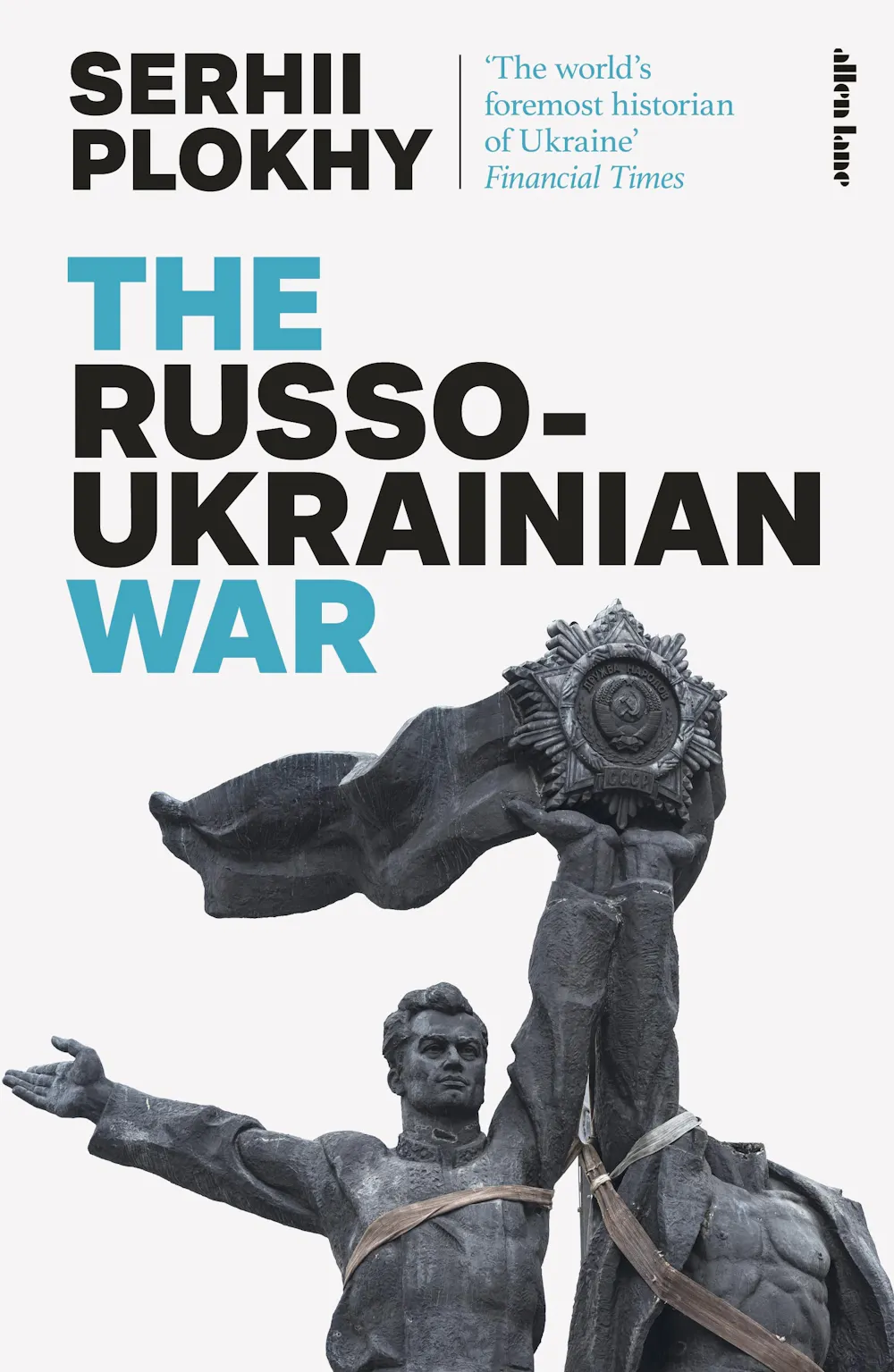
Plokhy prefers “Russo-Ukrainian war” to alternatives like “Russia’s war against Ukraine”. While the latter expression is well suited to emphasising Russia’s culpability in this war, the former stresses that Ukraine is not just a victim of Russia, but its equal.
The confrontation between these two countries has its own history. After the 1991 breakdown of the Soviet Union – in which they had formed two of the largest republics – Russia and Ukraine drifted apart. Russia moved further and further towards authoritarianism at home and imperialism abroad. Ukraine did the opposite. This parting of paths is one aspect of the historical background to this war.
Partially, this divergence was the result of the different position of each country vis-à-vis the Soviet legacy, as Plokhy explains:
In the eyes of the Russian public and a good part of the elite the fall of the USSR as a superpower and empire was a loss for Russia, the Ukrainian elite and much of the public considered it a gain for their country.
Autocratic Russia and democratic Ukraine
Decolonisation looks different if you are part of the metropole (Russia) or one of the colonies (Ukraine). In the first case, nostalgia for past greatness easily inspires revanchism – seeking to aggressively recover lost territory. In the second case, the fall of empire opens up the vision for a better future.
But there were domestic forces too. They encouraged Ukraine’s recurrent democratic corrections, whenever one strongman or another tried to move the country towards autocracy. Here, Plokhy turns perceived wisdom on its head.
In the three decades since the fall of the Soviet Union in 1991, the fragmentation of Ukraine’s political system has been frequently decried. Too many parties; a country split historically and culturally into various regions. Russians and Russian speakers as significant minorities, particularly in the east and the south of the country, as well as Crimea (where they constituted a majority). And a political class competing for power based on regional networks and voter blocks.
In Plokhy’s summary, “Ukraine was divided by history, culture, and the political orientations and instincts of its people as the Russian Federation never was.” Those who imagine a modern democratic nation in 19th-century terms – as a culturally, linguistically and politically united entity – stress all these factors as sources of instability.
Plokhy instead reminds us diversity is good for democracy:
Compromise emerged as the only viable way for the elites to sort out their differences and accommodate one another’s interests […] The country’s regional and cultural diversity, inherited from its long history of rule by foreign empires and states, contributed enormously to the political pluralism of Ukrainian society.
Thus, where in the more united Russia, democracy died in lockstep with the resurgence of imperial dreams, in Ukraine attempts to move towards presidential autocracy were foiled again and again – most dramatically in the revolutions of 2004-05 (the Orange Revolution) and 2013-14 (the Revolution of Dignity).
The further from 1991 we move, the further the rift between an increasingly autocratic and neo-imperialist Russia and a democratic Ukraine, orienting itself away from the old imperial metropole and towards Europe and the Atlantic. The current war is one result of this rift: Russia tried to reassert its dominance and Ukraine resisted subjugation by the old imperial overlord. The Russo-Ukrainian war is a delayed war of Soviet succession.
While it is not entirely clear from Plokhy’s account why this war broke out when it did, his narrative demolishes the popular notion that somehow NATO was to blame. At least, not in the way this thesis is usually understood.
Ukraine did not become vulnerable because NATO embraced it and thereby threatened Russia – which, like a toddler deprived of a favourite toy, was obliged to lash out. Rather, it was the opposite.
Relinquished nukes and worthless promises
First, Ukraine, which had inherited a good part of the Soviet Union’s nuclear arsenal, was pushed by the United States (doing Russia’s bidding) to return its stockpile to Russia.
In exchange, it received economic aid and the beautiful words of the Budapest Memorandum of 1994: Russia, the United Kingdom and the US would respect Ukraine’s territorial integrity, independence and sovereignty – and refrain from using military force or economic coercion against the country. These promises, of course, turned out to be worthless.
Would Ukraine have been better off holding onto its nukes? Maybe, but such a judgement is complicated by the fact, stressed by political scientist Andreas Umland, that most of these weapons “were not deployable, since the launch codes remained in Moscow and Ukraine had no technology to guide its inherited rockets”.
Meanwhile, Ukraine received desperately needed economic aid and established itself as a good global citizen in exchange for its nuclear arsenal. At the same time, Ukraine might have been able eventually to solve the technical problems that hindered its use of the nukes and hence become a formidable regional military power.
With 15% of the Soviet arsenal, Ukraine had “more atomic weapons than the United Kingdom, France, and China combined”, writes Umland. “Even if Ukraine had retained and made operational only a fraction of these weapons, today it would be a much-feared nuclear power.” Would Russia have dared to attack such a country? Unlikely.
Having given up its nuclear shield, Ukraine tried to follow the lead of other countries in the post-Soviet space that successfully found protection under the umbrella of the North Atlantic Treaty Organisation (NATO). Plokhy’s account of the crucial Bucharest summit in 2008 provides an important corrective to popular narratives, promoted by Moscow’s relentless disinformation campaign.
In Bucharest, NATO considered Ukraine’s and Georgia’s applications for a membership action plan, a roadmap to full membership. Although supported by the US and Eastern European member states, they were turned down after pressure from Russia, which made its unhappiness known publicly.
To soften the blow of the “concession to their former master” and hide the embarrassing victory of Russia over the US, NATO asserted that both countries did have the right to eventually join the alliance.
This “non-decision”, Plokhy explains, was “the worst possible outcome of the summit: their applications had been postponed indefinitely”, leaving Ukraine and Georgia “with no protection from the alliance that they had publicly stated they wanted to join. While Russia would not dare to attack NATO, it could easily attack its aspirants, and it did so.”
When Russia illegally annexed Crimea in 2014 and helped unleash a proxy war in Donbas in the east of the country, Ukraine had to face its aggressive neighbour alone. Plokhy’s account of both the annexation of Crimea and the mobilisation of separatists in Donbas eschews shades of grey.
While journalists present at the time depict a complex interaction between the Russian state, nationalist freelancers and local actors (in particular in Donbas), Plokhy tells the story as completely determined by the puppetmasters in Moscow: “the Russian intelligence services organized a push for independence from below.” Future historians will have to sort out the evidence here, once more sources become available.
The result for Ukraine’s defensive position was ambiguous. On the one hand, there was the ongoing war in Donbas; even at times of supposed ceasefire, Ukrainian servicemen died every year in intermittent exchanges of fire. The war pushed any potential NATO membership even further into the unknown future; the alliance was unwilling to even consider it while a hot war with Russia was going on.
On the other hand, however, Russia’s aggression did help arm and train Ukraine, which built a formidable, if still inadequately armed, army. When all-out war came in 2022, Ukraine was in a much stronger position to defend itself, particularly once NATO and the European Union overcame their reluctance to adequately support one of the few democracies in the former Soviet space.
Nevertheless, the counterfactual argument remains: had NATO put Ukraine on an actual path to membership in 2008, would Russia have attacked in 2014 or 2022? Probably not, Plokhy’s narrative suggests.
Important groundwork for history
While Plokhy’s surefooted interpretation of the genesis of this war will help dispel misconceptions, his detailed reconstruction of its first ten months provides important groundwork for a future historical appraisal of this war.
Critics who dismiss the bulk of the book as “just a competent assemblage of press cuttings” completely miss how crucial such work is. Without a chronological narrative of this war, more analytical work is impossible.
There will be a time to use more diaries, memoirs, interviews and archival materials for a fuller reckoning with what happened. But Plokhy has already made a convincing start here, drawing extensively on witnesses who shared their experiences on social media.
After covering both the origins and the first ten months of the war, the book ends on a semi-optimistic note: Ukraine might not be able to recover all its territories, but it will prevail. Russia will not win this war. The afterword moves beyond a putative Ukrainian victory and towards speculation about the war’s impact.
The Russo-Ukrainian war, Plokhy argues, marks the end of the unipolar world that had come into being after the collapse of the Soviet Union. Putin had hoped for multipolarity, with several great powers asserting their spheres of influence. However, what the historian sees emerging instead is a new confrontation between East and West.
The war buried Russia’s hopes of becoming a new global center […] It exposed weaknesses not only in Russia’s clearly overrated and overpromoted army but also in its economic potential.
Its destiny is as a junior partner to Beijing, the new leader of the anti-Western world. Meanwhile, “the West has been rebuilding its Cold War alliance, now strengthened by new members in eastern Europe, the Baltics and Scandinavia”. And “Ukraine emerges on the map as a new Cold War Germany, its territories divided not just between two countries, but two global spheres and economic blocks”.
Future historians will judge whether Plokhy’s vision was correct. Ukraine has not won the war yet, after all. And all kinds of nightmare scenarios, including nuclear war, might still play out.
Whatever happens, historians will draw on this book when assessing the history of this war. Alongside journalists such as Anna Arutunyan, Luke Harding and Owen Matthews, Plokhy has provided an invaluable first draft of a history of this war.
Together with Serhy Yekelchyk’s earlier exposé of the historical background of the Russo-Ukrainian conflict, Plokhy’s book should be on the reading list of anyone trying to understand this war and its consequences.
Mark Edele is Hansen Professor in History, Deputy Dean, The University of Melbourne. This article is republished from The Conversation under a Creative Commons license. Read the original article.

 ArmchairMayor.ca
“A Helmet For Dung Collectors” by Walter Trkla is available on Swans Commentary dated April 24, 2006
Some strong views to be certain.
LikeLike
It’s unfortunate that Alexey Navalny is no longer able to offer his opinion, Mel.
LikeLike
Considering the billions spent directly on war aid and indirectly on their own armed forces, the NATO alliance sure had some intriguing interests in making sure a war of this significance would happen. There is context, there is history and then there are powerful financial incentives. And they keep pushing Canada to up the military spending…just in case.
LikeLiked by 1 person
Should balanced reporting include the fact that NATO and US forces are on Russia’s borders, and the fact that EU and American governments instigated this revolution? Should pointed questions be asked about the history of Ukraine so that the public (the viewers) can really understand who’s involved and why it’s occurring?
Russia is not Serbia, or Libya, or Iraq. Russia has an arsenal of nukes, and the more we attempt to partition it into small units ripe for takeover or to isolate it to gain access to its resources, the more the world is in danger of a nuclear war.
That said, Russia has never attacked others, but it has been attacked: from the East (Mongols); South (Turks); and particularly, the West (Teutonic Knights, Poles, Swedes, Napoleon with a European Army, as well as British, French, and Germans in WWI, and Canadians, Americans, British, and French after WWI, plus Germans with a European Army under Hitler). Every time Russia was attacked, they expanded their territory at the expense of the invader. Russia and many nations around the world have a multitude of significant lessons from history to distrust the western countries.
Harper like Trudeau and Jagmeet did not tell Canadians that the government of democratically elected Viktor Yanukovych wanted closer ties with Russia rather than with the EU. The Neo Nazis Svoboda, UDAR, and the Right Sector (with support from the West) were instrumental in deposing Yanukovych. And, with this action, the move away from the EU was quashed, benefitting the west economically. The Nazi UDAR and Svoboda were on the EU and NATO side rather than Russia’s, thus they had to be seen as attractive partners, thus disregarding their Fascist history.
To Harper, Trudeau Jagmeet these Fascist became our allies sop we saluted their predecessors , and portrayed them as “worthy,” regardless of their history even though that history included murdering their own people like UDAR and Svoboda rioters did in Maidan. Even our present deputy prime Minister Freeland who was a CIA asset in Kiev at that time called her Nazi grandfather a “freedom fighter.”
We (the West) call ourselves “reformers” when we engineer a regime change for our own benefit, while the regime that wants to remain as they are labeled by our press and government as a “hardliner,” despot, or some similar easy-to-understand label like Axis of Evil to create the necessary impression. When we (our side) kill in war and innocents die, it’s called collateral damage, while when nations that simply don’t agree with us or follow our leadership engage in warfare, it’s called violence, murder, oppression, or genocide. Those words create an image, which has led people in Ukraine (eastern and southern) regions to vote with their feet as they are now demanding to join Russia.
All three political parties in Canada condemned Russia over Crimea and over the present conflict but did not condemn NATO which caused the conflict. This was done to appease the Ukrainian voters in Canada, even though a democratic vote was taken in Crimea to join Russia. However, this action shows our petty selfish prejudices, since these same parties supported Kosovo independence after they supported 78 days bombing of Serbia to detach Kosovo, which was part of Serbia for 2000 years. Once again, our politicians find it easier to support who we think are our friends, rather than the rule of international law. America and NATO have a policy paper in their front pocket for separatism that they support and another policy in their back pocket for a similar situation that they oppose.
LikeLiked by 1 person
America’s mingling is quite possibly the reason of the recent Haiti crisis too.
LikeLike
Honestly, I have to agree with most of this reports analysis of Plokhy’s assessment.
Although like it says, the only real way to determine the accuracy is by a future reconsideration of history … it makes a lot more sense than the simplistic idea that Ukraine wanted to be a member of NATO, therefore Putin invaded to ensure it didn’t due to missile flight time to Moscow, from such an advantageous eastern point of launch.
What this assessment or the report doesn’t include is Putin’s assertion that he views the world as Civilization-States as apposed to Nation States. This conception of statehood is where the formal mechanisms of government power protect a specific culture and its traditions in whatever territory such culture and traditions exist.
Culture, rather than politics or borders, lies at the heart of statehood under this theory. Recognized national borders do not matter as much. What matters, is the presence of a cultural tradition. This is part of the reason why Putin considered Ukraine to not be a real state, but rather a construction of the West’s post-Cold War international order based on the Westphalian and Versailles system.
To him, Ukraine is an extension of the Russian civilization because of the time Ukraine spent under successive Russian authorities creating the large presence of ethnic Russians and Russian-speaking people within its borders.
Putin is not alone in this belief system: Xi Jinping, Narendra Modi, and Turkish President Erdogan are all believers in the idea. Even Netanyahu has been called a proponent of the civilization-state viewpoint.
I only bring this up because … besides Putin’s maniacal drive of expansionism for personal gratification, and aside the argument of protection of existing borders with NATO … understanding his worldview on nation borders vs cultural borders should not be understated as a primary reason for invading Ukraine.
Someone with a belief system like this, in positions of power like him, Xi, Modi and Erdogan need to be watched, as they literally don’t draw borders the way the rest of the world does … and that alone should be a security concern.
LikeLike
David do you agree with any of this and if not Varify where this is not true
USA spent $5 billion to overthrow a legitimately elected Ukrainian government (Nuland)
USA attempted four colour revolutions to overthrow the existing government in Ukraine (look it up)
The coup leaders killed their own supporters and police to inflame the situation (Kochanowski Ukrainian Professor U of Ottawa)
The breakaway territories were attacked killing 14,000 people
Ukraine that has failed to live up to all of the 13 clauses of Minsk-2. But the EU sanctioned Russia who was not a party to either Minsk 1 and Minsk 2 (look it up)
Minsk 1 and Minsk 2 were used to stall in order to rearm Ukraine (Poroshenko former pres. of Ukraine)
The very first action that was taken by the coup government under Yatsenyuk was a bill that made Ukrainian the only legal language in Ukraine. What would Quebec do if we passed a bill which made English the only legal language in Canada? (Look it up)
Crimea had been part of Russia since 1783 but was “gifted” to Ukraine illegally by Khrushchev in 1954. (Taken from the Turks)
Kievan Rus (Russian Ukrainians same people)
Also, shortly before the dissolution of the USSR, Crimea voted in a referendum on January 20, 1991 to rejoin the Russian Federation, by a vote of 94% (with an 80% turnout). Ukraine passed a law that the whole nation had to vote. When Quebec voted twice and Scotland once it was not a national vote. (Hypocrisy)
in 2010, the UN International Court’s Advisory Opinion concerning Kosovo indicated that “international law contains no prohibition on declarations of independence,” which was a clear-cut endorsement of Kosovo’s declaration, which had been done without a referendum. (More hypocricy)
We write the history Conformity is society’s most powerful control mechanism. Those who don’t go along to get along can pay a very heavy price. Just ask Malcolm X, JFK, RFK, MLK and many other like Allende, Mandela, Milosevic, Hussein, Kaddafi, Hammarskjold, Lumumba, and so on
Key issue Citizens of high currency countries, USA, Canada, France Switzerland Germany and so on benefit in trade cheaper goods . The BRICS wanted to trade in domestic currencies eliminating the middle man (high currency countries). The war with Russia is an attempt by USA to stop dedollarization.
LikeLike
David,
I might suggest that you read “A Helmet For Dung Collectors” by Walter Trkla. Swans Commentary April 24, 2006
LikeLike