
GUEST COLUMN – Why Judge Begbie sentenced six fugitive chiefs to hang
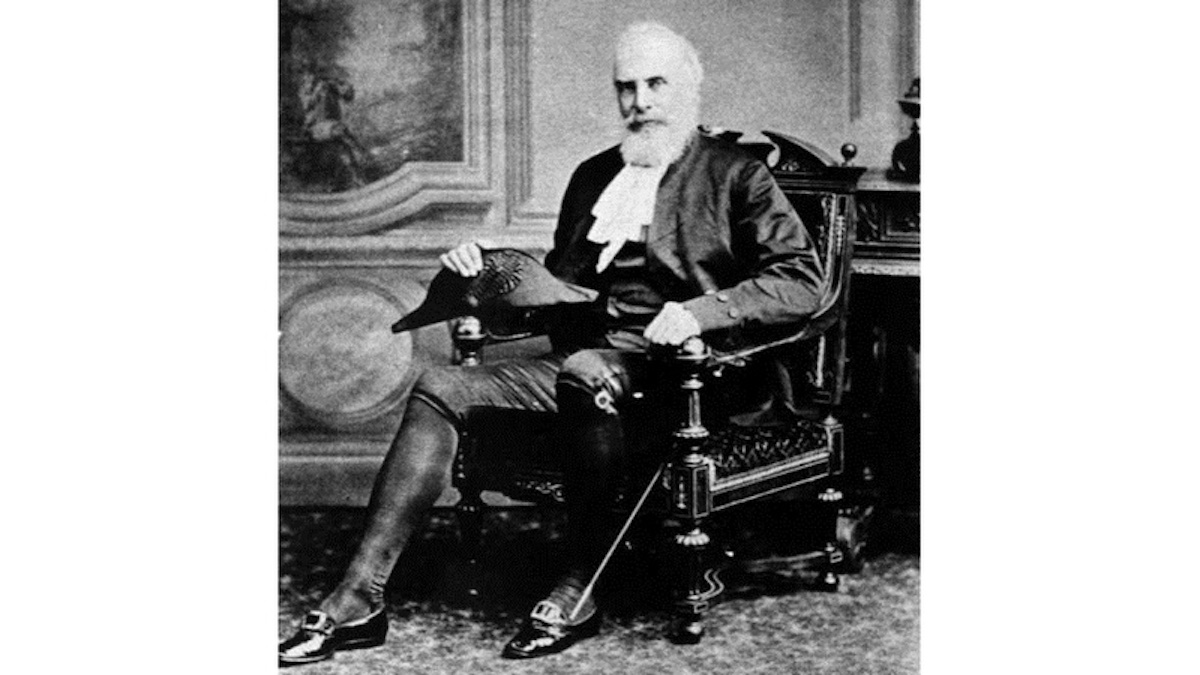
Judge Begbie. (Image: PABC)
By LYNNE STONIER-NEWMAN
Guest Columnist
LYNNE STONIER-NEWMAN here, author of the early B.C. history nonfiction book: PETER O’REILLY: The colonials who decreed and imposed British Columbia’s Indian Reserve lands.
Lynne Stonier-Newman.
After reading David Shawn Taylor’s HISTORY: British Columbia’s greatest judge deserves a fair trial of his own. (published in the Armchair Mayor on Sept. 10, 2023) I have more historical details to add.
I certainly agree with Taylor’s concern about how the widely respected and principled Sir Mathew Begbie is being wrongly maligned for the six chiefs’ hangings. As well, I agreed the history of what has become labelled The Chilcotin War remains confusing and I want to expand on why the ongoing discussion needs to continue.
In my opinion, trying to erase B.C. Chief Justice Sir Matthew Begbie’s reputation of being a fair and respected judge, is a weird historical rewrite, benefitting no one.
I also question whether Prime Minister Justin Trudeau’s 2018 apology was correct in light of the actual history. B.C. Gold Commissioner and Magistrate W. George Cox did betray fugitive Chief Klatsassine and the five other fugitive Tsilhqot’in chiefs but they had brutally murdered eighteen colonists without any agreement or support from their fellow Chilcotin Nation’s chiefs.
When Cox laid criminal charges rather than the prisoner-of-war charges as authorized, he changed the legal options available. And Begbie’s history is now being rewritten by some who considered him solely at fault for the chiefs’ hangings.
When I wrote Peter O’Reilly, I researched many sources including Mel Rothenburger’s book, The Chilcotin War. And my editor was TouchWood’s Marlyn Horsdal, who was knowledgable about that era’s archival resources, having published “…The Man For A New Country – Sir Matthew Baillie Begbie” by David Williams,
In my opinion, what discussions about Sir Matthew Begbie’s actions often miss are the consequences of George Cox’s betrayal of those six fugitive Tsilhqot’in chiefs.
Another factor usually ignored is that Governor Seymour had only arrived in New Westminster on April 22, 1864. He’d been immediately sworn in as the Colony of B.C. governor by Justice Begbie, giving him the retiring Governor James Douglas’ powers.
Seymour was gracious as his arrival was celebrated but later wrote he was horrified with how raw New Westminster was. Massive tree stumps and mud were everywhere and the unfinished rough timber house built for him was unsatisfactory. When he’d left England, Seymour had projected entertaining and governing from a comfortable manor.
As well, Seymour’s new duties differed radically from his only former governing experiences, 16 years in the West Indies and his two earlier British Empire administrative positions in Tasmania and Antigua.
Yet he promptly informed Brew, O’Reilly and other senior colonial administrators that he’d much experience in managing Natives … and added he believed Native populations were the same, worldwide.
The officials under his direction soon began privately sharing their concerns as well as recording them in daily diaries. Governor Seymour was not as interested as they’d expected in the complex information available about B.C.’s native tribes and the vast differences between them.
Nor was he interested in details about the Fraser’s earlier gold mining conflicts or in the many tribes’ devastation by the smallpox epidemic in 1862 or about how B.C.’s challenging geography and weather shaped its governance.
And all soon learned he also did not ride a horse, insisted on always having a coach despite a road’s condition …
Which was why almost four months later, O’Reilly ended up renting a Barkerville madame’s carriage with its red velvet upholstery for the governor when he and entourage arrived to assess the searchers’ failure to apprehend the fugitive chiefs and to inspect the Cariboo gold mines.
Seymour bounced many miles as he accepted that despite the horrendous amounts of colonial funds spent, the exhausted special constables did not project apprehending the fugitives. But the six hunted chiefs were reportedly almost without supporters or resources to survive the coming winter.
Before returning to New Westminster, the governor met with his officials, including Brew and O’Reilly. After weighing what to do, Seymour decided since the Navy had been involved, he could authorize offering the fugitives a surrender as prisoners-of-war. He directed Brew to send a messenger to Cox at Fort Chilcotin, authorizing him to make that offer of being treated as a prisoner-of-war.
Cox sent out the translator to make that offer, then when each of the chiefs surrendered, he betrayed them, charged each with murder.
The italic excerpts below are from Peter O’Reilly: Chapter Six – May Day Celebrations and the Chilcotin War, and provide more details.
In mid-May, an agitated O’Reilly told Carry, “I have to catch the stage in two hours.”
“Why? Are you going up to the Cariboo?”
“No, I’m off to the Fraser Canyon. There has been a dreadful massacre on Waddington’s road, up above Bute Inlet.”
The Chilcotin Indians employed on the project had killed the other road workers—and, almost as shocking, it had happened almost two weeks ago.
Governor Seymour had immediately feared it might be the first of many Indian rebellions and had asked for naval assistance, both to patrol the coastal areas and to investigate the massacre. He had ordered Chief Inspector Brew to send someone up the Fraser Canyon because he had decided that the Fraser River should be blockaded at Hope. He also wanted all Indians informed that the May Day celebrations were cancelled.
Brew had convinced the governor that it would be difficult, if not impossible, to stop traffic from using the Fraser; there was no physical way to erect a barricade there. Nor, at this late date, would it be feasible to cancel the annual May Day festivities.
The chief inspector then told O’Reilly to go to Yale and assess the Fraser region. “Find out what’s happening there, whether those Indians are aware of the massacre. We need to know how many of them might be supportive of the suspects —and if there are any signs of organizing for a future uprising.”
O’Reilly mulled the situation aloud to his wife as she packed his travelling trunk. “Carry, I do not expect all the Indians will revolt.” He told her that the men most knowledgable about the colonies’ tribes, particularly James Douglas, felt there was no possibility of all B.C. Natives joining together against the white population, because each group was an entity unto itself …
The road workers had been murdered up in the isolated coastal mountains above Butte Inlet where they were attempting to build the first road into the Chilcotin lands. The massacre and the subsequent almost four-month pursuit of the fugitive chiefs became know as The Waddington War or The Chilcotin War, though war was never declared.
After Seymour requested the British Navy’s assistance, HMS Sutlej with 515 officers and men, 35 broadside guns and a chase gun was sent to search the ragged and island-strewn coastal waters and to transport Chief Inspector Brew, 40 special constables and horses to Bella Coola.
That village was an estimated 300 miles from Fort Chilcotin and Brew’s men were to search that Chilcotin wilderness for the fugitive chiefs. As well, George Cox was replaced as the Cariboo’s gold commissioner by O’Reilly, then sent to Fort Chilcotin with a troop of special constables who were to search Puntzi Mountain and Fraser River areas.
When the fugitives were still at large four months later was when Governor Seymour made the decision to offer each Tsilhqot’in fugitive chief a surrender as a prisoner-of-war.
Cox was directed to send out the interpreter to make that offer to the chiefs’ representative. With almost no other options, each chief decided to accept and arrived at Fort Chilcotin to surrender.
That’s when Cox betrayed each one, and his superiors, by laying unauthorized murder charges before transferred his prisoners to the small Quesnel jail.
O’Reilly learned Brew was now in Quesnel and angry that Cox had not laid the prisoner-of-war charges as directed.
… O’Reilly immediately rode over (from Barkerville) and went looking for Brew. The chief inspector looked dreadful, and when O’Reilly said he looked much thinner, Brew admitted he’d lost over 40 pounds and said it had been a difficult four months.
He remained distraught about the situation and now distrusted Cox, who had not followed Brew’s orders about how the arrests were to be made and had jeopardized the trials. Brew confided that when Begbie came, he intended to confer with him before writing up his summary and returning to New Westminster to report to the governor.
“Do you expect Mr. Cox to be replaced as the Cariboo West’s gold commissioner?” O’Reilly asked.
Brew shook his head and predicted that Seymour would decide to keep him, since most British Columbians would consider Cox a hero. The residents of Quesnel were hosting a celebratory dinner, but Brew had declined.
“I claimed ill health because I do not believe the way the long hunt ended is an occasion for jubilation. I have allowed Mr. Cox to attend.”
O’Reilly asked if Brew felt like joining him for a meal in the government quarters. While they ate, the chief explained his concerns. During the negotiations with the Chilcotins’ representative, Cox had warranted through an interpreter that each suspect would be given rights as a prisoner-of-war. Then, when the fugitives had accepted those terms and had presented themselves at Fort Chilcotin, Cox had not sent for Brew as ordered but immediately imprisoned the men in chains. He had neither conformed with nor acknowledged the prisoner-of-war terms he had offered but, instead, had charged each suspect with murder.
O’Reilly was unable to contain his dismay. Both he and Brew understood how much civil law differed from military-based regulations. They also knew that the Indians could justifiably accuse Cox of having spoken with a forked tongue and that his action could negatively affect future interactions with all officials. Under Douglas’s governorship, first during the fur-trade and then the colonial era, the Queen’s men had prided themselves on their honesty.
“This is a new situation,” O’Reilly acknowledged, knowing how upset Brew was that one of his men, a gold commissioner and magistrate, had been blatantly untruthful.
The Chilcotins’ trials began in Quesnel, heard by Judge Begbie. As all had expected, guilty verdicts were quickly returned by the jury. In each trial by jury of a Tsilhqot’in chief, Judge Begbie had to follow British criminal law. The outcome was all the chiefs were found guilty with the only penalty feasible to being sentenced to hang. As usual, Judge Begbie then had the death sentences reviewed by the B.C. Executive Council and Governor Seymour.
Governor Seymour was advised by various private citizens to implement clemency as was within his power. He did not. Klatsassine, Tellot, Tahpitt, Pile and Chessus were hanged on the morning of October 26, 1864, as their fellow tribal peoples and residents from Quesnel watched. (Chief Ahan was hanged the following year in New Westminster.)
Those hangings distressed Brew, O’Reilly and many of B.C. administrators and legislators. They privately asked each other, “What will the consequences be?”
Now, we’re still experiencing those consequences, 168 years later. And like David Shawn Taylor, I believe we’re wrongly dishonouring B.C. Chief Justice Matthew Bailie Begbie by ignoring the factual history and believing the myths.
And I also continue to question Prime Minister Trudeau’s 2018 apology on Canadians’ behalf for those hangings.
As the Armchair Mayor wrote about the Chilcotin War in his March 31, 2018 editorial: “The Justin Trudeau government, assisted by all opposition parties, this week completed a masterful rewriting of history.”
I agree. Editing and rewriting B.C. history does not change what happened. ….
Lynne Stonier-Newman is a resident of Kamloops. She’s a social marketing and communication consultant, and a B.C. historian and author.

 ArmchairMayor.ca
How could Cox be ordered to arrest the Chiefs as ” Prisoners of War” when no “war” had been declared? He and his constables could just have easily employed frontier justice and executed the Chiefs on the spot or on their trip to Quesnel, no one would have been the wiser. The fact they didn’t suggests Cox was interested in seeing “justice” done. 24 natives were involved, but only 8 arrested and two of them were paroled and left, according to Begbie, “Quite unmolested” prior to the hangings. What’s particularly annoying is more has been made of Cox’s so-called betrayal than the brutal murders of 19 mostly unarmed victims, one of which at the ferry wasn’t on Tsilqhot’in land.
Re: Klatssassin’s comment to Begbie, “We meant war not murder”. Is remarkably similar to Chief Leschi’s comment at trial in 1858 ( just 6 years earlier) for the murder of 2 US soldiers in the Yakima Wars. A profound defense or a convenient excuse? Was Klatsassin born and raised in Chilcotin? His name translates as if he were a complete strangers. Could he have fled the Yakima conflict and brought this “defense” with him? Or had he been in contact with other natives who had heard of Leschi’s comment?
If this was a “war” since when was Canada ever obliged to apologize, recognize, exhonerate or pay reparations to enemy combattants?
LikeLike