
JOHNSON – Another side to what Canada learned at the G20 summit in India
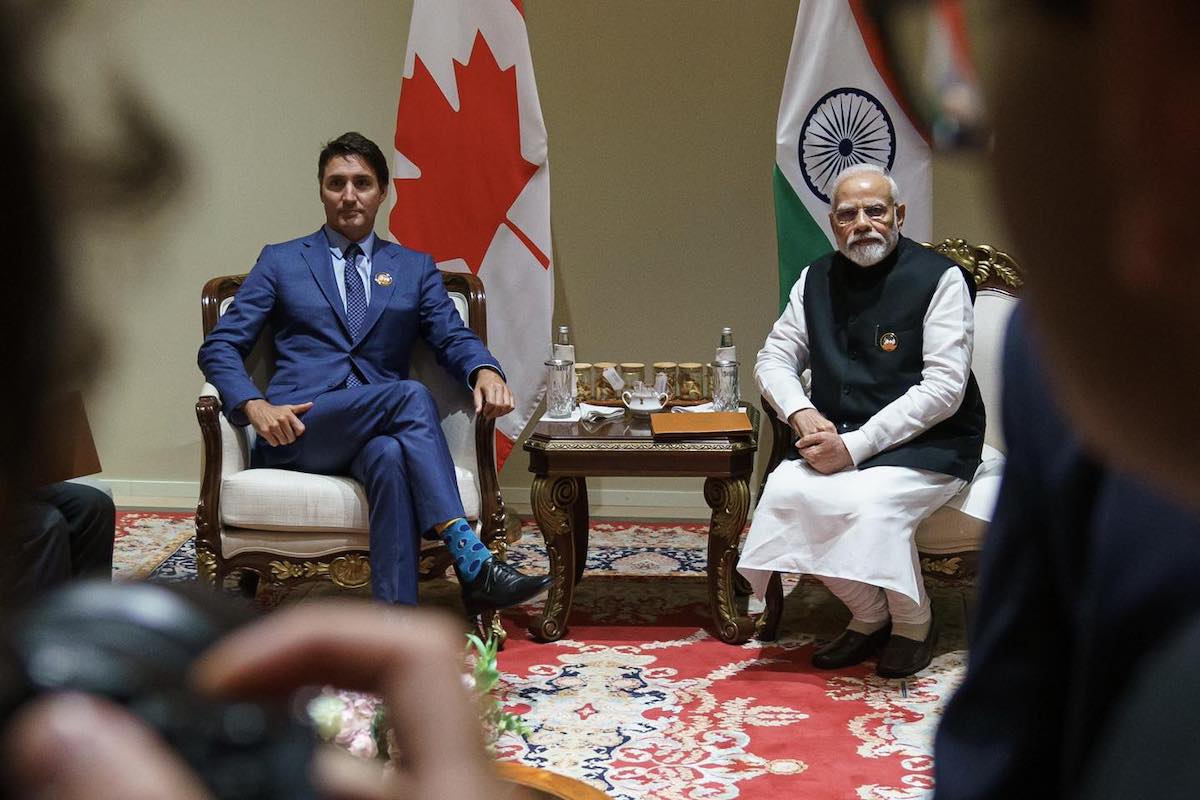
(Image: Justin Trudeau, Facebook)
SO, THIS WEEK is all about Trudeau being stranded at the G20 summit in New Delhi due to an aircraft technical failure, and the connected story about Indian Prime Minister Narendra Modi trying to dress him down for not responding the way India wants him to regarding Khalistan protests in Canada.
 All in all … not a good week.
The summit that did not go as expected for Trudeau. Although some positive results regarding trade came from his meeting with some world leaders, worldwide public focus was definitely on his short discussion with Narendra Modi, India’s Prime Minister.
While Trudeaus plan was to discuss apparent Indian involvement regarding interference in Canada’s election process, which he did bring up, Modi was prepared to backlash with what can only be termed as trying to jam Canada into the rhetorical fray of India’s internal squabble regarding the Khalistan Sikh separatist movement.
In short, the Khalistan movement is a separatist movement seeking to create a homeland for Sikhs by establishing an ethno-religious sovereign state called Khalistan in the Punjab region.
The Modi government has relegated this movement as ‘terrorist’ by definition, and some of that can easily be considered as appropriate, as the genesis of this movement is responsible for many past acts, including violence against the Indian government, its people and other peoples around the world.
The initial call for a separate Sikh state began in the wake of the fall of the British Empire back in the 1940s. With financial and political support of the Sikh diaspora, the movement grew through the 1970s and 1980s.
Prime Minister Indira Gandhi was assassinated by Khalistan extremists, and the bombing of Air India flight 182 in 1985 was caused by a very extreme arm of the same angle of Sikh separatism. There are extensive examples of other violent acts within India throughout the decades.
It is fair (albeit with very different histories and goals) to compare the reality of the desire behind the acts of the Khalistan movement with the Palestinians in Israel.
There are many persecuted Sikhs in India who would say that the Indian government is as criminally guilty as the Israeli government is, regarding unequal retaliation against the movement. A Khalistan protest peacefully waves signs, and the government responds with bullets and prison time.
As it is in all parts of the world that would like to separate from a larger country, the vast majority of Khalistan separatists are peaceful people who just want political autonomy and to be left to self rule, not unlike Palestinians in Israel.
One could say that the same cyclical violence we have seen for ever in Gaza and the Golan Heights, has been the norm between the Indian government and the Khalistan movement. Atrocities on both sides, blame being passed around equally.
Indian governmental, public and media programming has long laid the groundwork for the populous in and outside of India to see the Khalistan movement as simply violent extremist and terrorists, when in realty extremism is in the tiny minority within the larger group in India that are peaceful peoples who just want self governance. Again not unlike Israel.
Outside of India, the Sikh diaspora around the world also call for a peaceful Khalistan independence, with yearly protest demonstrations happening in many western countries.
An interesting aside is an internal generational divide within the Sikh community worldwide. The older generation of peaceful Khalistan separatists, who have lived through decades of mistreatment by the Indian government, are by percentage the bigger group still pushing for independence. That’s both in India and within the diaspora communities abroad.
This is in contrast with a younger, educated and perhaps more intellectual generation of Sikh that are not convinced that attaining true independence is a good or a wise thing. They wonder just what the functional blueprint is for economic independence, and just don’t see it happening within the reality of the proposed Sikh economic Punjab region.
Some of this younger generation that I have spoken to, draw a parallel between the Khalistan movement and past Quebec independence drives. Culturally speaking, it is an obvious and an easy-to-define step of self determination, but is fraught with the reality that brings into question … just how will this autonomy economically survive on its own?
This particular Punjab region has limited economic drivers, limited natural resources and no industries capable of economically supporting its own people without the additional support of the Indian government.
An interesting aside … India just recently crossed the barrier as the most populated country on earth, just bumping China off of top spot with more than 1.5 billion people. At the same time, only 2% of Indians pay any tax at all. Much of their society has always operated in the secondary cash economy, far from the reaches of government. A culture has long existed, that sees paying the government taxes as a personal failing, so it is actively avoided.
Just imagine if India manages to collect taxes from a 1.5-billion-person revenue stream; it would undoubtably be the most powerful democratic economic power on the planet, by a very long shot.
But that would likely be a long time after you, me and this year’s G20 Modi / Trudeau – Prime Ministerial public spat about Khalistan expats.
The Indian government has long claimed that “Khalistan extremism” is “backed by Pakistan and Khalistani sympathisers” in Canada, Italy, and the U.K. … and this is the rhetorical bus that Trudeau was tossed under by Modi.
Obviously, all Trudeau could do, like all Canadian PMs before him including Harper, was to state that freedom of speech and to protest, is a protected right in Canada, and that includes the Khalistan diaspora.
This particular recent local Vancouver protest included large crowds of voters, who lined up to cast votes on a non-binding referendum on Khalistan independence, part of an international messaging campaign on behalf of Sikhs in India.
On the same day, Indian PM Modi expressed “strong concerns” to Trudeau over “Canada’s handling of the Punjabi independence movement” among the overseas diaspora, and questioned why Trudeau didn’t do something to quell the terrorist threat.
It seems like after 15 short minutes, Trudeau walked out of the meeting. A wise response to being drawn between two sides in an internal Indian debate.
It seems that Modi and his government have learned the language of democratic rhetorical messaging. The truth is the Vancouver protest leaders never said they wanted to physically harm anyone, but very clearly said they wanted to do ‘political based harm to a government keeping them from attaining independence … with the pen and with referenda’.
That, in Canada, is protected speech, in fact the design of speech the Canadian Charter of Rights was actually created to protect in the first place.
The Charter is also razor clear that the government can not interfere with a peaceful protest that complies with Canadian law and local regulation. Just because a foreign government disagrees with the subject matter involved, that is no reason for the Canadian government to act against its own Charter.
Apparently, in the Indian Government ideal, democracy somehow means I can not give speeches about governmental change without being branded a terrorist. If that were true here in Canada, just how many Facebook, Youtube and other social media commentors would be tagged as terrorist for their anti Trudeau views?
Any time that someone here says that Trudeau has ‘destroyed our democracy’, know that their ability to say that publicly without government retaliation is actually proving them wrong. Democracy is destroyed when you can no longer speak out at all.
India is today’s example of how anti gubernatorial political speech is responded to in a country where democracy is more tenuous, and you’re not protected by a Charter.
That’s … what we learned at the G20 meeting this year.
At least Trudeau got to spend another 24 hours sitting in New Delhi, … wondering why he bothered going at all.
David Johnson is a Kamloops resident, community volunteer and self described maven of all things Canadian.


Did you know how they spell “heaven” in India?
C-A-N-A-D-A
LikeLike