
LETTER – FPTP, not proportional representation, causes instability
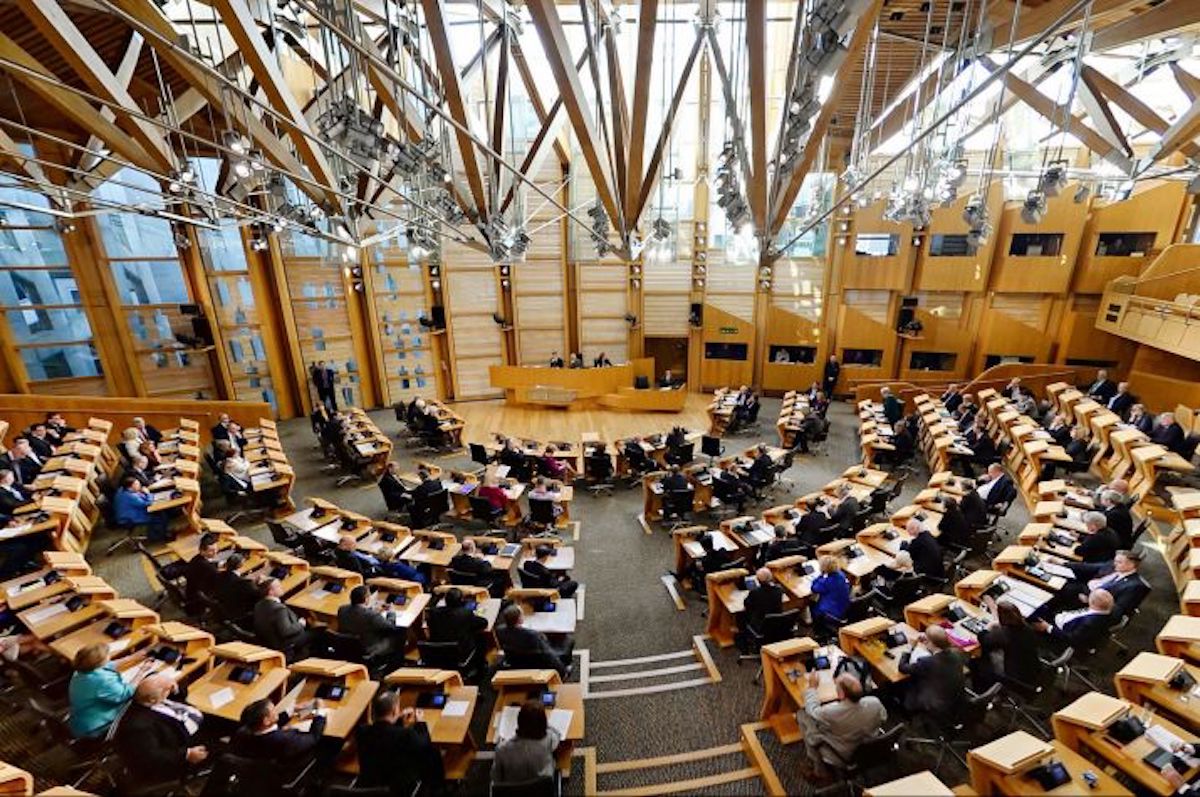
Scottish Parliament.
The Editor
Armchair Mayor
Dear Editor
Some commentators on the forthcoming referendum on the future voting system for British Columbia have suggested that PR would result in government instability. In our experience in the UK, it is FPTP that has caused political instability. FPTP manufactures artificial majorities for parties that have only minority support among the voters.
Worse, FPTP then causes a complete change of government when there is a comparatively small change in the voting at a subsequent election. One minority replaces another, but usually with a grossly exaggerated majority of seats.
We experienced this in the UK particularly in the succession of elections after 1945, when Labour was replaced by Conservatives who were then replaced by Labour only to be replaced by Conservatives. At each change of government there was complete change of policy: nationalise, denationalise, renationalise, denationalise again.
It was the same in every area of economic and social policy, including health and education. Gross policy instability, and consequent lack of progress, arising directly from the distortions of the defective FPTP voting system.
Some call it “strong government” when a party with only minority support among the voters can ram through its policies based on an artificial majority of seats manufactured by FPTP. But those of us who lived through the repeated policy reversals have quite a different view. There is nothing “strong” about government where the central policies of one party are reversed by its successor in government only to be reversed again, and again.
At least with PR small changes in the votes are reflected in small changes in the seats and, usually, small changes in policy. If the voters want a big change they can bring that about with PR, but then the change will properly reflect the wishes of the voters.
JAMES GILMOUR
Edinburgh, Scotland

 ArmchairMayor.ca
I don’t know what all the hoopla and fear-mongering is about proportional representation: Here are just a few countries that vote via a Proportional Representation method: Australia, Austria, Belgium, Czech Republic, Denmark, Finland, Germany, Greece, Greenland, Iceland, Ireland, Northern Ireland, Liechtenstein, Luxembourg, Malta, Netherlands, New Zealand, Norway, Portugal, Spain, Sweden, Switzerland. These are just some of the democratic countries in the world that have a proportional representation voting system.
LikeLike
I’m not sure about this numbers game. You list 23 countries governed with PR. By my count, there are also at least 25 countries governed by dictatorships.
LikeLike
Northern Ireland – 626 days with no government. Sweden – over a month with no government because they won’t work with a “fringe” party that got 17% of the vote. Germany – rise of the Nazis part zwei. Australia – New PM every 1.5 years. Really not sure why people think prop rep is a panacea.
LikeLike
A well presented article from the UK that clearly tells of large problems with FPTP. Good evidence!
LikeLike
Australia as a country doesn’t use Proportional Representation system, so its many elections (which use First Past the Post) are for other reasons. Only its Senate, its Capital Territory, and Western Australia’s Upper House use proportional systems, namely Single Transferable Vote (STV)
LikeLike
Why not start thinking about the ultimate in Pro Rep government and the most stable less dictatorial gov’t and bring in a transition to Non partisan gov’t. Increasing the number of “Free ” votes would bring about the slow transition and a greater understanding of the benefits of non partisan gov’t.
LikeLike
“There is nothing “strong” about government where the central policies of one party are reversed by its successor in government only to be reversed again, and again.”
I would certainly concur with this summary statement well backed up by the writer’s considerable experience with the policy lurches forced by FPTP governments in the Old Country. But the reason I concur is because we have had exactly the same experiences here in the New Country. To find the most recent example, excluding the policies of the present duality government, one only needs to remember back to the final desperate platform proposed by Christy Clark. It was a shocker! To hold onto power her agenda completely reversed the policies they had so recently run on. That cooked not only her party’s chances, but her own as well. Talk about flip-flop! Wow!
LikeLike
Mr. Gilmour makes a very good point about our current system. There is no continuity in gov’t policy. A slight change in voting percentages in an election can result in a new gov’t which institutes a radical change in policy. A case in point here is what has happened in the U.S which swung from Obama to Trump — even though Mr. Trump lost the popular vote. In a PR system, these radical changes in policy would be hard to push through without a radical change in voting patterns.
LikeLike
This is the most interesting letter/insight/opinion I have read in a long time over the subject and it coalesce disconnected but similar thoughts I had over “repeated policy reversals”.
Excellent!
LikeLike