
SUZUKI – Anthropocentric view ignores crucial connections
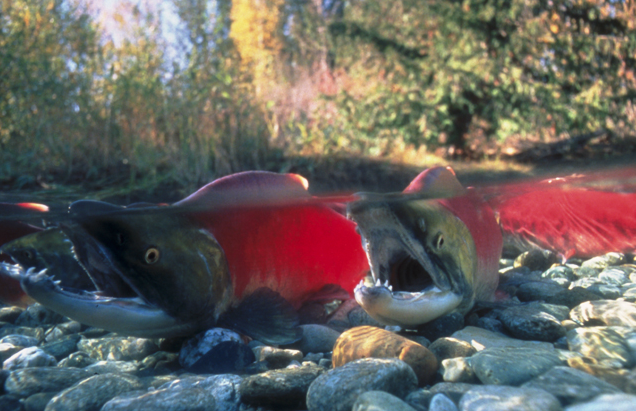
Adams River sockeye. (B.C. Parks photo)
FOR DECADES, scientists have warned that we’re on a dangerous path. It stems from our delusion that endless growth in population, consumption and the economy is possible and is the very purpose of society. But endless growth is not feasible in a finite biosphere. Growth is not an end but a means.
 Humans are one species among countless others to which we are connected and on which we depend. Viewed that way, everything we do has repercussions and carries responsibilities. That we are part of a vast web is a biocentric way of seeing that we’ve followed for most of our existence. But in assuming the mantle of “dominant” species, we’ve shifted to thinking we’re at the centre of everything. This anthropocentric perspective leads us to imagine our needs and demands supersede those of the rest of nature.
The failure to see our interconnectedness and interdependence is most striking in the way we manage government affairs. Forestry, environment and fisheries and oceans ministers’ priorities are not to protect forests, the environment or fish and oceans, but to rationalize our actions and ensure that whatever we do benefits us.
In an anthropocentric world, we attempt to manage important factors through separated silos, shattering the sense of interconnection. We draw arbitrary lines or borders around property, cities, provinces and countries and try to manage resources within those boundaries. But salmon may hatch in B.C. rivers and migrate through the Alaskan panhandle along the coasts of Russia, China, Korea and Japan before returning to their natal streams. To whom do they “belong”?
How do we manage monarch butterflies born in Ontario that travel through numerous U.S. states into Mexico? Grizzly bears are protected as an endangered species in the U.S. but can be shot if they cross into Canada.
This absurd disconnection was illustrated when provincial first ministers and the federal government met to discuss climate change and health in December. It was an opportunity to recognize the enormous health implications and costs of climate change. Instead, talks proceeded as if the two subjects were unrelated.
The repercussions of a mere 1 C rise in global average temperature over the past century have been enormous. In 2015, climate negotiations in Paris were meant to signal a shift away from fossil fuels to prevent an increase of more than 2 C this century. Though the Paris commitment dictates that most known deposits must be left in the ground, governments like Canada’s continue to support new pipelines and continued exploitation of fossil fuel reserves. Efforts by Canada, the U.S. and other major greenhouse gas emitters have been so minimal that scientists now openly discuss global temperature rises of 4 to 6 C this century. Because we can’t seem to curb our emissions, many suggest we must geoengineer the planet!
As top predator, our species remains dependent on clean air, water and soil and biodiversity, making our ability to survive catastrophic planetary disruption questionable. Surely that should be a top line in discussions about health.
At the December meeting, having ignored the effects of climate change on health, our political representatives simply assumed health-care costs will rise steadily (they have) without attempting to understand the cause. Instead, they focused on provincial demands for and federal resistance to annual payment increases. But health costs can’t continue to rise indefinitely.
We are accelerating degradation of the very source of our lives and well-being — air, water and soil — through massive use of pesticides, artificial fertilizers and literally tens of thousands of different molecules synthesized by chemists. Scientists suggest up to 90 per cent of cancer is caused by environmental factors. It’s lunacy to ignore widespread and pervasive pollution as a primary health hazard. What we put into the biosphere, we put into ourselves.
If we want to keep health costs from rising, we should focus on keeping people healthy rather than dealing with them after they’re sick. The highest priorities must be to stop polluting the biosphere and clean up what we’ve already dumped into it. Most importantly, we have to rid ourselves of anthropocentric hubris and return to the biocentric view that we are biological beings, as dependent on the rest of nature for our survival and well-being as any other.
David Suzuki is a scientist, broadcaster, author and co-founder of the David Suzuki Foundation. Learn more at http://www.davidsuzuki.org.

 ArmchairMayor.ca
Davey Crocket Suzuki:
“Sorry to state it like this, yet: ‘Let’s all run around chanting this either out loud or to ourselves,
“What we put into the biosphere, we put into ourselves.” [Quotation from D. Suzuki in above article.]
…Let’s… Not !
Davey Crocket Suzuki:
-God knows _this world_ is _not_ a religion; thank heaven for that, I’d say…because God knows that it has more than to do with just this tired ol’ world…! (And) Thank heaven for that too…and Yahweh Himself.
Mr. Suzuki can ‘anthro’…etc., all he likes…He didn’t invent getting here and he sure won’t ‘invent’ leaving with the rest of us, either….
-The Creator created the planet that we may live: To Understand About Him, not simply the planet
(Him, Suzuki, need bigger picture…)
David; David; David, I’ll tell ya. (I did one time explain to you about design being so comprehensive in all things and you simply sent me a postcard back saying that, ‘We all had our opinions.’
-End of story and discussion for us peons!
LikeLike
If we control population at or below 2 billion we only but this planet about 70 years.That is not enough time for the damage we have caused to correct it’s self.Remember the population 70 years ago was around 2 billion.We are now approaching 8 billion.Our problems continue ti increase.Our conflicts continue to increase just like rats in the maze,Sooner or later we start to feed on each other and the Earth will turn on us .Whether you believe the Ghia theory or not, Earth can only take so much abuse and we have surpassed that level.
Sooner or later someone will start an unstoppable conflict and in atwisted sort of way will start the Earth healing process..We of course will not be here to see it.
Population is our only problem.If we stop out- breeding the rats and rabbits all of our other problems will self correct.and Earth will heal.
LikeLike