
‘If any one thing doesn’t go right, it’s game over’
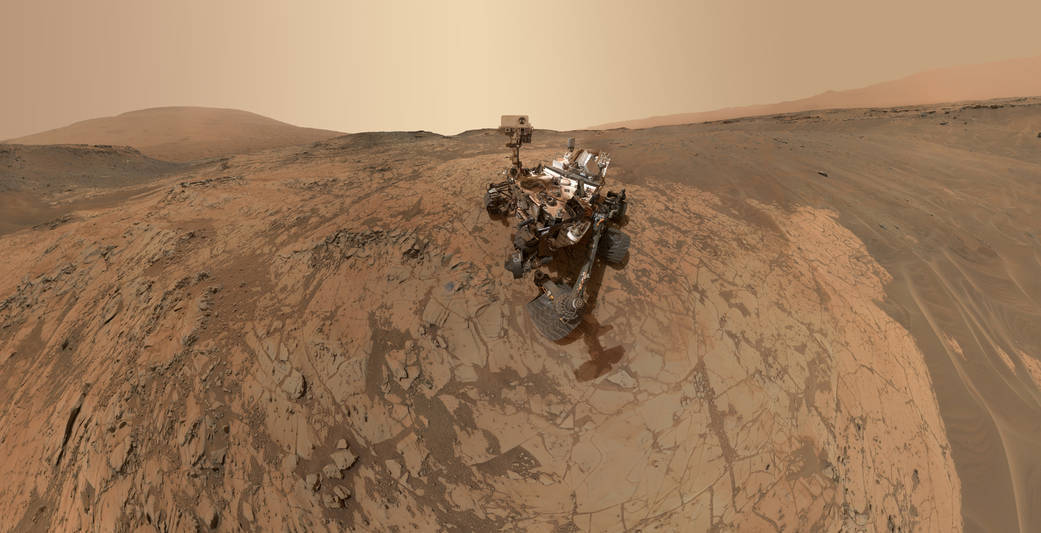
Curiosity self-portrait while doing its thing on Mars .(Jet Propulsion Lab photo)
Avionics engineer speaks on Mars missions
They are two brothers living on opposite sides of the Canada-U.S. border and their paths cross in Kamloops, a stroke of good fortune for the Big Little Science Centre.
Luke Dubord is an avionics systems engineer with NASA’s Jet Propulsion Laboratory (JPL) in Pasadena, Calif.; Marc is a chartered accountant who arrived in Kamloops not long ago to work for B.C. Lottery Corporation.
“Science has always been big in my family,” said Marc, explaining why he chose to join the board of the science centre to give back to his new community.
The Dubord family moved around, such that Luke was born in Iowa and holds U.S. citizenship, while Marc was born in Vancouver and holds Canadian citizenship.
When Luke visits later this month, he’ll give two presentations on space exploration, specifically about the Mars Science Laboratory (MSL), the landing of the Curiosity rover and next year’s launch of the Mars Lander InSight.
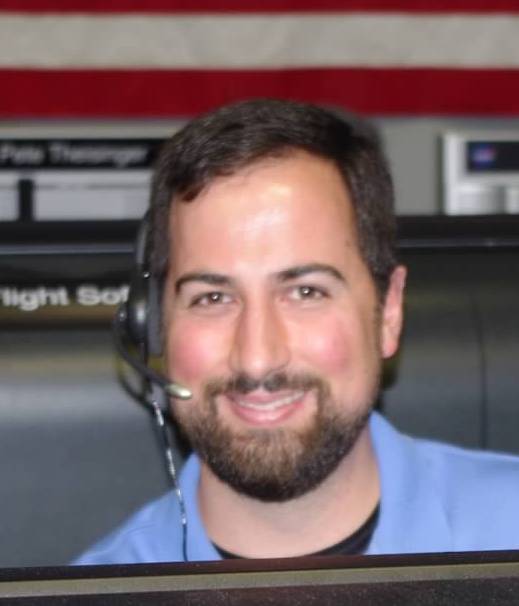
Luke Dubord.
Piquing the curiosity of future scientists is part of the mandate of the science centre, and Luke Dubord’s talk is a perfect match.
Though not a scientist, brother Marc has taken a public tour of the JPL lab. He recommends viewing the JPL video Seven Minutes of Terror, which captures the excitement of Curiosity’s descent to the surface of Mars three years ago.
“It really shows how it was kind of a complex landing on Mars,” Marc said.
EDL it’s called — Entry, Descent and Landing. In the short animated video, engineer Tom Rivelinni sums up the technological challenge:
“We’ve got literally seven minutes to get from the top of the atmosphere to the surface of Mars, going from 13,000 mph to zero in perfect sequence, perfect choreography, perfect timing,” Rivellini explains. “The computer has to do it by itself with no help from the ground. If any one thing doesn’t go right, it’s game over.”
A member of the Curiosity development team, Luke studied at the University of Washington before obtaining his masters degree at Stanford University. He was at the console for MSL launch and descent, observing while all pyrotechnic devices fired according to plan.
The outcome, broadcast around the world, was a stunning success, particularly in a field where failures are not uncommon. Leaving Earth’s atmosphere is a formidable challenge, never mind entering that of Mars with its thin atmosphere. There is a 50 per cent failure rate. Just ask Elon Musk, another Stanford grad.
“Sometimes when we look at it, it looks crazy,” says engineer Adam Steltzner in the video. “It is the result of reasoned engineering and science, but it still looks crazy.”
He will give two presentations at TRU’s Brown Family House of Learning on Saturday, July 25. One is a family-friendly talk from 6-6:45 p.m., the other an evening lecture from 7:30-8:30 p.m. Tickets, $5 each or $10 per family, can be purchased at the science centre, 655 Holt St., or online.
For more on the Curiosity mission, visit http://www.nasa.gov/mission_pages/msl/index.html.

 ArmchairMayor.ca
Maybe I missed it, but I couldn’t find a date in this article anywhere… just ‘later this month’.
LikeLike
Sorry about that. The event is Saturday, July 25.
LikeLike
I have been seeing ads for this talk around TRU and in the community, and I admit I am somewhat dismayed that there is a charge/entrance fee for the event. I suspect that the Big Little Science Centre had to pay some of the travel and/or honorarium costs for these speakers, but I think that sponsors should step forward or be sought out to defray the cost to the public. Our communities need more science education, and we need to draw more women into the hard sciences. Yet by charging even this small fee, some families interested in attending might be prohibited from doing so. I do think these types of public service/informational talks should be free.
LikeLike