
‘Save landscapes, keep pesticides’
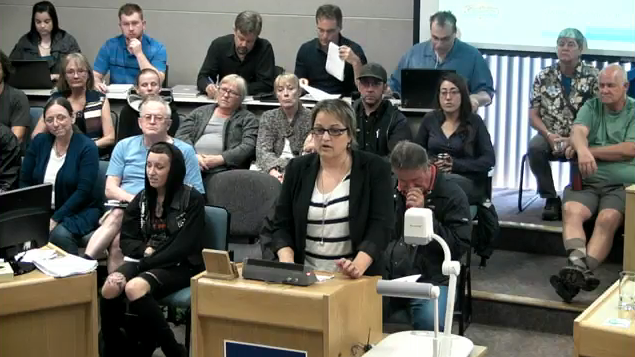
Arguing pesticide issue in City Hall. (File photo)
By MIKE YOUDS
Banning commercial use of cosmetic pesticides would backfire on the City, leading more property owners to resort to chemicals available at retail stores and therefore creating much greater risk of unsafe application as well as higher usage.
That was the scenario laid before council Tuesday by two commercial operators opposing the proposed ban, which would come into effect next year if approved later this summer.
Using a PowerPoint presentation as their backdrop with the plea of “Save Kamloops Landscapes,” they hoped to give council cause for reluctance.
“Prohibition all through history has never worked,” said Jacquie Doherty of Grassroots Lawn Choice.
Pesticides are still sold by local retail outlets and that’s where property owners will go when companies are no longer permitted to spray cosmetically, she said.
“I am told daily that customers will do it themselves, so the public may be unknowingly exposed to these products that council feels are banned.”
Since use of the domestic products is not tracked, there is no indication from other jurisdictions whether a cosmetics ban triggers increased consumer purchase of pesticides.
They cited a petition with 1,500 names of residents opposed to the ban and asked that the question be included in the referendum set for the fall. Short of that, the pair asked the City to strike a committee to examine the issues in greater detail.
Doherty said the pesticides used by the industry have been around for 70 years.
“They know they won’t metabolize through animals.”
“One concern I have is that I don’t think a lot of people understand what we do or why we do it,” said Terry Omrod of NutriLawn.
Omrod countered some of the misconceptions presented during discussions about the proposed ban. He said the industry strives to use as little pesticide as possible with spot applications rather than broadcast spraying.
“They are tools to protect everybody’s green space,” said Doherty, adding that she trusts Health Canada’s regulation of chemicals.

 ArmchairMayor.ca
Great response, Tyler.
LikeLike
Like one other issue in town, this is one that is bound to stir up the emotions. It is evident that people will indeed go to their local place of business and purchase what is needed for weed control. No amount of riding on a white charger to the rescue will prevent this from happening. Of course, we could see neighbors spying on neighbors, which will make for very good community living. In conclusion, I would hope that our City Council will approach this issue without tunnel vision.
LikeLike
What’s stopping people from applying pesticides themselves now vs paying the professionals to do it? What it really comes down to is is having a green lawn worth the potential health risks? The Canadian Cancer Society, Public Health Association of BC, the UBC Med School Department of Pediatrics, and the American Academy of Pediatrics all agree that pesticides are linked to health issues regardless of who applies them. We then have to think of who knows more about or health and what affects it. Doctors or the companies who want to keep making money?
Source from UBC med school
http://www.newswire.ca/en/story/654451/medical-community-debunks-common-myths-and-urges-bc-government-to-act-on-pesticides
Source from American Pediatric Society
http://pediatrics.aappublications.org/content/130/6/e1757.full.pdf+html
Also, there are many alternatives to pesticides. USask has a neat link on pesticide free gardening : https://www.saskatoon.ca/sites/default/files/pesticide_free_how_to_0.pdf
As does the city of Toronto (which btw passed their pesticide ban in 2004 before the Province acted in 2008: http://www1.toronto.ca/wps/portal/contentonly?vgnextoid=1ebf5ce6dfb31410VgnVCM10000071d60f89RCRD&vgnextchannel=12b1ebfc2bb31410VgnVCM10000071d60f89RCRD
http://www1.toronto.ca/wps/portal/contentonly?vgnextoid=15bf5ce6dfb31410VgnVCM10000071d60f89RCRD&vgnextchannel=12b1ebfc2bb31410VgnVCM10000071d60f89RCRD
To me this really is a no brainier. The only argument for not banning them is “my lawn won’t be a green.” A first world problem if I have ever heard one.
LikeLike
Hear, hear!
LikeLike
Amen, and well said.
LikeLike
So you’re saying invasive weeds and pests in our fruit trees and gardens have nothing to do with it? It’s not about a green lawn, its about a lawn that isn’t full of thistle and a garden that isn’t full of aphids and other pests.
FYI Fertilizer helps make your lawn green – not herbicides or insecticides.
…you’re welcome.
LikeLike
@Johnny Blue Shoes The current by-law will still allow fruit trees and gardens to be sprayed
LikeLike
In response to Tyler: You list a group of medical organizations. They all also endorse (and are now lobbying for mandatory) vaccinations. You are aware that vaccines contain known neurotoxins (mercury, aluminum, formaldehyde, etc.) random proteins and viruses as well as aborted fetal tissues and other goodies. They are injected directly into the blood stream, bypassing all of the body’s natural defenses. You are aware that Dr. William Thompson from the CDC, has “confessed” to altering the conclusions of the 2004 CDC paper that showed vaccines as safe (as reported widely by Dr. Brian Hooker who has spent over a decade doggedly pursuing FOI requests to the CDC). So which vector do you suspect may have greater impact on health; random skin exposure at a parts per billion to trillion range to relatively benign compounds which have been in constant use for over 70 years, or deliberate exposure to known toxins, direct to the blood stream, at thousands to tens of thousands times the concentrations you are concerned about with herbicides?
LikeLike
Tyler… this is the best and most rational comment that I’ve read for the last several weeks on this topic. Thank you!
LikeLike