
Burrard’s bunker fuel problem: Why even a small spill is too big
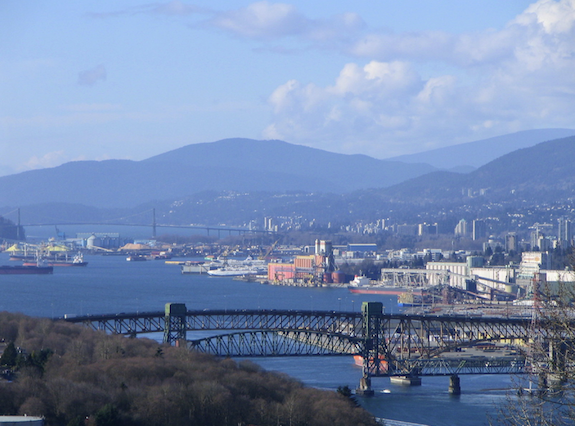
Burrard Inlet and the Second Narrows Ironworkers Memorial Bridge, looking west from Capitol Hill in Burnaby. (Image Credit: Creative Commons)
By DANIELA GINTA
On the evening of April 8, 2015, the waters of Burrard Inlet near Vancouver were tainted with oil, later determined to be bunker fuel that had leaked from a commercial shipping vessel transporting grain.
The oil slick spread on the water and some reached the popular beaches nearby in the form of a thick, tar-like substance, which was found deposited on sand and rocks. Residents and journalists took to documenting the spill in photos that presented a different image than most people are used to see when it comes to Vancouver.
While the emergency response was disappointing, according to Vancouver Mayor Gregor Robertson, the explanation for it (some of it, anyway) resides with the federal and provincial government, whom Robertson chastised for lack of coordination with the Coast Guard. B.C .Premier Christy Clark echoed the disappointment in how long it took the Coast Guard to alert the local authorities.
Had a now-closed Coast Guard base been open, the response would’ve taken minutes instead of hours, according to the former base commander.
Approximately 80 percent of the toxic 2,700 liter oil spill has been contained, but many questions and worries remain.
WHAT IS FUEL OIL?
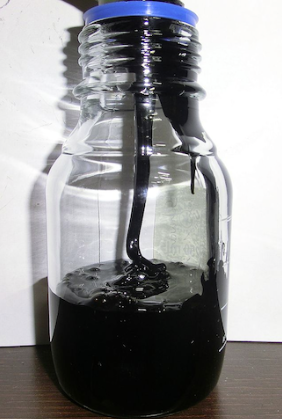
Residual fuel oil, or Bunker C oil. (Image Credit: Glasbruch2007 / Creative Commons)
Though lighter than diluted bitumen, bunker fuel causes acute and chronic health problems and has been classified as a possible cancer hazard. Bunker fuel is highly toxic to aquatic life, very difficult to clean up and has long-lasting effects. Its similarity to diluted bitumen is an added source of stress for environmentally minded British Columbians, as the province has been plagued with much controversy regarding future pipelines that will transport the said substance from Alberta’s tar sands to the Pacific Ocean for export.
Kinder Morgan, seeking to expand its existent Trans Mountain pipeline, has referred to oil spills as having both negative and positive effects – the positive ones being the economic benefits it will create for businesses and the employment opportunities for affected communities.
WHAT IS THE PROBLEM?
The views on the effects of a possible oil spill were received with disapproval, especially in the context of the company’s lack of disclosure of its emergency response plan for British Columbia.
Another pipeline, the Enbridge Gateway Northern pipeline, which will transport diluted bitumen from Alberta to Kitimat for shipment to North American and mostly Asian markets, has also been at the heart of many controversies and First Nations protests, given the high risks associated with having the pipeline cross pristine rainforest territory and heavy tankers navigating dangerous waters along the B.C. Coast. The building of the pipeline is still not certain, as the provincial government expects the terms to be renegotiated.
When it comes to oil, even a small amount can wreak havoc with the local marine environment and the health of residents. The effects will likely be seen for years to come (e.g. the many spills the world is still recovering from), and no oil spill is ever cleaned up completely. Depending on the type of oil, some of it will sink – especially in salted ocean water – and lead to tar balls surfacing on nearby and distant beaches for years.
Chemical dispersants, often used to break up oil in ocean spills, can further contaminate the environment and have been linked to cell damage in humans and wildlife. To add insult to injury, some experts believe their efficiency is decreased in case of heavy oils such as bunker fuel.
The cleanup costs will be charged to the company that own the freighter, yet that does not fix the environmental impact the spill has and will have on the area. For now, residents are advised to not swim in the water or touch the wet sand, and the cleaning efforts are expected to continue for weeks to come.
The question whether oil should be safer to transport via pipeline or train might just be answered with a third, and safest alternative: Leaving finite resources such as fossil fuel in the ground and focusing on renewable energies instead.
This article originally appeared in Planet Experts.

 ArmchairMayor.ca
Thank you Daniela for bringing this article to us.
The bureaucrats claiming that a good job was done is a sad joke. If we were this sloppy fueling our cars the electric powered ones would have taken over long ago.
Nobody’s watching the parking lot.
What if the weather had been bad and at night instead of a sunny afternoon?
Another Mt. Polley type warning. How many do we need?
LikeLike
Very good explanation. I agree that we need to look at leaving oil in rhe ground – probably the best way is by challenging the economic framework that makes it profitable to exploit them. There should be no subsidies for the fossil fuel industries. But, if we can’t keep the oil in the ground, we could at least REQUIRE that it is refined with the best possible technology close to the source prior to shipping. This would be so much better mitigation than anything else proposed. After Mt Polley, the expert panel recommended best practices and best available technology. Our regulators/ governments are not holding extraction companies to this standard at present in Canada across multiple industries, and this needs to change!
LikeLike