
Looking for Pvt. McLean, Part 2 — ‘If he doesn’t want to be found, we won’t find him’
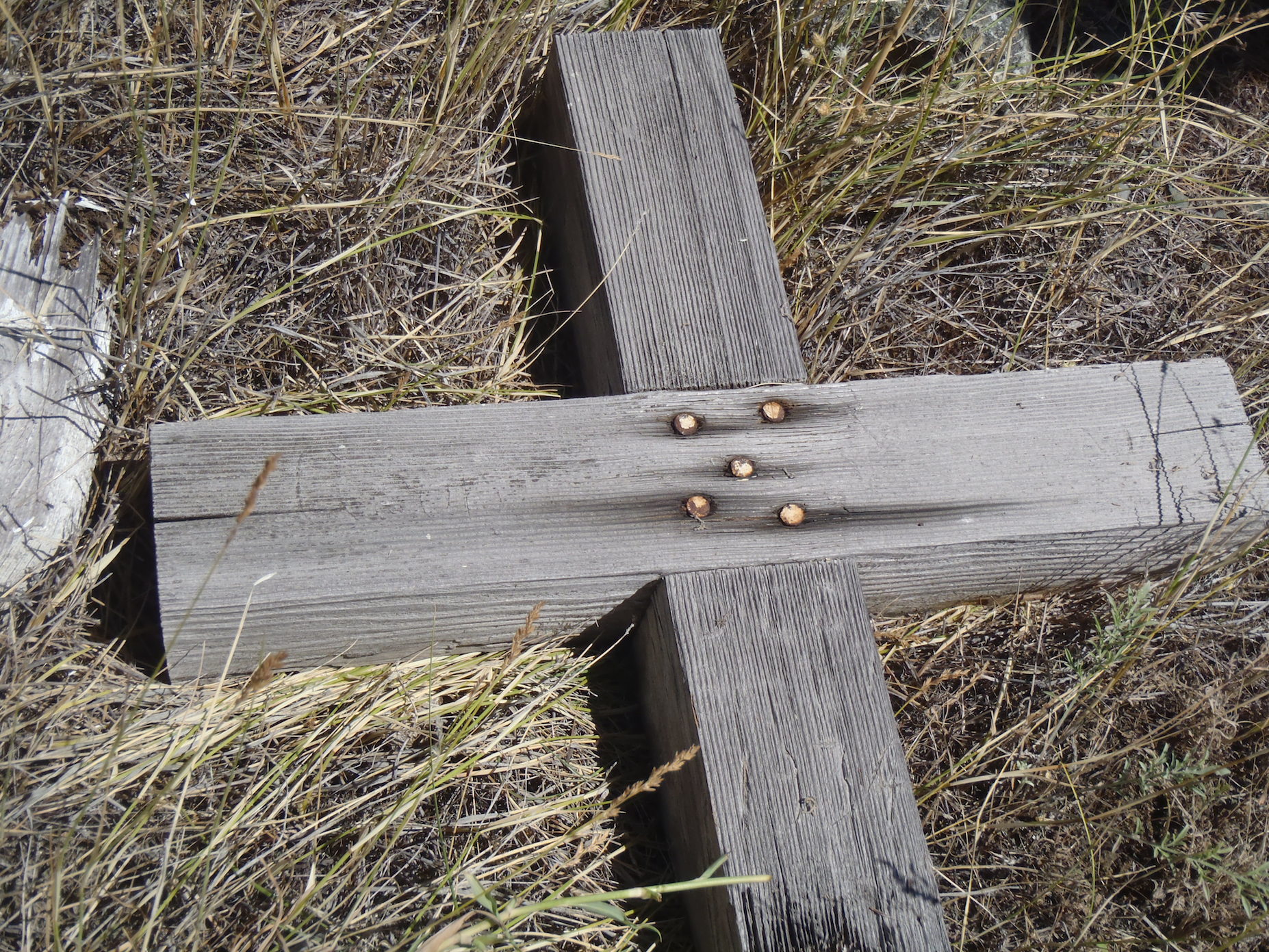
‘That could be a ‘G’,” I said.
LOOKING FOR PVT. McLEAN, PART 2 — In Part 1 published Wednesday, Lynne Jorgesen, Christine Saddleman and Hector Stewart of the Upper Nicola Indian Band and I go looking for the lost burial site of First World War hero Pvt. George McLean, one of my ancestors. Our search has taken us to a little cemetery on a remote country road on the reserve.
By MEL ROTHENBURGER
Back in the mid ‘90s, I used to correspond with an old cowboy named Red Watson, who lived in Virginia City, Nevada.
Red once rode with George McLean and George’s one-eyed horse Joker on the Douglas Lake Ranch, and got to know him. He got to know that George didn’t like being known as the son of an outlaw who was hanged for murder.
After Const. Johnny Ussher was killed, George’s mother took him to live across the border for awhile. George grew up thinking Allen McLean, the leader of the outlaw gang, was his uncle, not his father.
The whole story was, as Red put it, “a touchy subject.”
But George did talk about Vimy Ridge. One night when they were camped on the Nicola River, George talked about the famous day he captured all those German soldiers, killed some others, and won the Distinguished Conduct Medal.
“It seems he had an Indian friend who he thought a lot of,” Red wrote to me on Jan. 25, 1994. “And when they were getting ready to go over the top they passed out the powerful liquor that made you not fear God, man, beast or the devil.
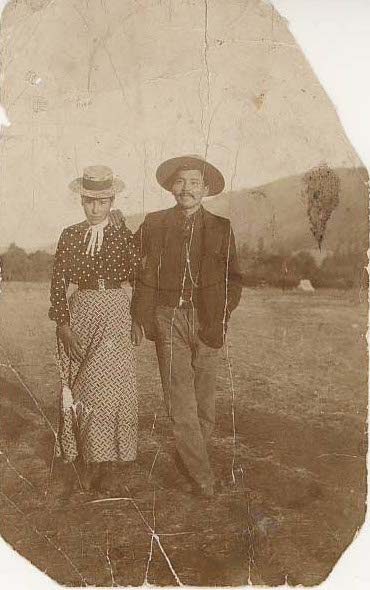
George and friend, very possibly his wife Theresa Adamson.
“And this young Indian refused it, and as George took it from him as the boy offered it to him, a sniper bullet ended the young man’s life. “
“George evidently went berserk and the rest is history. He did deserve the Victoria Cross.”
• • •
We’re examining grave markers in the cemetery, stepping between the gravesites, crouching and squinting, reading out names as Lynne checks the map.
“What year did he die?” Hector asks.
“’34,” I say. “So, (gravesite number) 74 is Johnny Moon, so that’s gotta be George right here. Did you try looking at this one, Hector?”
“I looked at that one,” says Christine.
“Is there writing on it?” Hector asks.
There are two decrepit markers lying on top of gravesite number 73. One is white, with no writing on it. Another is the remains of a bleached wooden cross.
I crouch, then get down on my hands and knees, not wanting to disturb this sacred place, but wanting to get as close a look as I can.
“That could be a ‘G,’” I say.
• • •
Lavina Lum on George McLean:
My mother knew her horses. She was good with them and could really ride. One time she was up Douglas Lake with ol’ George McLean. She was pregnant then, I think, with Alfred. Anyway, George said, “Theresa I’m goin’ go for a ride and I’m takin’ your horse.”
That was her horse, so she said, “What am I gonna ride?”
He said, “You can ride that horse in the barn!” Well, that horse wasn’t broke and she was real far along with my brother, Alfred. Anyway, them guys were gonna blind-fold the horse and ear him down, but she tol’ them to just leave him alone. “If you want me to ride that horse, I’ll ride him.”
He wouldn’t listen to her and he had just the rope on the horse, around its neck and was raisin’ his quirt.
Mom said, “I just raced and jumped onto the saddle. I grabbed the reins and reached for the rope and he wouldn’t let the rope go. He nubbed it to his saddle.
She kepta tellin’ him, “You let him go!” He wouldn’t. So she said the horse bucked and she said, “Let him go!” Finally, he let it go, and my mom took off with that horse just a buckin’.
George didn’t like it that she stayed on. He tol’ her, “you think you’re so smart” and raised his quirt against the horse again. My mom said she kepta talkin’ to the horse and as soon as that ol’ man would raise his quirt the horse would step aside. Then she said they went to the edge of the field where there was a shale bank that went down into a deep ravine. She said, with just the reins, she got the horse to sit down, and went all the way down to the bottom. Then she looked up at ol’ George and said, “You come down!” But he wouldn’t. He tol’ her, “You’re crazy to go down there! You could kill yourself.” She said, “Come down.”
But he wouldn’t. He went all the way around.
— Lavina Lum, daughter of Theresa Adamson, in Q’sapi, A History of Okanagan People As Told By Okanagan Families, written, edited and transcribed by Shirley Louis, Theytus Books, Penticton. George McLean and Theresa Adamson had four children. Thank-you to Theytus books for permission to publish the excerpt.
• • •
I’m looking at the cross now, just a few inches from my eyes.
“That could be a ‘George,’” I report.
Then, “That’s him!”
My heart is pounding somewhere up in my throat.
“See the outline! On this side, ‘George… McLean! That’s the one! Oh, man!”
• • •
Merritt
Friday, Sept. 7, 1934, morning
Sometime during the night, George McLean curled up in the bush behind a local farmer’s barn to sleep. They found him there in the morning, after someone had spotted his horse tethered nearby and started looking for him. He’d spent the previous evening around town, as he often did, getting drunk. Since it wasn’t yet very cold outside, even overnight, it wasn’t exposure that killed him. Probably he’d passed out, thrown up and suffocated on his own vomit.
Since the war George McLean had done exactly what he wanted to do, wrangling at Douglas Lake and other ranches in the Nicola, living in a small cabin. He was “a likeable type,” and for a few beers in one of the local watering holes, he’d tell any who wanted to listen about Vimy. He might even pull out his medal for people to admire. The legend of George McLean tended to get enhanced. It became an accepted part of the story that when he’d captured the German soldiers, they’d thrown up their hands in surrender and shouted, “Me go England.” And George had supposedly shouted, “You go Kingdom Come,” and bayonetted all of them.
Dying there on the ground, pointlessly, alone, was a sad end for a war hero. The Canadian Legion offered to arrange a funeral service, but some Indian friends claimed the body and took it to Douglas Lake for burial instead. George McLean had never again achieved the incredible strength of character that emerged from nowhere during those few hours at Vimy, for that was impossible, and maybe he’d lived in the past ever since, but the bravery of his actions on the slopes of an ignominious ridge near the coast of France would never be forgotten. The exploits at Vimy vindicated the name of McLean, at least in the minds of those who had lived under the dark memory of that bleak winter’s day when Allen McLean, George’s father, had helped kill Johnny Ussher and ruthlessly murdered a sheepherder named James Kelly.
— Excerpt, The Wild McLeans
• • •
We congratulate each other and take pictures of ourselves, and of the remnants of George McLean’s wooden cross, and talk about luck being with us that day.
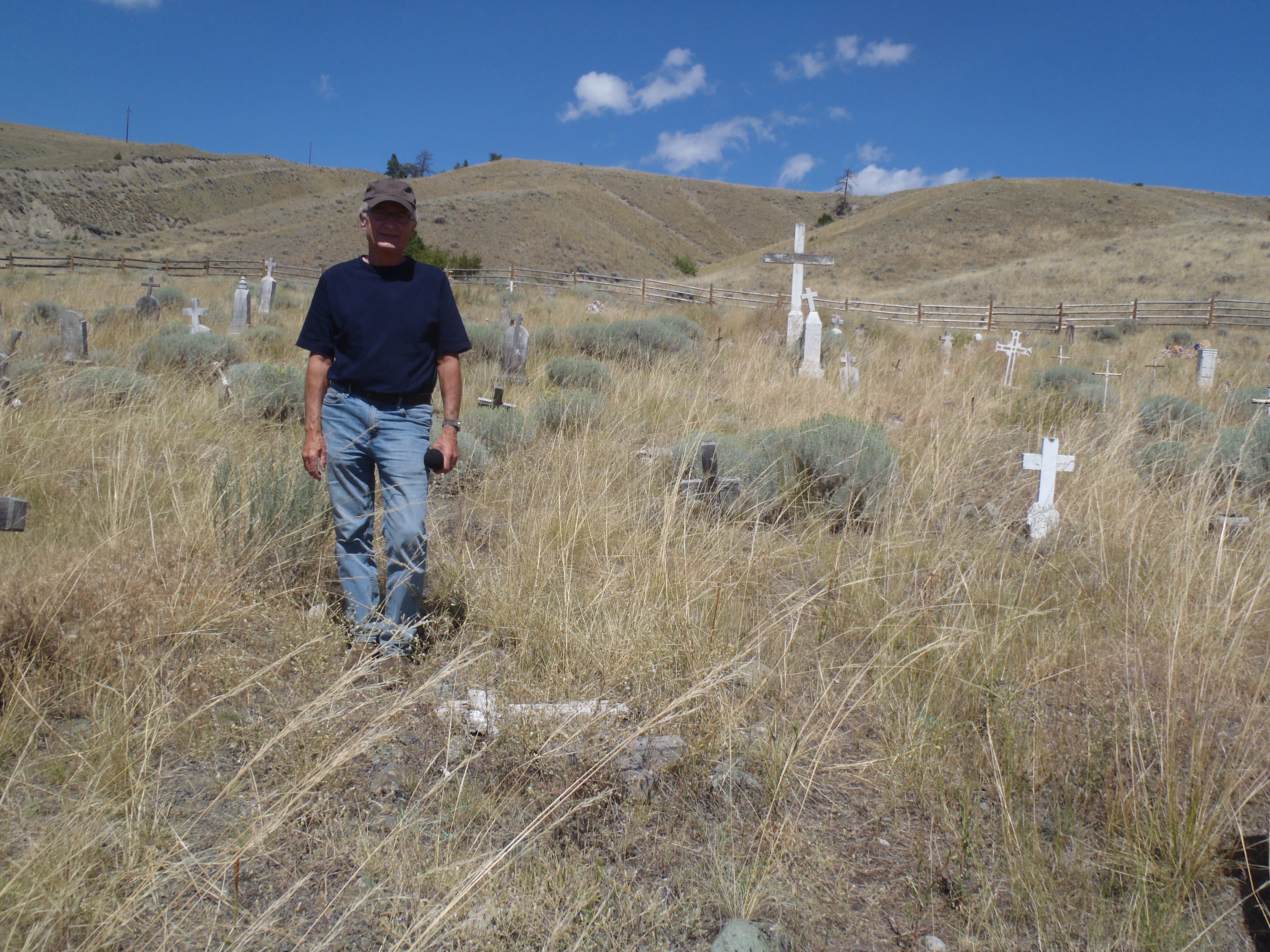
Mel Rothenburger beside the gravesite of his ancestor, George McLean.
And then I see something else. Looking at the cross again, I can now make out the year 1934 carved into it. ‘Died 1934.’
We pull yellow salsify and some stubborn knapweed from the gravesite, and discuss how we can now talk with chief and council about getting a new military marker under a Veterans Affairs funding program.
It will be up to band members to decide, but finding George McLean, my ancestor, after so long, fills me with an unmistakable joy and sense of closure.
“Like we were saying,” Christine Saddleman says as we prepare to leave. “’If he doesn’t want to be found, we won’t find him.’”
• • •
George McLean died almost exactly 80 years ago. Thank-you to the Upper Nicola Band Council, and especially to Lynne Jorgesen, for their cooperation and help in the search for George McLean. Today, Sept. 18, 2014, the Kamloops Museum and Archives will officially open a new exhibit called Into the Fray, honouring those from our local communities who served in the Great War, including Pvt. George McLean. It’s a coincidental but fitting way to mark the 80th anniversary of his death, and the year we found his resting place.

 ArmchairMayor.ca
We were there at the reception for the Museum. Your ancestor’s story is on the wall for everyone to see. This is how we honour our war dead. Lest we forget…
LikeLike