
Famed conservationist Jane Goodall delivers message of hope to overflow Kamloops crowd
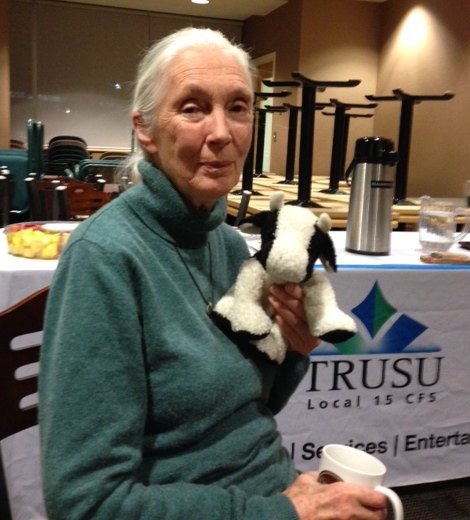
Jane Goodall at TRU with stuffed cow she uses during talk.
By MICHELE YOUNG
Despite the deforestation, despite the commercial bushmeat industry, despite the abject poverty that has resulted in the shrinking of chimpanzee habitat in Eastern Africa, primatologist Jane Goodall believes there is hope.
Hope in rebuilding and preserving their habitat. Hope in animals being treated more humanely. Hope that humans will stop destroying the planet where they live.
The British activist and conservationist reached more than 1,000 people Monday night as she addressed a packed Grand Hall and two overflow rooms at Thompson Rivers University.
Free tickets to Goodall’s Common Voices presentation disappeared in 38 minutes. Limited tickets for overflow were then issued and two side rooms were filled Monday night.
Goodall’s life has been dedicated to studying chimpanzees and discovering what they have in common with humankind. Her discovery that chimpanzees used sticks to fish termites out of holes for food threw the scientific world for a loop. Until then, it was thought only humans used tools. So then, what were chimps?
45 years studying chimpanzees in wild
The soft-spoken Goodall is considered the world’s top authority on chimpanzees. She spent 45 years studying the primates in the wild in Tanzania, and founded the Jane Goodall Institute to support her research.
She continues to return twice a year, and spends the rest of her time on the road giving inspirational speeches or, occasionally, stops for a rest at the family home where she was raised that she still shares with her sister.
She has worked for animal rights, written books, been the focus of numerous films and has a long list of awards and honorary university degrees.
Her message was about nurturing the young to do something about the future. She credited her own mother for not punishing her when she was four and a half and curious about how eggs came out of hens.
An attempt at blatantly following a hen into a coop resulted in a lot of ruffled feathers and an unco-operative bird, so Goodall hid herself under some hay in an empty coop and waited.
And waited.
It grew dark and Goodall’s family began to worry about where she was. When she made her observation, she went running to the house and her mother saw her eyes shining with discovery. Despite the panic her daughter created, Goodall’s mother didn’t berate her for the fright.
“Isn’t that the story of a little scientist?” Goodall said, noting she learned patience, making mistakes and other lessons and her mother encouraged her.
By 10, Goodall was a voracious reader living during the Second World War with a family that had little money to spare. She saved enough to buy Tarzan of the Apes at a used-book store and devoured it, cover to cover.
‘Of course I fell in love with Tarzan’
“Of course I fell in love with Tarzan,” she confessed to her TRU audience.
“He married the wrong Jane.”
The book gave her the desire to go to Africa, be with animals and write books — none of which was something girls at the time were expected to do. Her mother supported her, even went with her to Africa for three months at one point because the government didn’t think it proper for her to be alone.
Goodall encouraged young people to get involved with her organization’s Roots and Shoots program that promotes efforts that help community, animals and the environment.
“If our young people lose hope, then there’s little hope for the future,” she said.
Roots and Shoots has spread to 136 countries and has almost 1,500 active groups.
After her presentation, Goodall took a few questions on the side from the media. She admitted the bright lights in her eyes distracted her from getting to all of her messages. One she missed was about factory farming and how awful it is for animals, the environment and people. She held up a stuffed cow she usually uses in that part of her talks and mentioned how much suffering meat production can cause: overcrowded conditions for the animals, methane gas, deforestation, overuse of antibiotics that escape into the environment.
While most people who are a week and a half from turning 80 would be retired and perhaps puttering in their garden, Goodall keeps going. She’s healthy — she credits her dad for her good genes — and the idea of giving up her public speaking circuit just isn’t going to happen.
“How could I?” Goodall said about retiring.
‘I’m thanked for giving hope’
Instead, she asked the TRU audience to help support her institute’s efforts to raise money for orphaned chimpanzees so they can go to the three islands the Congolese government has given her as refuges.
That’s what she’d like for her birthday on April 3. Freedom for more orphaned chimpanzees.
That, and a new generation of Janes to carry on her compassion and her work.
As for her legacy, she returned to that one word that was her theme for the evening: hope.
“If I’m thanked for anything, I’m thanked for giving hope.”

 ArmchairMayor.ca
Curiosity of children, a lovely story. Why does it disappear in so many and remain in so few?
LikeLike